
A v. S, 2026
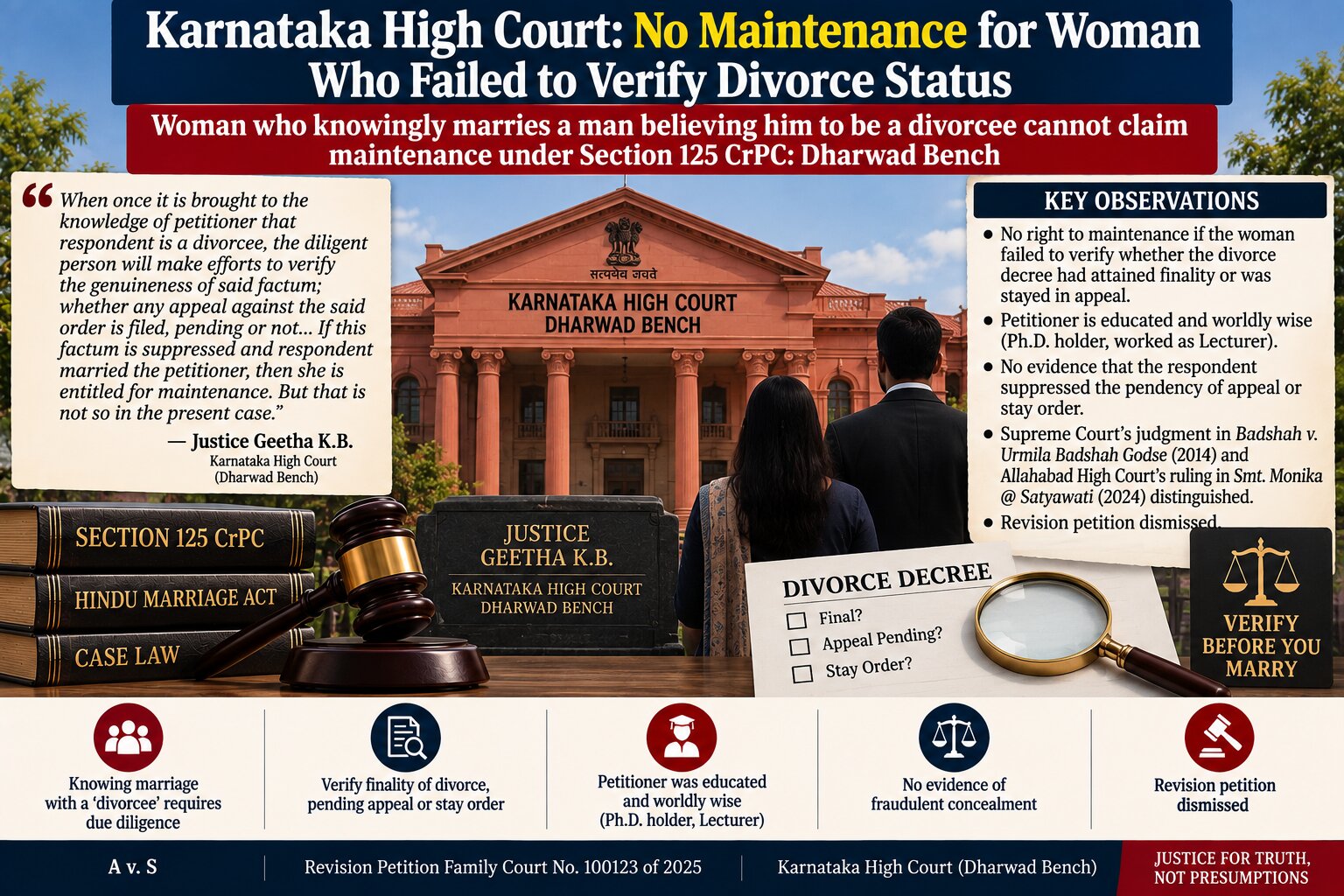
A woman who knowingly marries a man represented as a divorcee must exercise reasonable diligence in verifying the legal status of the divorce where circumstances warrant such verification.
Judgement Details
Court
Karnataka High Court
Date of Decision
7 September 2026
Judges
Justice Geetha K. B.
Citation
Acts / Provisions
Facts of the Case
-
The petitioner approached the Karnataka High Court challenging the Family Court's decision denying her maintenance under Section 125 CrPC.
-
The petitioner had married the respondent, who had previously been married to another woman.
-
Before the petitioner's marriage, the respondent had obtained a divorce decree concerning his first marriage.
-
However, an appeal against that divorce decree, MFA No. 101347/2015, was pending.
-
A stay order had also been passed in connection with the appeal.
-
Consequently, the respondent's first marriage continued to have legal significance when he married the petitioner.
-
The petitioner claimed maintenance from the respondent under Section 125 CrPC.
-
The respondent disputed her entitlement to maintenance, relying upon the circumstances surrounding the second marriage and the continuing status of his first marriage.
-
The petitioner did not specifically plead that the respondent had fraudulently concealed the pendency of the appeal against the divorce decree.
-
She also did not plead that the respondent had concealed the stay order operating in relation to the divorce proceedings.
-
The High Court noted that no such allegation was made either in the petition or in the petitioner's affidavit evidence.
-
The petitioner also did not give such evidence during her cross-examination.
-
The Court noted that once the petitioner knew that the respondent was a divorcee, a diligent person would ordinarily make reasonable efforts to verify the legal status of the divorce.
-
Such verification could include checking whether an appeal had been filed, whether it was pending and whether the divorce decree had been stayed.
-
The petitioner was a Ph.D. holder in Kannada Philosophy.
-
She had also worked as a Lecturer at Hukkeri College for one year in 2015.
-
The Court therefore considered her sufficiently educated and capable of understanding the circumstances surrounding the respondent's divorce proceedings.
-
The petitioner also failed to establish that the respondent had compelled her to resign from her employment.
-
The petitioner relied upon decisions including Badshah v. Urmila Badshah Godse and Smt. Monika @ Satyawati v. State of U.P.
-
The High Court distinguished those cases because, in those matters, the husbands had fraudulently concealed their existing first marriages at the time of the subsequent marriages.
-
According to the High Court, that factual situation was not established in the present case.
Issues
-
Whether a woman who marries a man believing him to be a divorcee is entitled to maintenance under Section 125 CrPC when she fails to verify whether the divorce decree has attained finality?
-
Whether the petitioner could claim maintenance when the respondent's first marriage was still legally subsisting at the time of the second marriage?
-
Whether the petitioner established that the respondent had fraudulently suppressed the pendency of the appeal against the divorce decree or the stay order passed in that appeal?
-
Whether the principles laid down in Badshah v. Urmila Badshah Godse apply where there is no established fraudulent concealment of the existing marriage by the husband?
-
Whether the petitioner's educational and professional background was relevant in determining whether she could reasonably have verified the respondent's marital status?
-
Whether the petitioner was entitled to maintenance under Section 125 CrPC in the absence of proof that the respondent had deliberately deceived her regarding the subsistence of his first marriage?
Judgement
-
The Karnataka High Court dismissed the revision petition filed by the petitioner.
-
The Court upheld the Family Court's decision denying maintenance under Section 125 CrPC.
-
The Court observed that once the petitioner knew that the respondent was a divorcee, she could reasonably have taken steps to verify the status of the divorce proceedings.
-
Such verification would include determining whether an appeal had been filed against the divorce decree and whether the decree had been stayed.
-
The Court noted that the petitioner had not pleaded or proved that the respondent deliberately concealed the pending appeal or the stay order.
-
There was no such allegation in the petition, affidavit evidence or cross-examination.
-
The Court therefore did not find sufficient material to conclude that the respondent had fraudulently deceived the petitioner into believing that his first marriage had finally ended.
-
The Court noted that the respondent's first marriage was still subsisting when he married the petitioner.
-
It held that the circumstances necessary to bring the case within the protective principle applied in Badshah v. Urmila Badshah Godse were not established.
-
The Court also distinguished the Allahabad High Court decision in Smt. Monika @ Satyawati, observing that those cases involved concealment of the first marriage itself.
-
In the present case, the petitioner was aware that the respondent had previously been married and had obtained a divorce decree.
-
The Court considered the petitioner's educational and professional background while assessing whether she could reasonably have verified the status of the divorce.
-
The Court also found that the petitioner failed to establish that the respondent had forced her to resign from her employment.
-
Accordingly, the High Court found no reason to interfere with the Family Court's order.
-
The revision petition was dismissed.
Held
-
Where the husband's first marriage continues to subsist, the second marriage does not automatically create an entitlement to maintenance under Section 125 CrPC.
-
The protective principle recognised in cases involving fraudulent concealment of an existing marriage depends upon establishing such fraudulent concealment or deception.
-
Mere knowledge that the man was previously married and had obtained a divorce decree does not establish that the first marriage was fraudulently concealed.
-
The pendency of an appeal against the divorce decree and the existence of a stay order were material circumstances in determining the legal status of the first marriage.
-
The petitioner had not pleaded or established that the respondent suppressed those circumstances from her.
-
The principles in Badshah v. Urmila Badshah Godse were distinguishable because that case involved fraudulent concealment of the existing first marriage.
-
The petitioner's educational and professional background was considered relevant to whether she could reasonably understand and verify the respondent's marital status.
-
The petitioner also failed to establish that the respondent had compelled her to leave her employment.
-
The Family Court's refusal to grant maintenance was therefore not interfered with.
Analysis
-
Focus on fraudulent concealment: The central distinction made by the High Court was between a woman who is deliberately deceived about the existence of a first marriage and a woman who knows that the man was previously married but does not verify the finality of the divorce proceedings.
-
Section 125 CrPC: The Court examined the maintenance claim within the factual context of the parties' marriage and the continuing legal status of the respondent's first marriage.
-
Importance of the pending appeal: The existence of an appeal against the divorce decree, coupled with a stay order, meant that the legal status of the first marriage required careful examination before the second marriage.
-
No allegation of suppression: A significant factor was that the petitioner did not specifically allege that the respondent had concealed the pending appeal or the stay order. The Court therefore found no factual foundation for applying the fraudulent-concealment principle.
-
Distinction from Badshah: The Supreme Court's decision in Badshah was based upon circumstances involving fraudulent suppression of an existing marriage. The Karnataka High Court held that the same reasoning could not automatically be extended to materially different facts.
-
Diligence of the claimant: The Court considered whether the petitioner could reasonably have verified the respondent's marital status after learning that he was a divorcee. The Court placed significance on the absence of any evidence showing that she had attempted such verification.
-
Educational background: The Court referred to the petitioner's Ph.D. qualification and prior employment as a lecturer in assessing her ability to understand the significance of divorce proceedings. This was used as a factual consideration rather than as an independent legal test for maintenance.
-
Burden of establishing relevant circumstances: The judgment demonstrates the importance of pleading and proving the specific circumstances that may bring a second marriage within the protective principles developed in maintenance jurisprudence.
-
Limits of the judgment: The decision does not establish that every woman in a second marriage is automatically disentitled to maintenance. The Court's reasoning turned on the particular facts, especially the petitioner's knowledge of the prior marriage and the absence of proof of fraudulent concealment.
-
Overall significance: The judgment highlights the distinction between fraudulently concealed bigamy-related circumstances and a situation where the claimant knew of the prior marriage and failed to establish that the husband deliberately concealed the pending legal proceedings concerning the divorce.