
A v. M, 2026
A party cannot obtain a second opportunity to litigate the same issue after it has been finally adjudicated.
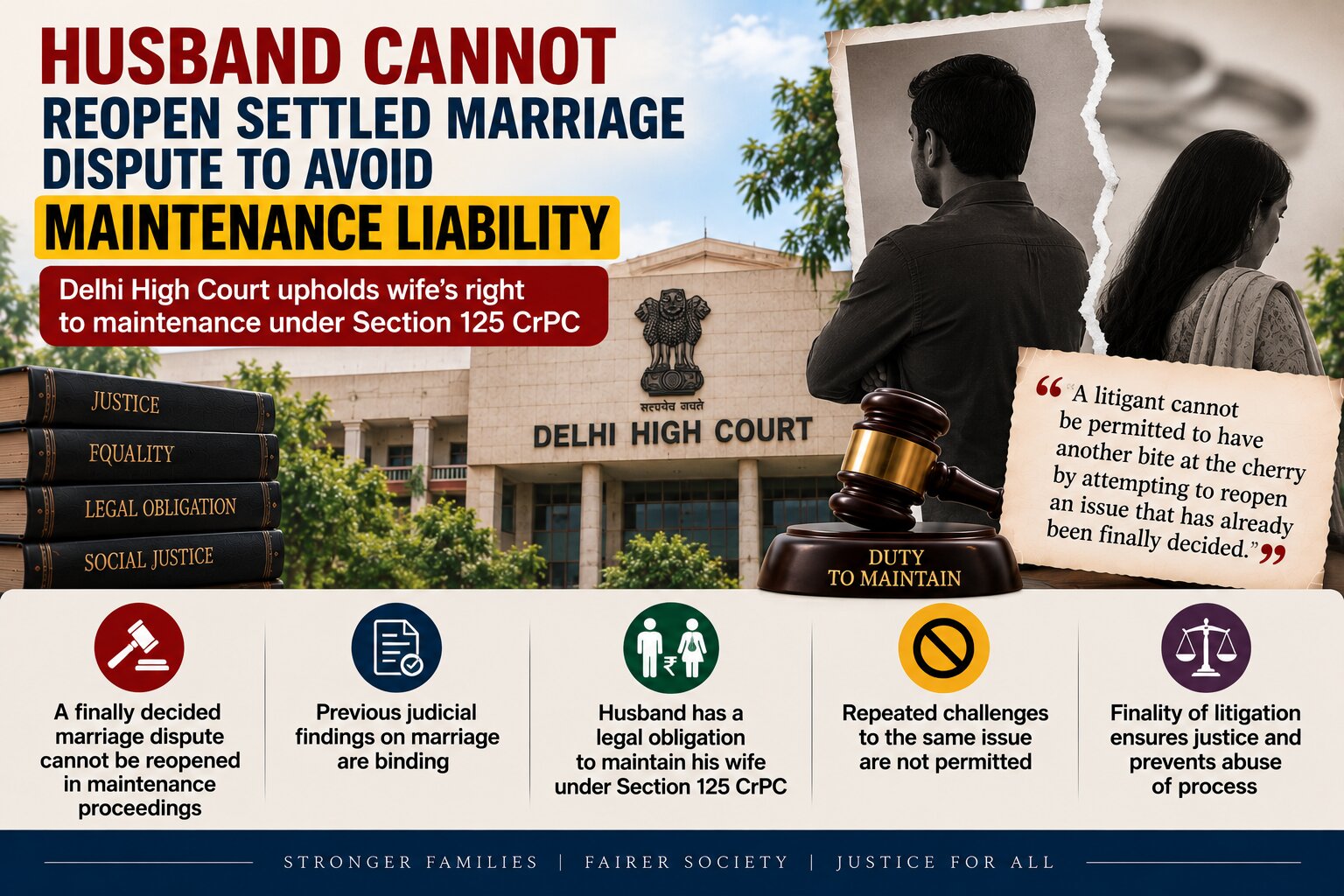
Judgement Details
Court
Delhi High Court
Date of Decision
20 August 2026
Judges
Justice Saurabh Banerjee
Citation
Acts / Provisions
Facts of the Case
-
The parties married according to Hindu rites in 2002.
-
In 2003, the husband instituted proceedings seeking a declaration that he was unmarried and an injunction restraining the woman from claiming to be his wife.
-
The husband initially succeeded before the Trial Court.
-
The wife challenged the decision, and the appellate court allowed her appeal in 2006.
-
The husband's second appeal was dismissed in 2011, conclusively upholding the finding regarding the marriage.
-
Meanwhile, the wife had initiated proceedings under Section 125 CrPC in 2008 seeking maintenance.
-
The Family Court directed the husband to pay maintenance in different amounts for different periods, along with ₹11,000 towards litigation expenses.
-
The husband challenged the maintenance order before the Delhi High Court and again argued that the woman was not his legally wedded wife.
-
He contended that the earlier appellate decision was based on technicalities rather than merits and therefore should not prevent him from contesting the marital relationship in the maintenance proceedings.
Issues
-
Whether a husband can reopen a finally decided matrimonial issue in subsequent maintenance proceedings under Section 125 CrPC?
-
Whether the previous final determination regarding the existence of marriage is binding upon the husband in proceedings for maintenance?
-
Whether the husband can avoid his maintenance liability by again disputing the wife's status as his legally wedded wife?
-
Whether the Family Court was justified in granting maintenance under Section 125 CrPC on the basis of the earlier final adjudication of the marriage?
Judgement
-
The Delhi High Court dismissed the husband's revision petition.
-
The Court held that the issue concerning the parties' marriage had already been finally and conclusively determined in the earlier proceedings.
-
The husband could not reopen the same issue in subsequent maintenance proceedings merely to avoid his obligation to maintain his wife.
-
The Court held that the earlier appellate and second appellate decisions were binding upon him.
-
The woman was therefore treated as the petitioner's legally wedded wife for the purpose of Section 125 CrPC.
-
The Court upheld the principle that a litigant cannot repeatedly challenge an issue that has already been finally settled.
-
The husband was held liable to fulfil his legal obligation to maintain his wife.
Held
-
The husband's earlier matrimonial litigation had conclusively established the existence of the marriage.
-
He could not circumvent that determination by raising the same contention afresh in maintenance proceedings.
-
The woman was legally entitled to invoke Section 125 CrPC as the petitioner's wife.
-
The husband has a legal obligation to maintain his wife, and that obligation cannot be defeated by repeatedly disputing an issue already settled by a competent court.
-
The Court emphasized the importance of finality of litigation and refused to permit the petitioner to have "another bite at the cherry."
Analysis
-
The judgment strongly reinforces the principle of finality of judicial decisions. Once a competent court has conclusively determined an issue between the parties, the same party cannot ordinarily reopen that issue in subsequent proceedings merely because the result creates an adverse consequence.
-
The central issue was not simply the husband's liability to pay maintenance, but whether he could once again challenge the very foundation of the marital relationship after losing that issue in earlier proceedings.
-
The High Court rejected this strategy and treated the earlier adjudication as binding. This prevents inconsistent findings in different proceedings concerning the same parties and the same factual relationship.
-
The Court's observation that the husband could not have "another bite at the cherry" reflects the broader policy that litigation must eventually come to an end.
-
The decision is particularly relevant to Section 125 CrPC proceedings because the provision is intended to provide a speedy remedy against neglect or refusal to maintain a wife and certain other dependants.
-
Allowing a husband to repeatedly dispute a marriage already judicially established could unnecessarily prolong maintenance proceedings and defeat the protective purpose of the provision.
-
The ruling also illustrates the distinction between challenging an existing judgment through a legally permissible remedy and attempting to re-litigate the same issue in a fresh proceeding.
-
Once the marriage was conclusively upheld in the earlier litigation, the husband could not use the maintenance proceeding as a vehicle to obtain a different finding.
-
The Court therefore connected the principle of finality with the husband's continuing legal duty of maintenance, holding that he could not escape that obligation by repeatedly raising a settled matrimonial dispute.