
A v. B, 2026
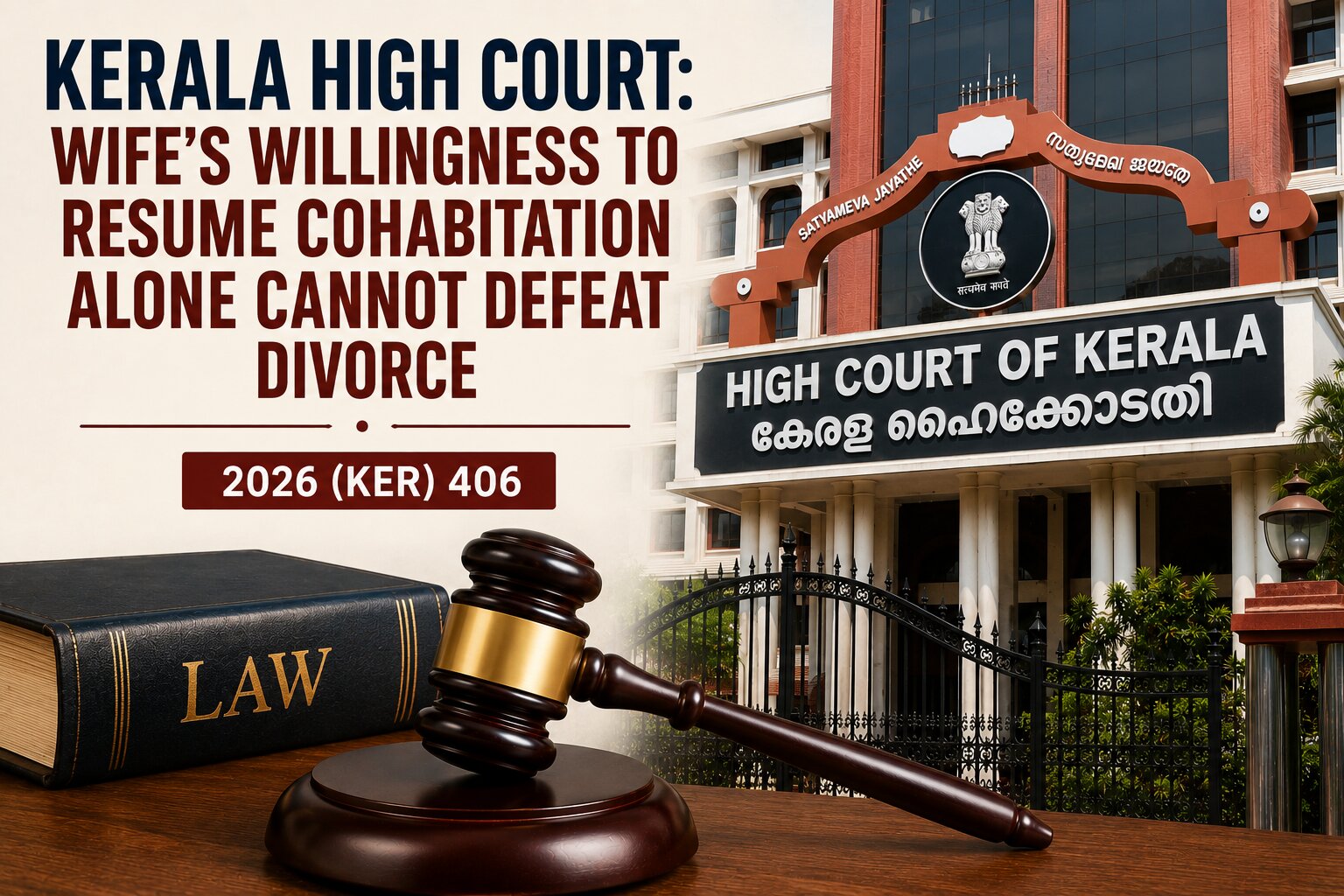
Mere willingness of one spouse to resume cohabitation does not automatically defeat a claim for dissolution of marriage.
Judgement Details
Court
Kerala High Court
Date of Decision
11 August 2026
Judges
Justice J. Nisha Banu and Justice Sobha Annamma Eapen
Citation
Acts / Provisions
Facts of the Case
-
The parties belonged to different religions.
-
They fell in love and decided to marry.
-
Their marriage was solemnised under the Special Marriage Act, 1954.
-
Before marriage, they had agreed to respect each other's religion and faith.
-
According to the husband, difficulties arose in the marital relationship after several years of marriage.
-
He alleged that the wife gradually departed from the understanding regarding a secular family life.
-
He alleged that she displayed unreasonable anger and hostility towards him.
-
The husband further alleged that his emotional needs were being neglected.
-
He stated that although the couple had a child, the wife was allegedly not sufficiently interested in caring for their son.
-
He also alleged that he experienced harassment from members of the wife's family.
-
According to him, he became alienated from his own relatives because of the marital circumstances.
-
The husband further alleged that the wife made an extremely serious allegation concerning his relationship with his mother.
-
He stated that he had purchased 25 sovereigns of gold ornaments for the wife and had not demanded dowry or financial contribution from her.
-
The wife disputed the allegations made by the husband.
-
She maintained that she had suffered harassment and continued to be willing to maintain the marital relationship.
-
She alleged that 10 sovereigns of her gold ornaments had been misappropriated.
-
She claimed that her family had not been informed about the marriage and that she had agreed to the marriage on the husband's assurance that he would look after her throughout her life.
-
The wife sought restitution of conjugal rights.
-
The husband, however, maintained that the marital relationship had irretrievably broken down from his perspective and that reunion was not possible.
-
The Family Court examined the pleadings and evidence and granted the husband a decree of dissolution of marriage.
-
The Family Court also dismissed the wife's petition seeking restitution of conjugal rights.
-
The wife challenged the Family Court's decision before the Kerala High Court.
-
During the proceedings, several attempts were made to reconcile the parties.
-
The parties participated in mediation and counselling through the KeLSA Family Counselling Centre.
-
The reconciliation efforts were unsuccessful.
-
A counselling report indicated that the parties were residing in the same house even after the decree but were not living together as husband and wife.
-
The husband was willing to allow the wife to remain in the same house but did not wish to restore the legal or emotional marital relationship.
-
A psychological assessment reportedly indicated that the wife's insistence on continuing the marriage was likely connected with isolation and lack of familial support.
-
The High Court therefore reconsidered the circumstances and upheld the Family Court's decree of divorce.
Issues
-
Whether a husband can be denied a decree of dissolution of marriage merely because the wife expresses her willingness to resume cohabitation?
-
Whether repeated unsuccessful attempts at mediation and counselling are relevant in determining whether restoration of the marital relationship is realistically possible?
-
Whether the Family Court was justified in granting dissolution of marriage despite the wife's willingness to continue the marital relationship?
-
Whether the wife's petition seeking restitution of conjugal rights was sufficient, by itself, to defeat the husband's claim for dissolution of marriage?
-
Whether the Kerala High Court was justified in upholding the Family Court's decree after considering the parties' unsuccessful reconciliation efforts and surrounding circumstances?
Judgement
-
The Kerala High Court dismissed the wife's appeal.
-
The Court upheld the Family Court's decree dissolving the marriage.
-
The Court noted that numerous efforts had been made to reconcile the parties.
-
The parties had participated in mediation and counselling, including proceedings before the KeLSA Family Counselling Centre.
-
Despite these efforts, the parties could not restore their marital relationship.
-
The Court noted that the parties were residing in the same house but were not living together as husband and wife.
-
The husband was unwilling to resume the marital relationship despite being willing to permit the wife to remain in the same house.
-
The Court considered the psychological assessment concerning the wife's insistence upon continuation of the relationship.
-
The Court concluded that merely expressing a willingness to resume cohabitation was not sufficient to defeat the husband's claim for divorce.
-
The Court held that the circumstances had to be assessed realistically rather than merely on the basis of a formal expression of willingness to live together.
-
The High Court therefore found no reason to interfere with the Family Court's decision.
-
The wife's appeal was accordingly dismissed.
Held
-
Mere willingness of one spouse to resume cohabitation does not automatically defeat a claim for dissolution of marriage.
-
Courts may consider whether genuine reconciliation is realistically possible in light of the entire matrimonial history.
-
Repeated unsuccessful attempts at mediation and counselling are relevant circumstances.
-
A formal statement that a spouse is willing to return to the marriage cannot, by itself, compel the other spouse to resume marital life.
-
Where reconciliation efforts have repeatedly failed and one spouse remains firmly unwilling to resume the relationship, the court may consider the surrounding circumstances while deciding the matrimonial dispute.
-
The wife's request for restitution of conjugal rights did not, by itself, require dismissal of the husband's divorce petition.
-
The Family Court's decree of dissolution was therefore upheld.
-
The wife's appeal was dismissed.
Analysis
-
Central reasoning: The Kerala High Court adopted a practical approach to matrimonial disputes. The Court looked beyond the wife's formal expression of willingness to resume cohabitation and examined whether an actual marital relationship could realistically be restored.
-
Willingness is not conclusive: The Court made it clear that merely saying “I am ready to live with my husband” cannot automatically prevent a divorce decree. The court must consider the overall circumstances of the marriage.
-
Reconciliation efforts: The repeated attempts at mediation and counselling were particularly significant. The failure of multiple reconciliation efforts provided objective evidence that the relationship could not easily be restored.
-
Conduct after divorce decree: The fact that the parties continued to live under the same roof but did not live as husband and wife was an important circumstance. Physical residence in the same house does not necessarily establish restoration of the matrimonial relationship.
-
Emotional relationship: The Court recognised that marriage involves more than physical cohabitation. The husband's unwillingness to resume the emotional and legal relationship was relevant to assessing whether reconciliation was genuinely possible.
-
Restitution of conjugal rights: A spouse's request for restitution cannot automatically override the factual circumstances demonstrating that the relationship has ceased to function as a marriage.
-
Role of counselling: The case illustrates the importance of family counselling and mediation in matrimonial litigation. The counselling process provided the court with additional information concerning the actual relationship between the parties.
-
Psychological assessment: The Court took note of the assessment indicating that the wife's insistence on continuing the relationship might have been influenced by isolation and lack of familial support. This illustrates the Court's broader consideration of the parties' circumstances.
-
Family Court's factual findings: The High Court found no sufficient reason to overturn the Family Court's assessment after re-examining the pleadings and evidence.
-
Matrimonial reality versus formal position: The judgment emphasises that courts may distinguish between a formal declaration of willingness to cohabit and the practical possibility of restoring a functional marital relationship.
-
Important qualification: The judgment should not be understood as creating an automatic rule that a spouse's willingness to reconcile is irrelevant. The Court's conclusion was based on the particular facts, including repeated failed reconciliation efforts and the circumstances of the parties.
-
Impact on matrimonial litigation: The decision may be relevant where one spouse seeks divorce while the other opposes dissolution solely by expressing willingness to resume cohabitation, particularly where reconciliation attempts have repeatedly failed.
-
Judicial approach: The judgment reflects an approach that considers the substance of the marital relationship rather than relying exclusively upon formal statements made during litigation.