
Vivo India Private Limited v. Serious Fraud Investigation Office, Ministry of Corporate Affairs, Union of India, 2026
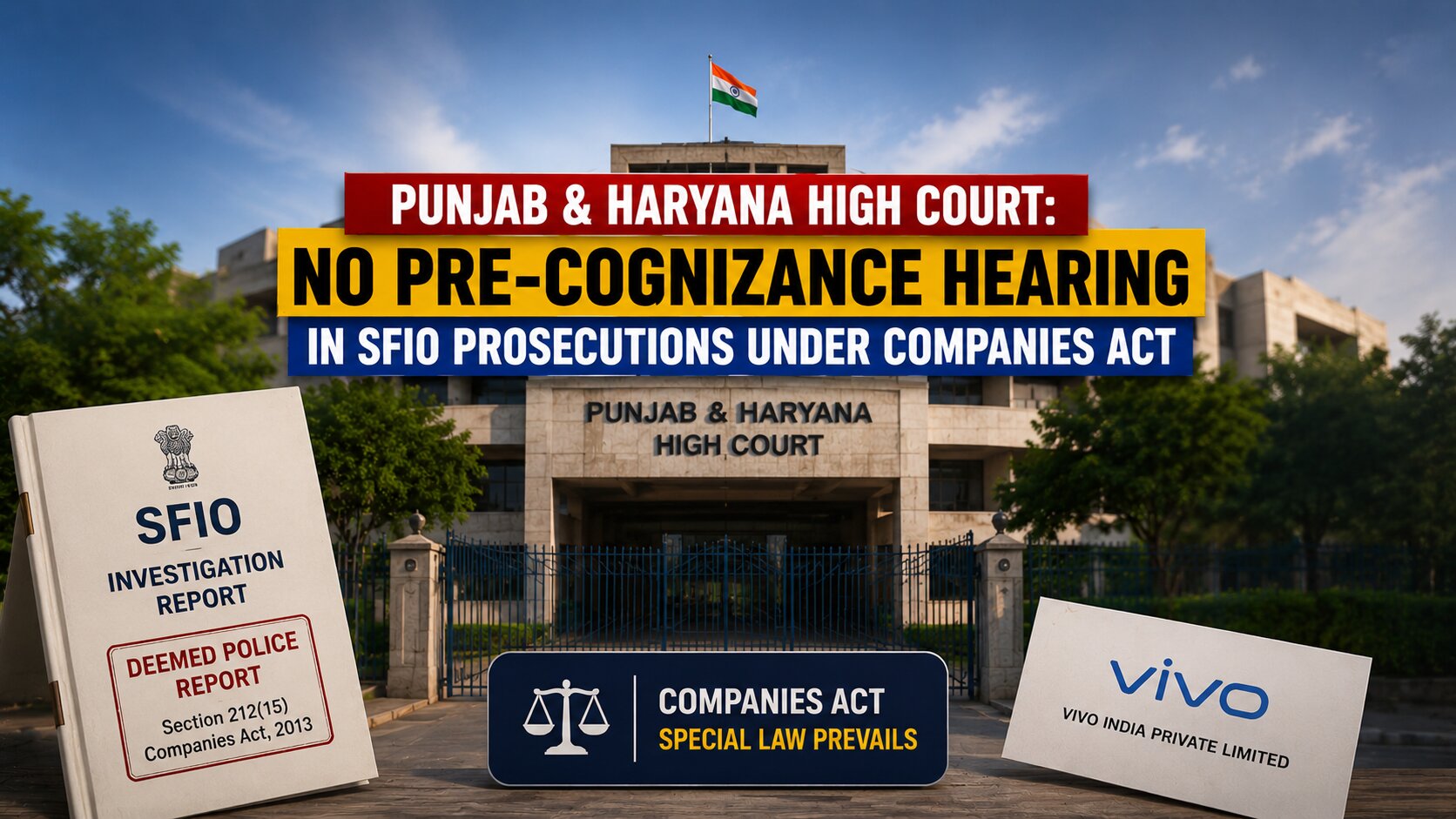
Punjab & Haryana High Court holds that accused in SFIO prosecutions under the Companies Act are not entitled to a mandatory pre-cognizance hearing under Section 223 of the BNSS.
Judgement Details
Court
Punjab and Haryana High Court
Date of Decision
9 July 2026
Judges
Justice Subhas Mehla
Citation
Acts / Provisions
Facts of the Case
-
The Serious Fraud Investigation Office (SFIO) investigated Vivo India under Section 212 of the Companies Act, 2013.
-
Following the investigation, the SFIO filed a prosecution complaint before the Special Court, Gurugram, alleging offences under Sections 447, 449, 7(5), and 7(6) of the Companies Act.
-
Before the Special Court could take cognizance, Vivo India sought a pre-cognizance hearing under the first proviso to Section 223 BNSS.
-
Vivo India argued that since the SFIO had filed a "complaint," the procedure applicable to complaint cases under Chapter XVI of the BNSS, including a pre-cognizance hearing, should apply.
-
The Additional Sessions Judge, Gurugram, rejected the application on 11 February 2026.
-
Aggrieved by this order, Vivo India filed a petition before the Punjab and Haryana High Court under Section 528 BNSS.
-
The principal issue before the High Court was whether an accused in an SFIO prosecution has a statutory right to a pre-cognizance hearing under Section 223 BNSS.
Issues
-
Whether persons proposed to be arraigned as accused in SFIO prosecutions under the Companies Act, 2013 are entitled to a pre-cognizance hearing under the first proviso to Section 223 of the BNSS?
-
Whether an SFIO investigation report deemed to be a police report under Section 212(15) of the Companies Act excludes the application of Chapter XVI of the BNSS?
-
Whether the Companies Act, 2013 constitutes a special self-contained code overriding the general provisions of the BNSS in matters of cognizance?
-
Whether the Special Court constituted under the Companies Act follows Section 213 BNSS instead of Section 223 BNSS while taking cognizance?
-
Whether the description of SFIO proceedings as a "complaint" changes their legal character for the purpose of claiming a pre-cognizance hearing?
Judgement
-
The High Court dismissed the petition filed by Vivo India.
-
The Court held that the first proviso to Section 223 BNSS does not apply to prosecutions initiated by the SFIO under the Companies Act, 2013.
-
It ruled that the Companies Act is a special legislation containing a self-contained procedural framework, which prevails over the general provisions of the BNSS.
-
The Court observed that Section 212(15) statutorily deems the SFIO investigation report to be a police report, thereby excluding the procedure applicable to ordinary complaint cases.
-
It held that the Special Court is required to take cognizance in accordance with Section 436(1)(d) of the Companies Act, which does not provide for any mandatory pre-cognizance hearing.
-
The Court observed that the investigation conducted by the SFIO already provides sufficient opportunity to the company and its officers to present their version during the investigation.
-
It held that granting another hearing before cognizance would merely duplicate the investigative process without serving any legal purpose.
-
The Court applied the principle "generalia specialibus non derogant", holding that special legislation overrides general procedural law wherever inconsistency exists.
-
It distinguished the Supreme Court decisions relating to the Prevention of Money Laundering Act (PMLA) by observing that the Companies Act contains a unique deeming provision under Section 212(15), which has no equivalent in the PMLA.
-
The Court further held that the administrative description of the proceedings as a "complaint" cannot determine their true legal nature.
Held
-
The petition filed by Vivo India Private Limited was dismissed.
-
The High Court upheld the order of the Additional Sessions Judge, Gurugram.
-
The Court held that persons proposed to be arraigned as accused in SFIO prosecutions have no vested right to a pre-cognizance hearing under Section 223 BNSS.
-
It reaffirmed that SFIO prosecutions under Section 212 of the Companies Act are governed by the special procedure prescribed under the Companies Act and not by Chapter XVI of the BNSS.
Analysis
-
The judgment reinforces the principle that special statutes prevail over general procedural laws where both occupy the same field.
-
The Court adopted a purposive interpretation of Section 212(15), giving full effect to the legislative intent behind treating SFIO investigation reports as police reports.
-
The decision clarifies the procedural framework governing corporate fraud prosecutions under the Companies Act.
-
The Court emphasized that procedural safeguards under the BNSS cannot be imported into special statutory schemes unless expressly provided.
-
The judgment strengthens the investigative and prosecutorial framework of the Serious Fraud Investigation Office, reducing procedural delays before cognizance.
-
It distinguishes ordinary private complaints from prosecutions following detailed statutory investigations conducted by specialized agencies.
-
The ruling provides certainty regarding the jurisdiction and procedure of Special Courts established under the Companies Act.
-
The decision is likely to serve as an important precedent in future prosecutions involving SFIO investigations and corporate fraud.