
Tushar Agrawal v. Ganesh Prasad, 2026
Mandatory enforcement of contracts after the 2018 amendment to the Specific Relief Act, 1963, subject to Sections 11(2), 14 and 16.
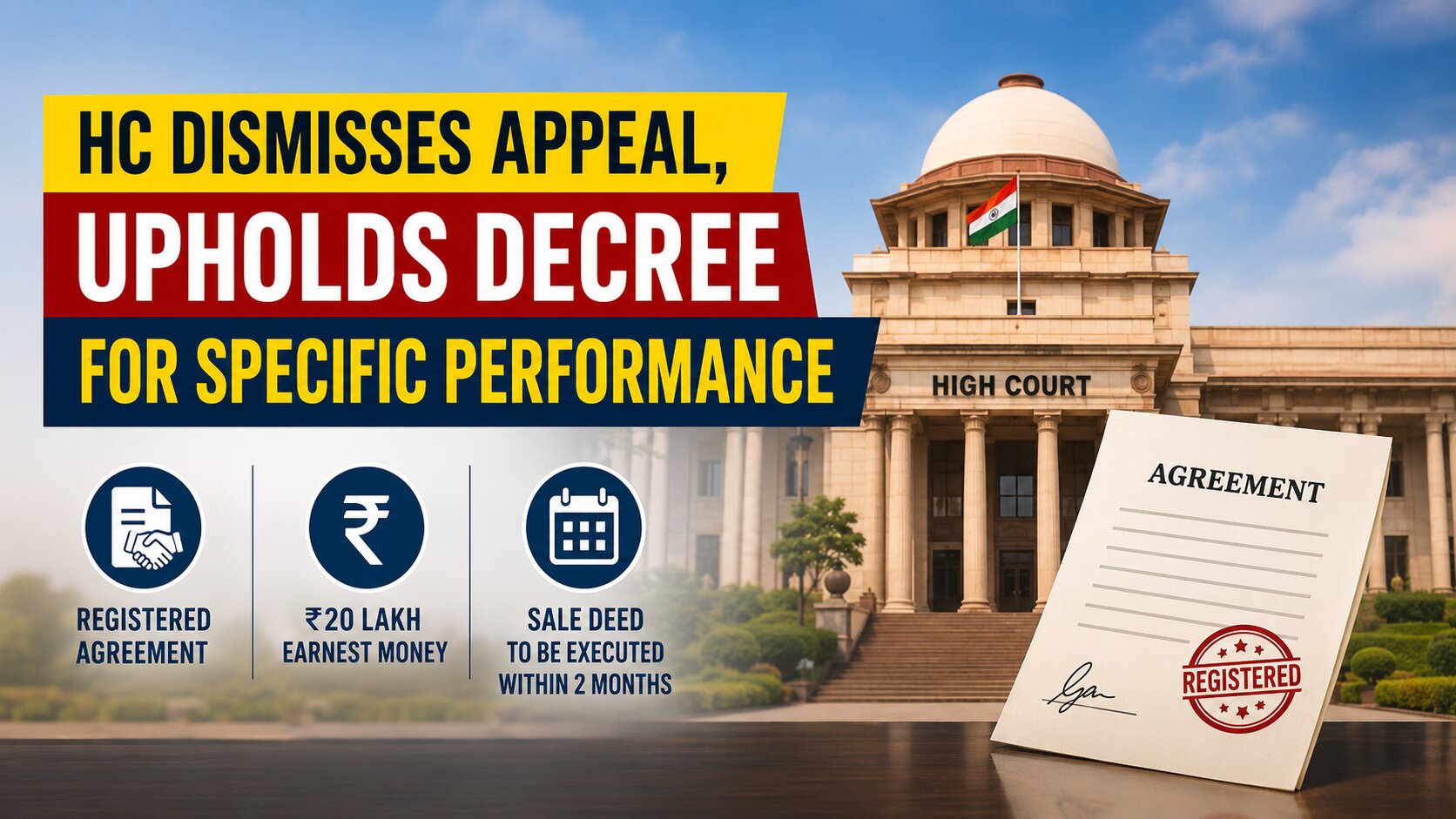
Judgement Details
Court
Allahabad High Court
Date of Decision
10 July 2026
Judges
Justice Sandeep Jain
Citation
Acts / Provisions
Facts of the Case
-
The plaintiff, Ganesh Prasad, and the defendant, Tushar Agrawal, executed a registered agreement to sell dated 30 December 2019 concerning a two-storey house situated at Bhadohi.
-
The agreed sale consideration was ₹30 lakh, out of which ₹20 lakh was paid by the plaintiff as earnest money through cheque.
-
The remaining ₹10 lakh was agreed to be paid at the time of execution of the sale deed.
-
The agreement stipulated that the sale deed would be executed within three years.
-
Despite receiving legal notice, the defendant failed to execute the sale deed.
-
Consequently, the plaintiff instituted a suit seeking specific performance of the agreement.
-
The defendant denied executing the agreement voluntarily and alleged that the ₹20 lakh represented payment relating to their silver business.
-
The defendant further alleged that the plaintiff had fraudulently obtained his signatures on blank papers by taking advantage of their business relationship.
-
The defendant contended that the disputed property was his only residential house with his shop situated therein and was worth more than ₹2 crore, making it improbable that he would agree to sell it for ₹30 lakh.
-
The Civil Judge (Senior Division), Bhadohi, decreed the suit for specific performance on 11 March 2025.
-
Aggrieved by the decree, the defendant preferred an appeal before the Allahabad High Court.
Issues
-
Whether the amended Section 10 of the Specific Relief Act, 1963, applicable from 1 October 2018, makes the grant of specific performance mandatory rather than discretionary?
-
Whether the registered agreement to sell dated 30 December 2019 was validly executed by the defendant?
-
Whether the defendant successfully established his plea that the agreement was obtained by fraud and misrepresentation?
-
Whether the plaintiff proved his continuous readiness and willingness to perform his part of the contract as required under Section 16 of the Specific Relief Act?
-
Whether readiness and willingness must be pleaded strictly in the format prescribed under Forms 47 and 48 of Appendix A to the Code of Civil Procedure?
-
Whether the 2018 amendment to the Specific Relief Act applies prospectively to agreements executed after 1 October 2018?
-
Whether the defendant could avoid specific performance on the ground that the property was his only residence and allegedly worth substantially more than the agreed sale consideration?
Judgement
-
The High Court dismissed the appeal and affirmed the decree passed by the Civil Judge (Senior Division), Bhadohi.
-
The Court held that after the amendment effective from 1 October 2018, specific performance is no longer a discretionary remedy and courts are ordinarily bound to enforce contracts, subject only to Sections 11(2), 14 and 16 of the Specific Relief Act.
-
The Court found that the disputed agreement, having been executed on 30 December 2019, was governed by the amended provisions of the Act.
-
The Court rejected the defendant's allegation of fraud, observing that he failed to provide any convincing explanation regarding the alleged fraudulent procurement of his signatures.
-
The Court noted that the defendant neither lodged any criminal complaint nor instituted proceedings seeking cancellation of the registered agreement.
-
The Court further observed that the defendant continued business dealings with the plaintiff even after the alleged fraud, thereby weakening his defence.
-
The Court accepted that the ₹20 lakh paid by cheque constituted earnest money under the registered agreement and was unrelated to the parties' business transactions.
-
The Court held that the plaintiff had successfully established his readiness, willingness and financial capacity by maintaining sufficient funds, issuing legal notice and making good the deficiency in court fees.
-
The Court ruled that compliance with the requirement of readiness and willingness must be assessed in substance rather than by adherence to a rigid or technical pleading format.
-
The Court held that any hardship arising from enforcement of the agreement was attributable to the defendant's own conduct.
-
The Court directed the defendant to execute the sale deed within two months upon receipt of the balance sale consideration of ₹10 lakh.
-
The Court further directed that if the defendant failed to execute the sale deed, the plaintiff would be entitled to have it executed through the court after depositing the balance consideration.
Held
-
The appeal was dismissed with costs.
-
The decree for specific performance passed by the trial court was affirmed.
-
The amended Section 10 of the Specific Relief Act applies to agreements executed after 1 October 2018.
-
Specific performance is now the general rule and not a discretionary remedy, subject only to Sections 11(2), 14 and 16 of the Act.
-
The plaintiff successfully established readiness and willingness to perform his contractual obligations.
-
The defendant's allegations of fraud were rejected for lack of credible evidence.
Analysis
-
The judgment reinforces the legislative shift brought about by the Specific Relief (Amendment) Act, 2018, transforming specific performance from an equitable discretionary remedy into a statutory rule.
-
The Court correctly interpreted amended Section 10 by emphasizing that courts are obligated to enforce contracts unless one of the statutory exceptions under Sections 11(2), 14 or 16 applies.
-
The decision strengthens contractual certainty by assuring parties that valid agreements entered into after the amendment will ordinarily be specifically enforced.
-
The Court appropriately relied on B. Santoshamma v. D. Sarala to affirm that judicial discretion under the pre-amendment regime has been significantly curtailed.
-
By relying on P. Daivasigamani v. S. Sambandan, the Court clarified that the 2018 amendment operates prospectively and applies only to agreements executed after 1 October 2018.
-
The judgment adopts a practical interpretation of "readiness and willingness," emphasizing substantive compliance rather than technical or formulaic pleadings.
-
The Court placed considerable importance on objective evidence such as bank balance, legal notice and conduct of the plaintiff in determining readiness and willingness.
-
The rejection of the fraud defence illustrates that allegations of fraud must be supported by convincing evidence and contemporaneous conduct.
-
The judgment discourages frivolous attempts by vendors to evade contractual obligations after property values increase.
-
The decision contributes to strengthening commercial certainty and reinforces confidence in the enforceability of registered agreements to sell.