
Shaheed and Others v. State, 2026
Allahabad High Court held that conviction under Section 34 IPC is unsustainable unless the prosecution proves prior concert and a pre-arranged common intention among the accused.
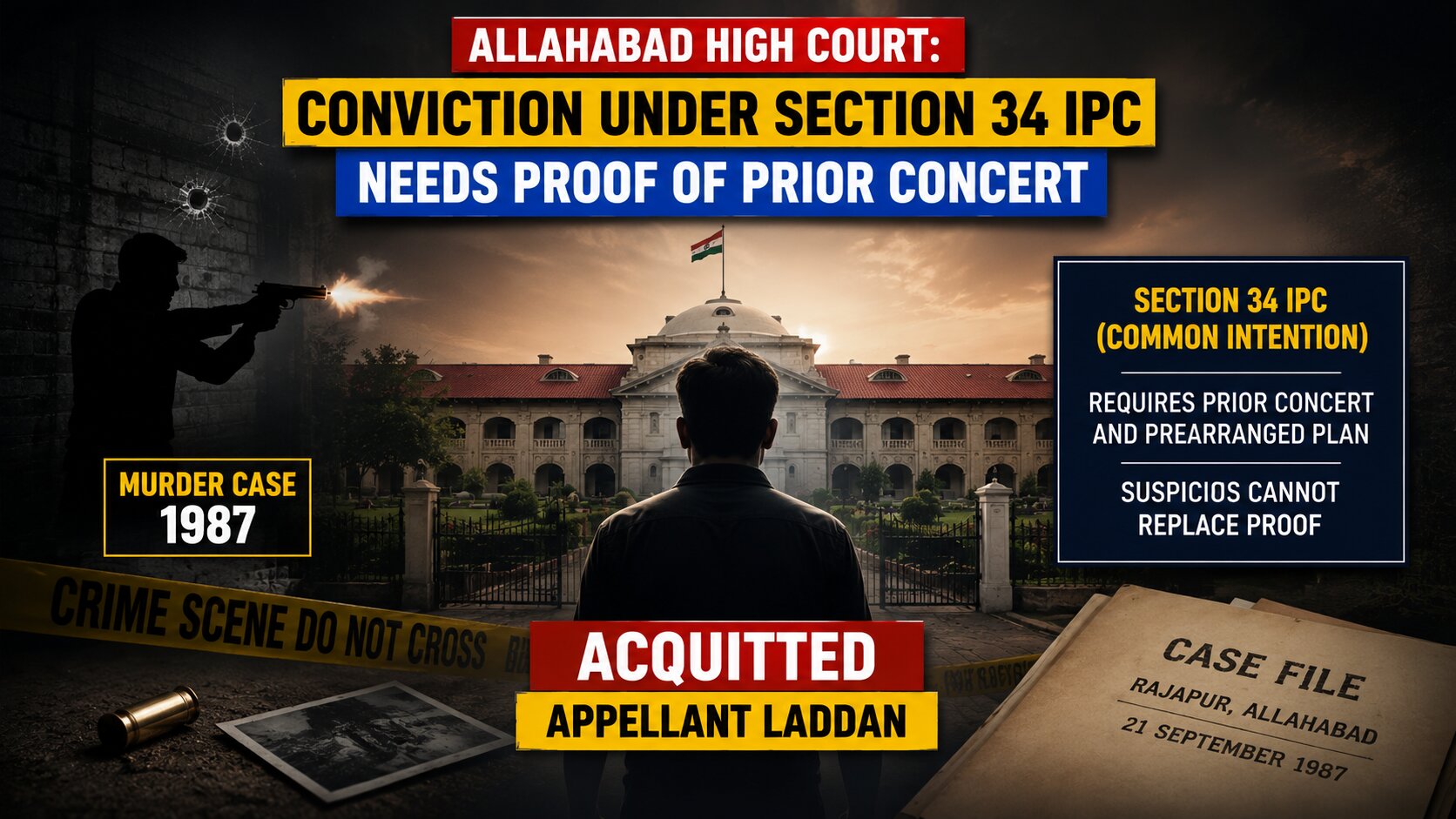
Judgement Details
Court
Allahabad High Court
Date of Decision
9 July 2026
Judges
Justice J.J. Munir & Justice Vinai Kumar Dwivedi
Citation
Acts / Provisions
Facts of the Case
- On 21 September 1987, the deceased Nanhey was shot dead in Rajapur, Allahabad.
-
The prosecution alleged that the murder was committed because the deceased had an illicit relationship with the sister of the main accused, Shaheed.
-
According to the FIR, Shaheed fired the fatal shot at the deceased.
-
It was alleged that Laddan (appellant) and Rahmat fired shots in the air to terrorize witnesses before fleeing.
-
In 1990, the Trial Court convicted Shaheed under Section 302 IPC, while Laddan and Rahmat were convicted under Section 302 read with Section 34 IPC.
-
During the pendency of the appeal, Shaheed and Rahmat died, leaving only Laddan's appeal for consideration.
-
Laddan argued that he had no connection with Shaheed and was falsely implicated merely because he was known in the locality.
-
The Investigating Officer admitted during cross-examination that only one fired bullet was recovered from the scene and no pellets, cartridges, or other evidence supported the allegation of aerial firing by Laddan.
Issues
-
Whether a conviction under Section 34 IPC can be sustained without proof of prior concert and a pre-arranged common intention among the accused?
-
Whether the prosecution proved beyond reasonable doubt that Laddan participated in the murder by sharing the common intention of the main accused?
-
Whether mere presence at the scene or alleged aerial firing is sufficient to attract liability under Section 34 IPC?
-
Whether suspicion without corroborative evidence can sustain a criminal conviction?
-
Whether the conviction recorded by the Trial Court required interference by the High Court?
Judgement
-
The High Court allowed the criminal appeal.
-
The Court held that Section 34 IPC requires clear evidence of prior concert and a pre-arranged plan among the accused.
-
It observed that the prosecution failed to establish any meeting of minds between Laddan and the main accused.
-
The Court found no evidence that Laddan shared any common intention to commit the murder.
-
The Court relied upon the testimony of the Investigating Officer, who confirmed that only one bullet was recovered from the crime scene.
-
The absence of pellets, cartridges, or other physical evidence contradicted the prosecution's allegation that Laddan fired shots in the air.
-
The Court held that mere presence at the scene or suspicion cannot establish criminal liability under Section 34 IPC.
-
It observed that the Trial Court convicted Laddan without examining the essential legal requirements for invoking Section 34 IPC.
-
Relying upon Sujit Biswas v. State of Assam, the Court reiterated that suspicion, however strong, can never replace legal proof.
-
The Court concluded that the prosecution failed to prove the appellant's guilt beyond reasonable doubt.
Held
-
The criminal appeal was allowed.
-
The conviction of Laddan under Section 302 read with Section 34 IPC was set aside.
-
Laddan was acquitted of all charges.
-
The Court held that prior concert and pre-arranged common intention are indispensable requirements for invoking Section 34 IPC.
Analysis
-
The judgment reaffirms that Section 34 IPC does not create a separate offence but fixes joint liability only when common intention is clearly proved.
-
The Court correctly emphasized that common intention cannot be presumed merely from presence at the scene.
-
The decision strengthens the principle that criminal liability must rest upon legally admissible evidence rather than conjecture or suspicion.
-
The Court highlighted the importance of corroborative forensic and physical evidence in supporting eyewitness testimony.
-
The judgment reiterates that courts must record a definite finding regarding prior concert before applying Section 34 IPC.
-
It reinforces the principle that prosecution must establish guilt beyond reasonable doubt, especially in cases involving constructive criminal liability.
-
The ruling serves as an important precedent limiting the indiscriminate application of Section 34 IPC where evidence of common intention is lacking.