
Jitendra @ Jitu Niansingh Gehlot v. Union of India & Anr., 2026
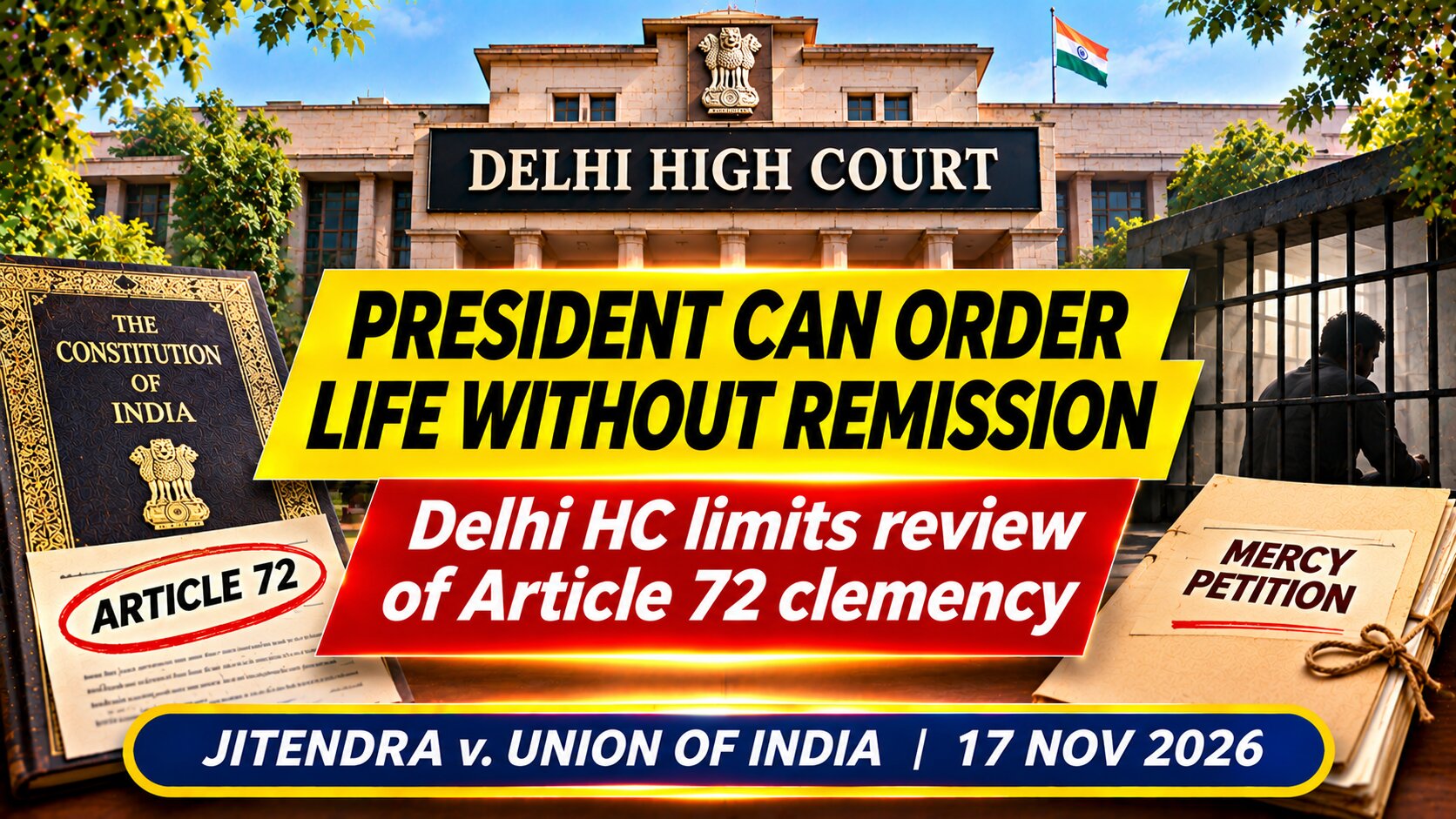
The President of India can exercise the power under Article 72 to commute a death sentence to imprisonment for the remainder of the convict's natural life without remission.
Judgement Details
Court
High Court of Delhi
Date of Decision
17 November 2026
Judges
Justice Navin Chawla and Justice Ravinder Dudeja
Citation
Acts / Provisions
Facts of the Case
-
The petitioner, Jitendra @ Jitu Niansingh Gehlot, was convicted for his involvement in a robbery and multiple murders committed at the residence of the Rathi family in Pune, Maharashtra, in August 1994.
-
The incident resulted in the deaths of seven persons, including five women and two children. One of the deceased women was pregnant.
-
The prosecution case was that the petitioner and his co-accused had planned to rob the residence and kill the occupants to prevent them from identifying the offenders.
-
The petitioner was arrayed as Accused No. 2. The prosecution alleged that he actively participated in the conspiracy and execution of the robbery and murders.
-
The Additional Sessions Judge, Pune, convicted the petitioner by judgment dated 19 February 1998 in Sessions Case No. 462/1994 and imposed the death penalty by order on sentence dated 23 February 1998.
-
The Bombay High Court confirmed the death sentence on 22 July 1999, holding that the case fell within the category of the rarest of rare cases.
-
The petitioner and his co-accused challenged the conviction and sentence before the Supreme Court in Criminal Appeal Nos. 25–26 of 2000. The Supreme Court dismissed the appeals on 5 September 2000, upholding the conviction and death sentence.
-
The petitioner's review petition was also dismissed by the Supreme Court on 24 November 2000.
-
The petitioner submitted a mercy petition before the President of India on 27 June 2001, seeking commutation of the death sentence.
-
The mercy petition remained undecided for more than 15 years. During this period, the petitioner also sent a further communication seeking mercy and commutation.
-
The Ministry of Home Affairs sought the opinion of the State Government and processed the mercy petition. The file was ultimately referred for the opinion of the Attorney General of India in view of the prolonged delay and the Supreme Court's decision in Shatrughan Chauhan v. Union of India.
-
The Attorney General opined that there had been huge unexplained delay at every stage and recommended commutation of the death sentence to life imprisonment.
-
The Ministry of Home Affairs, however, recommended rejection of the mercy petition.
-
The President considered both the Attorney General's opinion and the Ministry's recommendation.
-
On 18 September 2016, the President commuted the petitioner's death sentence to life imprisonment, subject to the condition that he would remain in prison for the remainder of his natural life without any further remission by any authority.
-
The decision was communicated to the petitioner through a letter dated 15 October 2016 issued by the Superintendent, Nagpur Central Jail.
-
Challenging the condition barring further remission, the petitioner filed W.P. (CRL) 3053/2017 before the Delhi High Court under Article 226 of the Constitution read with Section 482 of the Code of Criminal Procedure, 1973.
-
The petitioner contended that the President could not impose a condition that would exclude the statutory and constitutional remission powers of the appropriate Government.
-
He also argued that the delay of more than 15 years in deciding the mercy petition violated Article 21 and that his prolonged period under the shadow of the death sentence and alleged solitary confinement had not been adequately considered.
-
The Union of India opposed the petition, relying upon the constitutional power of the President and the Supreme Court's recognition of a special category of sentence involving imprisonment for the remainder of natural life without remission.
Issues
-
Whether the President of India, while exercising the power of clemency under Article 72 of the Constitution, can commute a death sentence to imprisonment for the remainder of the convict's natural life without remission?
-
Whether a sentence of imprisonment for the remainder of natural life without remission is constitutionally valid in view of the statutory remission powers under Section 432 of the Code of Criminal Procedure, 1973?
-
Whether the constitutional power of the President under Article 72 is distinct from the statutory remission powers of the appropriate Government under the Code of Criminal Procedure?
-
Whether the Delhi High Court can judicially review the President's decision under Article 72 and, if so, whether such review extends to the merits of the decision or is confined to the manner in which the power was exercised?
-
Whether the delay of more than 15 years in deciding the petitioner's mercy petition and the alleged solitary confinement established grounds for setting aside the condition imposed by the President?
-
Whether the President's consideration of the Attorney General's recommendation and the Ministry of Home Affairs' contrary recommendation demonstrated application of mind and consideration of relevant material?
Judgement
-
The Division Bench dismissed the writ petition and upheld the condition imposed by the President while commuting the petitioner's death sentence to imprisonment for the remainder of his natural life without remission.
-
The Court held that the President possesses constitutional power under Article 72 to commute a death sentence to imprisonment for the remainder of the convict's natural life without remission.
-
It relied upon the Constitution Bench judgment in Union of India v. V. Sriharan, which upheld the validity of a special category of sentence in which imprisonment for the remainder of natural life is imposed beyond the ordinary operation of remission.
-
The Court explained that V. Sriharan recognised the validity of such a special category in exceptional cases where an ordinary life sentence subject to remission would be grossly inadequate considering the gravity and nature of the offence.
-
It rejected the petitioner's argument that the condition automatically violated Section 432 CrPC or deprived the appropriate Government of its statutory powers.
-
The Bench distinguished an ordinary life sentence from a sentence expressly imposed for the remainder of natural life without remission. In an ordinary life sentence, the statutory remission framework remains available; the special category of sentence recognised in V. Sriharan operates differently.
-
The Court reiterated that the powers under Articles 72 and 161 are constitutional powers, distinct from statutory remission powers under the Code of Criminal Procedure.
-
It held that judicial review of an order passed by the President or Governor in exercise of constitutional clemency powers is limited to examining the manner in which the power was exercised.
-
Relying upon Epuru Sudhakar, the Court identified the recognised grounds for judicial interference, including non-application of mind, mala fides, arbitrariness, reliance on extraneous or irrelevant considerations and exclusion of relevant material.
-
The Court acknowledged that the petitioner's mercy petition had remained pending for more than 15 years, from 27 June 2001 until 18 September 2016.
-
It observed that such prolonged delay could have constituted a sufficient ground for commuting the death sentence to life imprisonment, particularly in view of the psychological and physical consequences of remaining under the shadow of a death sentence.
-
However, the Court found that the President was conscious of the delay and had specifically sought the opinion of the Attorney General on the applicability of Shatrughan Chauhan v. Union of India.
-
The Attorney General had recommended commutation because of the unexplained delay, while the Ministry of Home Affairs had recommended rejection of the mercy petition.
-
The President had the benefit of both competing recommendations and considered them before passing the final order.
-
The Court held that the President's consideration of the relevant material demonstrated application of mind. The fact that the High Court might have reached a different conclusion did not permit it to substitute its own opinion for that of the President.
-
The Bench emphasised that the High Court was exercising judicial review and not appellate jurisdiction over the President's clemency decision.
-
Finding no mala fides, arbitrariness, non-application of mind or exclusion of relevant material, the Court found no ground to interfere.
-
Accordingly, the writ petition was dismissed. The pending application was also disposed of as infructuous, and no order as to costs was made.
Held
-
A special category of sentence involving imprisonment for the remainder of natural life without remission is constitutionally recognised under the principles laid down in Union of India v. V. Sriharan.
-
The constitutional powers under Articles 72 and 161 are distinct from the statutory remission powers under Section 432 CrPC.
-
The scope of judicial review of a Presidential clemency decision is limited to the legality of the manner in which the power was exercised, and does not permit the Court to substitute its own opinion on the merits.
-
Judicial interference may be justified where the decision suffers from non-application of mind, mala fides, arbitrariness, reliance on extraneous considerations or exclusion of relevant material.
-
The delay of more than 15 years in deciding the mercy petition was acknowledged, but the President had expressly considered the delay and obtained the Attorney General's opinion before deciding the matter.
-
Since the President had considered both the Attorney General's recommendation and the Ministry of Home Affairs' contrary recommendation, the High Court found no ground to hold that relevant material had been ignored.
-
The petitioner's challenge to the no-remission condition was dismissed, and the Presidential order was not interfered with.
Analysis
-
Constitutional clemency and remission are distinct powers: The judgment reiterates that the President's power under Article 72 is a constitutional power and is not identical to the statutory power of remission under Section 432 CrPC. The two operate in distinct legal spheres and must not be conflated.
-
Validity of imprisonment for natural life without remission: Relying on the Constitution Bench decision in Union of India v. V. Sriharan, the Court reaffirmed the validity of a special category of sentence for the remainder of natural life without remission. Such a sentence is intended for exceptional cases where an ordinary life sentence subject to remission would be grossly inadequate in light of the gravity and nature of the crime.
-
Limited judicial review of clemency: The decision reinforces the principle that courts do not sit in appeal over the President's exercise of constitutional clemency. Judicial review examines the legality and fairness of the decision-making process rather than substituting the Court's preferred outcome.
-
Recognised grounds for interference: The Court relied upon Epuru Sudhakar to identify the limited grounds on which a clemency decision may be reviewed: non-application of mind, mala fides, arbitrariness, extraneous or irrelevant considerations and failure to consider relevant material.
-
Importance of considering competing opinions: A significant feature of the case was the difference between the Attorney General's recommendation and the Ministry of Home Affairs' recommendation. The Attorney General favoured commutation because of the delay, whereas the Ministry recommended rejection. The President's consideration of both views was treated as evidence that the relevant material had been placed before the constitutional authority.
-
Delay in mercy proceedings and Article 21: The Court acknowledged that an unexplained delay of more than 15 years in deciding a mercy petition can have grave psychological consequences for a death-row convict. The prolonged uncertainty and the continuing shadow of execution may engage Article 21. However, in the present case, the delay had been expressly considered by the President.
-
Difference between ordinary life imprisonment and special-category life imprisonment: The judgment clarifies that an ordinary life sentence does not automatically exclude the possibility of remission under the applicable law. A sentence expressly imposed for the remainder of natural life without remission belongs to a distinct category recognised by the Constitution Bench in V. Sriharan.
-
Judicial review is not appellate review: The High Court emphasised that even if it might have assessed the mercy petition differently, that alone would not justify interference. The relevant inquiry was whether the President had considered the material and exercised the constitutional power lawfully.
-
Impact on constitutional and criminal jurisprudence: The decision is significant for reaffirming the constitutional validity of the no-remission sentence category and the limited scope of judicial review over Presidential clemency. It also highlights the need for constitutional authorities to consider delay, relevant recommendations and all material circumstances while deciding mercy petitions.