Supreme Court Collegium Recommends New Chief Justices for Rajasthan, MP and J&K-Ladakh High Courts, Chhattisgarh
Lexpedia News · 2 September 2026 · 11 min read
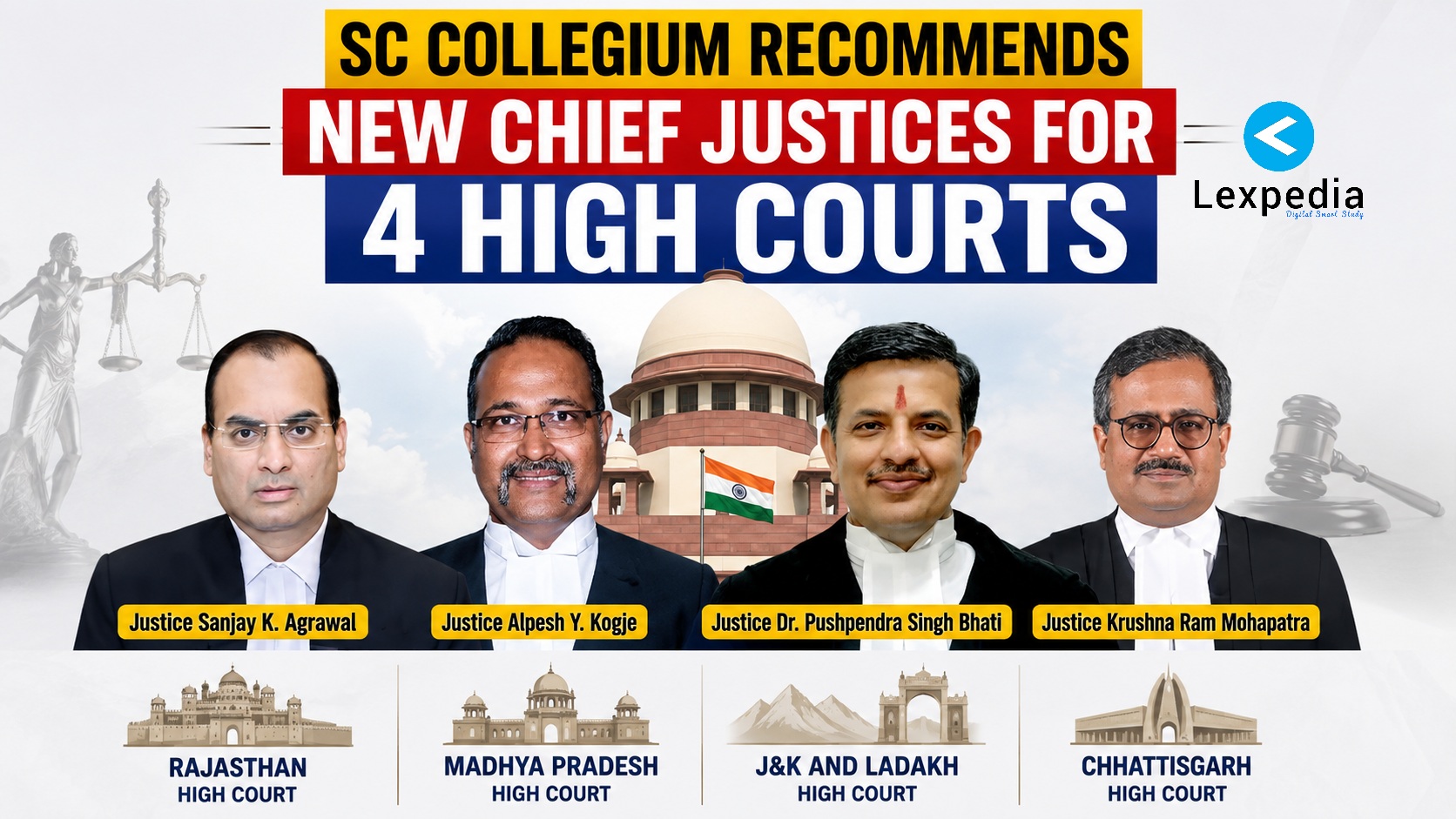
Justice Sanjay K. Agrawal recommended for Rajasthan, Justice Alpesh Yeshvant Kogje for Madhya Pradesh and Justice Dr. Pushpendra Singh Bhati for J&K and Ladakh; Justice Krushna Ram Mohapatra separately recommended for Chhattisgarh
New Delhi | September 2, 2026
The Supreme Court Collegium, headed by Chief Justice of India Justice Surya Kant, has recommended the appointment of new Chief Justices for three High Courts—Rajasthan, Madhya Pradesh, and Jammu & Kashmir and Ladakh.
At its meeting held on August 31, 2026, the Collegium recommended Justice Sanjay K. Agrawal of the Chhattisgarh High Court as Chief Justice of the Rajasthan High Court, Justice Alpesh Yeshvant Kogje of the Gujarat High Court as Chief Justice of the Madhya Pradesh High Court, and Justice Dr. Pushpendra Singh Bhati of the Rajasthan High Court as Chief Justice of the High Court of Jammu & Kashmir and Ladakh. The Supreme Court's official Collegium resolution confirms these three recommendations.
Important clarification: Although the LiveLaw report carrying the linked article discusses four High Courts, the Supreme Court's official statement dated August 31 concerns three Chief Justice recommendations. A fourth recommendation—for the Chhattisgarh High Court—was made at an earlier Collegium meeting on August 6, 2026 and its statement was uploaded on August 31. It is therefore more accurate to describe the August 31 resolution as recommending Chief Justices for three High Courts, while reporting the Chhattisgarh recommendation separately.
Three New Chief Justice Recommendations
The latest August 31 resolution provides the following proposed appointments:
| Present High Court | Judge Recommended | Proposed High Court |
|---|---|---|
| Chhattisgarh High Court | Justice Sanjay K. Agrawal | Rajasthan High Court |
| Gujarat High Court | Justice Alpesh Yeshvant Kogje | Madhya Pradesh High Court |
| Rajasthan High Court | Justice Dr. Pushpendra Singh Bhati | Jammu & Kashmir and Ladakh High Court |
These are, at this stage, Collegium recommendations, not final appointments. The recommendations will have to proceed through the constitutional appointment process before the judges formally assume the respective Chief Justice offices.
Justice Sanjay K. Agrawal Recommended as Rajasthan High Court Chief Justice
The most closely watched recommendation is that of Justice Sanjay K. Agrawal, presently a judge of the Chhattisgarh High Court, for appointment as Chief Justice of the Rajasthan High Court.
The Supreme Court Collegium has separately recommended his transfer from the Chhattisgarh High Court to the Rajasthan High Court. The official Collegium page lists a separate August 31 resolution concerning his transfer.
The recommendation comes against the backdrop of an unusual controversy at the Rajasthan High Court involving its Acting Chief Justice Sanjeev Prakash Sharma.
Background to the Rajasthan controversy
Supreme Court Justice Sandeep Mehta, whose parent High Court is Rajasthan, had written letters to CJI Surya Kant raising serious concerns regarding the functioning of Justice Sharma as Acting Chief Justice.
Reports have described the complaints as involving alleged maladministration, favouritism and misuse of administrative powers. These remain allegations and should not be treated as established findings against Justice Sharma.
The Rajasthan High Court Bar had also launched protests and demanded that a regular Chief Justice be appointed.
On August 31, Justice Sharma went on leave, and the updated roster indicated that he would not hold court from September 1 to September 5.
The Collegium's recommendation of Justice Agrawal therefore comes at a particularly significant moment for the Rajasthan High Court.
Justice Sanjay K. Agrawal: Judicial background
Justice Sanjay K. Agrawal was born on July 15, 1965, at Ratanpur in Bilaspur, Chhattisgarh.
According to the Chhattisgarh High Court's official profile, he completed his B.Sc. and LL.B. from Guru Ghasidas University, Bilaspur, and obtained an LL.M. from Pt. Ravishankar Shukla University, Raipur.
He enrolled as an advocate on January 3, 1989, and practised in the District and Sessions Court at Bilaspur, the Madhya Pradesh High Court at Jabalpur and subsequently the Chhattisgarh High Court. His practice covered several branches of law, particularly civil and constitutional law.
He was elevated to the Chhattisgarh High Court and has served as a judge there. The Collegium's latest recommendation would move him to Rajasthan and, subject to the completion of the appointment process, place him at the head of that High Court.
Justice Alpesh Yeshvant Kogje Recommended for Madhya Pradesh High Court
The Collegium has recommended Justice Alpesh Yeshvant Kogje, presently a judge of the Gujarat High Court, as the next Chief Justice of the Madhya Pradesh High Court.
Justice Kogje was born on July 16, 1969.
He completed his B.Sc. in Chemistry in 1990 and obtained his LL.B. degree from the Faculty of Law, Maharaja Sayajirao University of Baroda, in 1993.
He joined the Bar in 1993 and practised before the Gujarat High Court in several areas, including civil, criminal, constitutional, service, labour, company and indirect-tax matters.
He also served as:
- Additional Public Prosecutor;
- counsel for the Central Excise and Customs Department; and
- Special Public Prosecutor for the SIT.
His professional work included handling significant matters arising from the 2002 Gujarat riots.
Justice Kogje was elevated as an Additional Judge of the Gujarat High Court in April 2016 and became a Permanent Judge in March 2018.
If the recommendation is approved, he will move from Gujarat to Madhya Pradesh and head the Madhya Pradesh High Court.
The Madhya Pradesh High Court is currently functioning under Acting Chief Justice Vivek Rusia, who was appointed to perform the duties of Chief Justice from June 1, 2026, following the elevation of Justice Sanjeev Sachdeva to the Supreme Court.
Justice Dr. Pushpendra Singh Bhati Recommended for J&K and Ladakh High Court
The third recommendation concerns Justice Dr. Pushpendra Singh Bhati, currently serving as a judge of the Rajasthan High Court.
The Collegium has recommended him as Chief Justice of the High Court of Jammu & Kashmir and Ladakh.
Justice Bhati was born on September 21, 1970.
The Rajasthan High Court's official judicial directory records that he holds:
- B.A.
- LL.B.
- LL.M. in Mercantile Law
- Ph.D. on “Promotion & Seniority in Public Employment, its Changing Dimensions and Role of Supreme Court.”
He enrolled as an advocate in 1992 and was elevated to the Rajasthan High Court on November 16, 2016.
His proposed appointment would take him from Rajasthan to the High Court exercising jurisdiction over the Union Territories of Jammu & Kashmir and Ladakh.
The High Court is presently headed by Acting Chief Justice Sanjeev Kumar, who assumed the responsibilities following the elevation of then Chief Justice Arun Palli to the Supreme Court.
Separate Recommendation: Justice Krushna Ram Mohapatra for Chhattisgarh
There is an important fourth development connected with the same round of High Court Chief Justice vacancies, but it arose from a separate Collegium meeting.
At its meeting on August 6, 2026, the Supreme Court Collegium recommended Justice Krushna Ram Mohapatra, a judge of the Orissa High Court, as Chief Justice of the Chhattisgarh High Court.
The official Supreme Court resolution states that the recommendation was made in view of the retirement of the incumbent Chhattisgarh High Court Chief Justice on September 4, 2026.
The August 6 resolution was uploaded on the Supreme Court's website on August 31, alongside the newer August 31 resolutions.
Who is Justice Krushna Ram Mohapatra?
According to the Orissa High Court's official profile, Justice Mohapatra was born on April 18, 1965 and holds a B.A., LL.B.
He enrolled as an advocate with the Orissa State Bar Council on February 7, 1988, and had approximately 26 years of practice across civil, service, criminal and constitutional law before his elevation.
He also served as Additional Standing Counsel for the State and the Orissa Public Service Commission and represented several government bodies and public institutions.
He was elevated as a judge of the Orissa High Court on April 17, 2015.
Thus, the complete picture is:
August 31 Collegium meeting → 3 Chief Justice recommendations
August 6 Collegium meeting → 1 additional Chief Justice recommendation for Chhattisgarh
Why the Rajasthan Recommendation Is Particularly Significant
Among the three August 31 recommendations, the Rajasthan proposal has attracted the greatest attention because of the circumstances surrounding the High Court's current administration.
The Rajasthan High Court had been functioning under an Acting Chief Justice, rather than a permanent Chief Justice, and lawyers had been protesting against the continuation of Justice Sanjeev Prakash Sharma in that role.
Justice Sandeep Mehta of the Supreme Court had separately written to CJI Surya Kant regarding concerns about the functioning of the Rajasthan High Court under Justice Sharma. Reports state that the CJI had sought a response from Justice Sharma, reflecting the requirement of due process before any administrative or disciplinary conclusion could be drawn.
The Collegium's recommendation of Justice Agrawal from outside Rajasthan therefore also represents a move towards installing a regular Chief Justice from another High Court.
However, it is important not to state that the Collegium's recommendation was a finding against Justice Sharma. The recommendation itself does not record any finding of misconduct or wrongdoing.
Recommendations Are Not Yet Final Appointments
A crucial legal distinction is that a Supreme Court Collegium recommendation is not the same as a final appointment notification.
The Collegium recommends candidates for appointment. The recommendation then proceeds through the established constitutional process involving the Union Government and the President of India.
Accordingly, as of September 2, 2026, the three judges should accurately be described as:
- “recommended by the Supreme Court Collegium”, rather than already appointed Chief Justices;
- Justice Sanjay K. Agrawal — recommended for Rajasthan;
- Justice Alpesh Yeshvant Kogje — recommended for Madhya Pradesh;
- Justice Dr. Pushpendra Singh Bhati — recommended for J&K and Ladakh.
The official Supreme Court resolution expressly describes these as recommendations for elevation, confirming that the appointments were not themselves the final government notifications.
Similarly, Justice Krushna Ram Mohapatra's appointment as Chhattisgarh Chief Justice should presently be described as a Collegium recommendation, unless and until the formal appointment notification is issued.
Complete List at a Glance
| Judge | Present High Court | Recommended as Chief Justice of | Status |
|---|---|---|---|
| Justice Sanjay K. Agrawal | Chhattisgarh | Rajasthan HC | Collegium recommended |
| Justice Alpesh Yeshvant Kogje | Gujarat | Madhya Pradesh HC | Collegium recommended |
| Justice Dr. Pushpendra Singh Bhati | Rajasthan | J&K & Ladakh HC | Collegium recommended |
| Justice Krushna Ram Mohapatra | Orissa | Chhattisgarh HC | Recommended earlier, on Aug. 6 |
The first three recommendations were made at the August 31 meeting; the fourth was made at the August 6 meeting.
Current Acting Leadership of the Three High Courts
The latest reporting shows that the recommendations will replace or regularise acting arrangements at the respective High Courts:
Rajasthan High Court
Justice Sanjeev Prakash Sharma has been functioning as Acting Chief Justice. He has opted out of judicial work until September 5 amid the ongoing controversy and lawyers' protests.
Madhya Pradesh High Court
Justice Vivek Rusia is functioning as Acting Chief Justice, following the elevation of former Chief Justice Sanjeev Sachdeva to the Supreme Court.
Jammu & Kashmir and Ladakh High Court
Justice Sanjeev Kumar is functioning as Acting Chief Justice after the elevation of former Chief Justice Arun Palli to the Supreme Court.
Chhattisgarh High Court
The Collegium has separately recommended Justice Krushna Ram Mohapatra to take over as Chief Justice following the retirement of the incumbent Chief Justice on September 4.
What Happens Next?
The recommendations will now move through the constitutional appointment process.
Until the formal appointment notifications are issued, the recommended judges should not be described as having already assumed the office of Chief Justice.
Once the appointments are formally notified and the judges take oath, they will assume administrative and judicial leadership of the respective High Courts.
The latest Collegium recommendations are significant because they address leadership vacancies or acting arrangements in four High Courts, although the three August 31 recommendations and the earlier August 6 Chhattisgarh recommendation should be kept factually distinct.
Key Takeaways
- The Supreme Court Collegium, headed by CJI Surya Kant, met on August 31, 2026 and recommended Chief Justices for three High Courts.
- Justice Sanjay K. Agrawal has been recommended for the Rajasthan High Court.
- Justice Alpesh Yeshvant Kogje has been recommended for the Madhya Pradesh High Court.
- Justice Dr. Pushpendra Singh Bhati has been recommended for the Jammu & Kashmir and Ladakh High Court.
- The Collegium separately recommended Justice Krushna Ram Mohapatra of the Orissa High Court as Chief Justice of the Chhattisgarh High Court at its August 6 meeting.
- The Rajasthan recommendation comes amid lawyers' protests and controversy surrounding Acting Chief Justice Sanjeev Prakash Sharma.
- The allegations concerning Justice Sharma remain allegations and should not be treated as established findings.
- These are Collegium recommendations, not final appointments. The formal appointment process remains to be completed.