“Regrettable That No Legal Academic Has Ever Been Appointed as Supreme Court Judge”: Justice Ujjal Bhuyan Calls for Greater Role for Legal Scholars
Lexpedia News · 31 August 2026 · 20 min read
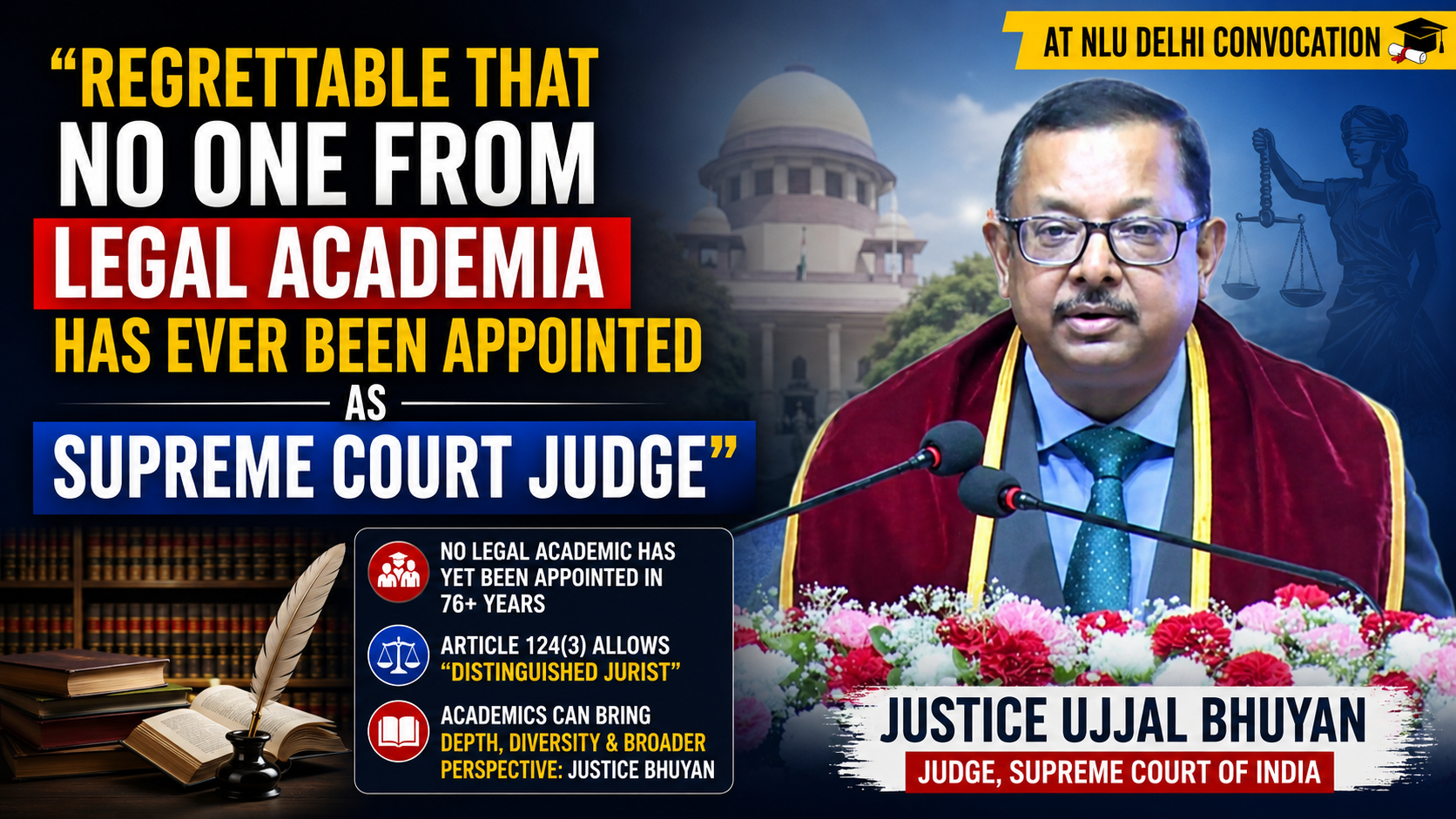
At NLU Delhi’s 13th LL.M. Convocation, Supreme Court judge says Article 124(3) provision for “distinguished jurists” has remained an unused constitutional mandate for over 76 years; rejects lack of practical experience as a “shallow” objection
Supreme Court Judge Justice Ujjal Bhuyan has called attention to the absence of legal academics and distinguished jurists from the Supreme Court Bench, observing that although the Constitution expressly provides for the appointment of a “distinguished jurist”, no legal academic has so far been appointed as a Supreme Court judge.
Justice Bhuyan made the observations while delivering the Convocation Address at the 13th Convocation of National Law University, Delhi (NLU Delhi) for its LL.M. programmes on August 30, 2026. He argued that distinguished legal scholars could bring academic depth, diversity of perspective and a broader understanding of public-law issues to the Supreme Court.
The remarks assume significance amid a broader discussion about judicial appointments, diversity on the Supreme Court Bench and the role of legal academia in India's constitutional system.
Article 124(3): Three Constitutional Routes to the Supreme Court
Justice Bhuyan's observations centre on Article 124(3) of the Constitution of India, which lays down the qualifications for appointment as a Supreme Court judge.
Article 124(3) provides three broad routes:
- A person who has been a High Court judge for at least five years;
- A person who has been an advocate of a High Court for at least ten years; or
- A person who is, in the opinion of the President, a “distinguished jurist.”
It is the third category—“distinguished jurist”—that Justice Bhuyan said has effectively remained unexplored when it comes to bringing legal academics onto the Supreme Court Bench.
According to Justice Bhuyan, the Constitution has been in force for more than 76 years, yet no legal academic has been appointed as a Supreme Court judge.
“It is regrettable that this provision has remained one of our Constitution's unused mandates.”
He said distinguished jurists could be a “great value addition” to the Bench because of their scholarship and could make a significant contribution to decision-making at the highest judicial level.
“No Legal Academic Has Yet Been Appointed”
Justice Bhuyan specifically distinguished legal academics from the traditional routes through which Supreme Court judges have generally been appointed.
He noted that the usual practice has been to elevate senior High Court judges or Chief Justices to the Supreme Court. There have also been instances of direct appointments from the Bar, some of which, he observed, have proved highly successful.
But, he said, legal academics have not yet been appointed to the Supreme Court Bench, despite the presence of scholars who could potentially make substantial contributions to the Court's work.
Justice Bhuyan suggested that there could be two explanations for this situation.
One possibility, according to him, is that the Union Government in the pre-collegium era and the Collegium thereafter may have considered Indian legal academia insufficiently deep to merit serious consideration for Supreme Court appointments.
The second—and, in his assessment, more probable—possibility is that the provision has simply not been seriously explored by either the government or the Collegium.
Practical Experience Argument “Very Shallow”
One of the principal objections sometimes raised against appointing legal academics directly to constitutional courts is their alleged lack of practical courtroom experience.
Justice Bhuyan rejected this reasoning as a “very shallow objection.”
According to him, the Supreme Court is not merely the country's highest adjudicatory institution. It also functions as the moral, legal and constitutional conscience of the nation.
He said the purpose behind including the distinguished-jurist category in the Constitution was to diversify the Bench with talented individuals possessing significant academic and juristic knowledge.
Justice Bhuyan further suggested that academics with deep legal scholarship may be particularly valuable in dealing with public-law and constitutional questions, because they may not be as constrained by narrow technical approaches to legal problems.
What Does “Distinguished Jurist” Mean?
Justice Bhuyan also addressed the meaning of the expression “distinguished jurist.”
The Constitution itself does not provide a detailed statutory definition of the term.
According to Justice Bhuyan, the expression should encompass eminent persons involved in the practice, teaching and research of law.
He emphasised that courtroom practice should not be treated as an indispensable requirement for a person to qualify as a distinguished jurist.
In his view, a person who is highly skilled or knowledgeable in the field of law can fall within the broader concept of a jurist.
This interpretation would potentially open the constitutional category to law professors, legal researchers, scholars and other eminent legal thinkers, subject of course to the constitutional appointment process.
Why Legal Academia Could Add Value to the Supreme Court
Justice Bhuyan argued that legal scholars could contribute to the Supreme Court in ways that complement the experience of career judges and practising advocates.
He said academic scholarship could help a judge approach questions of constitutional and public law from a broader perspective.
The judge observed that the framers of the Constitution had contemplated the participation of distinguished jurists in the Supreme Court precisely to expand the range of expertise available on the Bench.
The inclusion of academics, therefore, would not necessarily mean replacing judges drawn from the High Courts or advocates from the Bar. Instead, it could provide greater diversity in professional background and intellectual perspective.
Examples From the United States and Other Countries
Justice Bhuyan also referred to international examples to illustrate that legal academics can transition to the highest constitutional courts.
He referred to the United States and cited figures including Felix Frankfurter, a Harvard law professor who later became a US Supreme Court Justice.
He also referred to Samuel Miller and Ruth Bader Ginsburg in discussing the broader diversity of backgrounds from which judges of the US Supreme Court have been appointed.
Justice Bhuyan further noted that legal academics can be appointed to top courts in countries including the United Kingdom, Canada and Kenya.
The international comparison was used to support his broader argument that academic expertise and judicial competence need not be mutually exclusive.
Indian Bar Rules and the Academic-Practice Divide
Justice Bhuyan also pointed to a structural issue affecting Indian legal academia.
He noted that Bar Council of India rules create restrictions on full-time law professors practising as advocates, meaning that an academic pursuing a full-time teaching career generally cannot simultaneously maintain the same kind of active legal practice as a practising advocate.
He contrasted this with the United States, where, according to his remarks, a full-time professor can practise law provided that such practice does not interfere with academic responsibilities.
This distinction is relevant to the argument that Indian legal academics lack courtroom experience: the absence of such experience may, at least partly, be a consequence of the institutional separation between full-time legal teaching and legal practice.
A Broader Message on Universities and Constitutional Democracy
Justice Bhuyan's comments on legal academia formed part of a wider address on the role of universities in a constitutional democracy.
He told the graduating LL.M. students that universities should be places where established ideas can be questioned and competing viewpoints can be debated through reason rather than hostility.
He emphasised that a healthy academic environment does not require everyone to reach the same conclusion.
He also spoke about the importance of free thought, dissent and questioning authority, saying that the habit of thinking independently should begin in universities.
The Supreme Court judge separately said that students should not be threatened with punitive action merely for expressing a different point of view or asking difficult questions, describing such an approach as unconstitutional and a misuse of power.
Justice Bhuyan on Excessive Deference to Authority
In a related part of his convocation address, Justice Bhuyan said that society should shed excessive deference to authority, including the judiciary.
He indicated that universities should encourage students to question established positions rather than accepting them merely because they come from an authority figure.
His comments placed academic freedom, dissent and independent thinking within the larger framework of constitutional democracy.
NLU Delhi Convocation
Justice Bhuyan delivered the address as Chief Guest at NLU Delhi's 13th Convocation for LL.M. programmes on August 30.
According to NLU Delhi's official account, 189 postgraduate degrees were conferred across the LL.M. programmes, while eight medals and four cash prizes were awarded for academic excellence and distinguished achievements.
The ceremony was attended by Justice Bhuyan, Justice Vivek Chaudhary of the Delhi High Court, who was the Chancellor's Nominee of NLU Delhi, and Justice O. P. Shukla of the Delhi High Court, along with academic leaders, jurists, faculty members, graduating students and their families.
A Constitutional Provision That Has Attracted Debate
Justice Bhuyan's statement has revived an old constitutional debate over Article 124(3)(c).
The provision has existed since the Constitution came into force, but its practical use has been the subject of legal discussion.
While current reporting of Justice Bhuyan's remarks states that no distinguished jurist/legal academic has been appointed to the Supreme Court, earlier legal scholarship has examined historical appointments and questioned whether certain early Supreme Court judges could potentially have fallen within the “distinguished jurist” category. One analysis, for instance, discussed the possible status of Justice Subimal Chandra Roy and Justice T. L. Venkatrama Aiyyar, while also noting conflicting government records on the issue.
Accordingly, the more precise formulation of Justice Bhuyan's present point is that no legal academic has been appointed to the Supreme Court through the modern appointment process, rather than treating the historical legal question about every past appointment under Article 124(3)(c) as conclusively settled.
What Justice Bhuyan's Remarks Could Mean for Judicial Appointments
Justice Bhuyan's observations do not constitute a formal proposal or change in the Supreme Court's appointment process.
The remarks are instead an institutional and constitutional argument for taking the “distinguished jurist” category more seriously.
If the category were actively explored, potential candidates could theoretically include eminent law professors, constitutional scholars, legal researchers and other jurists with exceptional expertise.
Such appointments could potentially broaden the professional backgrounds represented on the Supreme Court and introduce greater academic and interdisciplinary expertise into constitutional adjudication.
However, any actual appointment would still have to comply with the constitutional framework and the prevailing judicial-appointment mechanism.
Why the Remarks Matter
Justice Bhuyan's intervention comes at a time when questions surrounding judicial appointments, Collegium transparency, diversity on the Bench and institutional accountability have received increasing attention.
Only earlier this month, Justice Bhuyan had called for greater transparency in the Collegium system, arguing that reasons behind judicial appointments should be disclosed in the public interest.
His latest comments similarly focus on the composition of the Supreme Court and the range of expertise that should potentially be considered while selecting judges.
Taken together, his remarks point toward a broader argument: the constitutional design of India's judiciary should not be interpreted so narrowly that entire categories of legally distinguished professionals remain outside consideration.
Key Takeaways
- Justice Ujjal Bhuyan has called for serious consideration of distinguished legal jurists and academics for appointment to the Supreme Court.
- He made the remarks at NLU Delhi's 13th LL.M. Convocation on August 30, 2026.
- He pointed to Article 124(3)(c), which permits appointment of a person who, in the President's opinion, is a “distinguished jurist.”
- Justice Bhuyan said no legal academic has yet been appointed as a Supreme Court judge, despite the constitutional provision existing for more than 76 years.
- He suggested that the provision may either not have been seriously explored or that authorities have considered Indian legal academia insufficiently deep for such appointments.
- He rejected the argument that academics lack practical experience as a “very shallow” objection.
- He said legal scholarship could diversify the Bench and contribute particularly to public-law and constitutional adjudication.
- He cited examples from the US, UK, Canada and Kenya, where legal academics have served on top courts.
- His remarks do not change the existing judicial appointment process; they constitute a call for greater consideration of the constitutional “distinguished jurist” route.
- Justice Bhuyan also emphasised academic freedom, dissent, questioning authority and independent thinking in his convocation address.
“किसी लीगल एकेडमिक को सुप्रीम कोर्ट जज नहीं बनाया गया, यह अफसोसजनक”: जस्टिस उज्ज्वल भुइयां ने कानूनी शिक्षाविदों को SC में नियुक्त करने पर जोर दिया
NLU दिल्ली के LL.M. दीक्षांत समारोह में जस्टिस भुइयां ने कहा—Article 124(3) में “Distinguished Jurist” की नियुक्ति का प्रावधान 76 साल से अधिक समय से प्रभावी रूप से अप्रयुक्त है; व्यावहारिक अनुभव की कमी वाली दलील को बताया “बहुत सतही”
नई दिल्ली | 31 अगस्त 2026
सुप्रीम कोर्ट के न्यायाधीश जस्टिस उज्ज्वल भुइयां ने सुप्रीम कोर्ट की बेंच में कानूनी शिक्षाविदों और distinguished jurists की अनुपस्थिति पर महत्वपूर्ण टिप्पणी करते हुए कहा है कि संविधान में “distinguished jurist” को सुप्रीम कोर्ट का जज नियुक्त करने का स्पष्ट प्रावधान होने के बावजूद अब तक किसी legal academic को सुप्रीम कोर्ट का न्यायाधीश नहीं बनाया गया है।
जस्टिस भुइयां ने यह टिप्पणी 30 अगस्त 2026 को National Law University, Delhi (NLU Delhi) के LL.M. programmes के 13वें Convocation में Convocation Address देते हुए की। उन्होंने कहा कि distinguished legal scholars सुप्रीम कोर्ट की बेंच में academic depth, diversity of perspective और public-law issues की व्यापक समझ ला सकते हैं।
उनकी टिप्पणी ऐसे समय में महत्वपूर्ण है जब judicial appointments, Supreme Court Bench में diversity और constitutional system में legal academia की भूमिका को लेकर चर्चा जारी है।
Article 124(3): सुप्रीम कोर्ट जज बनने के तीन संवैधानिक रास्ते
जस्टिस भुइयां की टिप्पणी का केंद्र भारतीय संविधान का Article 124(3) है।
Article 124(3) के तहत सुप्रीम कोर्ट के जज के रूप में नियुक्ति के लिए तीन broad categories हैं:
- ऐसा व्यक्ति जो कम से कम पांच वर्ष तक High Court Judge रहा हो;
- ऐसा व्यक्ति जो कम से कम दस वर्ष तक High Court का Advocate रहा हो; या
- ऐसा व्यक्ति जो राष्ट्रपति की राय में “Distinguished Jurist” हो।
इसी तीसरी category—“Distinguished Jurist”—को लेकर Justice Bhuyan ने कहा कि legal academics को Supreme Court Bench में लाने की दिशा में इस provision को अब तक प्रभावी रूप से explore नहीं किया गया है।
जस्टिस भुइयां के अनुसार संविधान को लागू हुए 76 वर्ष से अधिक हो चुके हैं, लेकिन अभी तक किसी legal academic को Supreme Court judge के रूप में नियुक्त नहीं किया गया है।
उन्होंने कहा कि distinguished jurist अपनी scholarship के कारण Bench के लिए महत्वपूर्ण योगदान दे सकता है और शीर्ष स्तर पर judicial decision-making को समृद्ध कर सकता है।
“किसी Legal Academic को अब तक जज नहीं बनाया गया”
जस्टिस भुइयां ने Supreme Court में नियुक्ति के पारंपरिक तरीकों की ओर भी ध्यान दिलाया।
उन्होंने कहा कि सामान्यतः High Courts के senior judges या Chief Justices को Supreme Court में elevate किया जाता है। कभी-कभी Bar से direct appointments भी हुई हैं और उनमें से कुछ नियुक्तियां बेहतरीन साबित हुई हैं।
लेकिन, उनके अनुसार, legal academics को अभी तक Supreme Court Bench में नियुक्त नहीं किया गया, जबकि देश में ऐसे कई प्रतिभाशाली legal scholars मौजूद हैं जो Bench का हिस्सा बनकर महत्वपूर्ण योगदान दे सकते हैं।
जस्टिस भुइयां ने इस स्थिति के दो संभावित कारण बताए।
पहला, उनके अनुसार, यह हो सकता है कि Collegium system से पहले केंद्र सरकार और Collegium system आने के बाद Collegium ने भारतीय legal academia को Supreme Court में elevation के लिए पर्याप्त गहराई वाला नहीं माना हो।
दूसरा और उनके अनुसार अधिक संभावित कारण यह है कि सरकार और Collegium ने इस constitutional provision को अब तक गंभीरता से explore ही नहीं किया।
Practical Experience की कमी वाली दलील “बहुत सतही”
Legal academics को Supreme Court judge नियुक्त करने के खिलाफ अक्सर यह तर्क दिया जाता है कि उनके पास practical courtroom experience नहीं होता।
Justice Bhuyan ने इस तर्क को “very shallow objection” बताया।
उनके अनुसार Supreme Court केवल देश की सबसे बड़ी adjudicatory institution नहीं है, बल्कि यह देश की moral, legal and constitutional conscience का भी महत्वपूर्ण संरक्षक है।
उन्होंने कहा कि Constitution में distinguished jurist की category रखने का उद्देश्य Bench में talented और diverse expertise वाले लोगों को शामिल करना था।
उन्होंने कहा कि गहरी academic scholarship रखने वाले legal scholars विशेष रूप से public law और constitutional questions पर व्यापक दृष्टिकोण दे सकते हैं।
“Distinguished Jurist” का क्या अर्थ है?
Justice Bhuyan ने “distinguished jurist” expression के अर्थ पर भी अपने विचार रखे।
Constitution में इस term की विस्तृत statutory definition नहीं दी गई है।
Justice Bhuyan के अनुसार इसमें ऐसे eminent persons शामिल हो सकते हैं जो law की practice, teaching और research से जुड़े हों।
उन्होंने कहा कि किसी व्यक्ति को distinguished jurist माना जाने के लिए courtroom में law practice करना आवश्यक नहीं है।
उनके विचार में कानून के क्षेत्र में असाधारण knowledge और skill रखने वाला व्यक्ति broader sense में jurist हो सकता है।
Legal Academia Supreme Court के लिए क्यों महत्वपूर्ण हो सकती है?
Justice Bhuyan का तर्क है कि legal scholars Supreme Court को ऐसी expertise दे सकते हैं जो career judges और practising advocates के अनुभव की पूरक हो।
Academic scholarship constitutional और public-law questions पर अधिक व्यापक perspective प्रदान कर सकती है।
उनके अनुसार Constitution makers ने distinguished jurist category को इसलिए शामिल किया था ताकि Supreme Court Bench में expertise और intellectual diversity का विस्तार हो।
इसका अर्थ यह नहीं है कि High Court judges या practising advocates की जगह academics को नियुक्त किया जाए। बल्कि इसका उद्देश्य professional और intellectual backgrounds में diversity बढ़ाना हो सकता है।
अमेरिका और अन्य देशों के उदाहरण
Justice Bhuyan ने international examples का भी उल्लेख किया।
उन्होंने अमेरिका के Felix Frankfurter का उदाहरण दिया, जो Harvard Law professor थे और बाद में US Supreme Court Justice बने।
उन्होंने Samuel Miller और Ruth Bader Ginsburg का भी उल्लेख किया।
उन्होंने यह भी कहा कि United Kingdom, Canada और Kenya जैसे देशों में legal academics को top courts में judge नियुक्त किया जा सकता है।
इन उदाहरणों के माध्यम से Justice Bhuyan ने यह तर्क रखा कि academic expertise और judicial competence एक-दूसरे के विरोधी नहीं हैं।
Indian Bar Rules और Academic-Practice का अंतर
Justice Bhuyan ने भारत में legal academics के सामने मौजूद एक structural issue की ओर भी ध्यान दिलाया।
उन्होंने कहा कि Bar Council of India Rules full-time law professors के legal practice करने पर restrictions लगाते हैं। इस वजह से full-time academic career और active legal practice को एक साथ जारी रखना कठिन है।
उन्होंने अमेरिका से तुलना करते हुए कहा कि वहां full-time professor कुछ परिस्थितियों में law practice कर सकता है, यदि उससे academic responsibilities प्रभावित न हों।
इस प्रकार Indian legal academics के courtroom experience की कमी कुछ हद तक institutional separation between legal teaching and legal practice का परिणाम भी हो सकती है।
Universities और Constitutional Democracy पर व्यापक संदेश
Legal academia पर टिप्पणी Justice Bhuyan के broader convocation address का एक हिस्सा थी।
उन्होंने कहा कि universities ऐसी जगह होनी चाहिए जहां established ideas को question किया जा सके और अलग-अलग viewpoints पर reasoned debate हो।
उन्होंने कहा कि healthy academic environment में सभी लोगों का एक ही conclusion पर पहुंचना आवश्यक नहीं है।
उन्होंने free thought, dissent और authority को question करने की आवश्यकता पर भी जोर दिया।
Justice Bhuyan ने अलग से कहा कि students को केवल अलग viewpoint रखने या questions पूछने के लिए punitive action की धमकी नहीं दी जानी चाहिए और ऐसा करना unconstitutional तथा misuse of power हो सकता है।
Authority के प्रति Excessive Deference कम करने की बात
अपने address के एक अन्य हिस्से में Justice Bhuyan ने कहा कि society को authority के प्रति excessive deference, जिसमें judiciary भी शामिल है, कम करना चाहिए।
उन्होंने कहा कि universities को students में established positions को केवल इसलिए स्वीकार करने की बजाय उन पर सवाल करने और स्वतंत्र रूप से सोचने की आदत विकसित करनी चाहिए।
उनकी टिप्पणियों में academic freedom, dissent और independent thinking को constitutional democracy से जोड़ा गया।
NLU Delhi का 13वां Convocation
Justice Bhuyan ने 30 अगस्त को NLU Delhi के 13th Convocation for LL.M. programmes में Chief Guest के रूप में Convocation Address दिया।
NLU Delhi की official information के अनुसार इस समारोह में विभिन्न LL.M. programmes के कुल 189 postgraduate degrees प्रदान किए गए।
इसके अलावा academic excellence और distinguished achievements के लिए 8 medals और 4 cash prizes भी दिए गए।
समारोह में Justice Bhuyan के अलावा Delhi High Court के Justice Vivek Chaudhary, जो NLU Delhi के Chancellor's Nominee हैं, और Delhi High Court के Justice O. P. Shukla सहित judges, jurists, academic leaders, faculty members, graduating scholars और उनके परिवार शामिल हुए।
Constitutional Provision पर फिर शुरू हुई बहस
Justice Bhuyan की टिप्पणी ने Article 124(3)(c) को लेकर पुरानी constitutional debate को फिर सामने ला दिया है।
यह provision संविधान लागू होने के समय से मौजूद है, लेकिन इसका practical use legal scholarship में चर्चा का विषय रहा है।
Justice Bhuyan के वर्तमान remarks में कहा गया है कि किसी legal academic को Supreme Court judge नहीं बनाया गया है। हालांकि, पुराने legal analyses में कुछ शुरुआती Supreme Court appointments को लेकर सवाल उठाए गए हैं कि क्या वे संभवतः “distinguished jurist” category में आते थे।
एक पुराने analysis में Justice Subimal Chandra Roy और Justice T. L. Venkatrama Aiyyar की नियुक्तियों पर चर्चा की गई थी और यह भी बताया गया था कि इस संबंध में government records में conflicting positions सामने आई थीं।
इसलिए अधिक सटीक editorial formulation यह होगी कि modern judicial appointment process में किसी legal academic को Supreme Court judge के रूप में नियुक्त नहीं किया गया है, जबकि Article 124(3)(c) की ऐतिहासिक व्याख्या को लेकर कुछ legal scholarship में अलग-अलग views रहे हैं।
Judicial Appointments के लिए इसका क्या अर्थ हो सकता है?
Justice Bhuyan की टिप्पणी अपने आप में Supreme Court appointment process में कोई बदलाव नहीं करती।
यह एक constitutional और institutional argument है कि distinguished jurist category को अधिक गंभीरता से explore किया जाना चाहिए।
यदि इस category पर सक्रिय रूप से विचार किया जाए तो संभावित candidates में eminent law professors, constitutional scholars, legal researchers और अन्य distinguished jurists शामिल हो सकते हैं।
ऐसी नियुक्तियां Supreme Court में professional backgrounds को broaden कर सकती हैं और constitutional adjudication में academic तथा interdisciplinary expertise बढ़ा सकती हैं।
हालांकि किसी भी actual appointment को Constitutional framework और prevailing judicial appointment mechanism के अनुसार ही किया जाना होगा।
Justice Bhuyan की टिप्पणी क्यों महत्वपूर्ण है?
Justice Bhuyan की यह टिप्पणी ऐसे समय में आई है जब judicial appointments, Collegium transparency, Bench diversity और institutional accountability पर लगातार चर्चा हो रही है।
इसी महीने की शुरुआत में Justice Bhuyan ने Collegium system में greater transparency की वकालत की थी और कहा था कि judicial appointments के पीछे के reasons public interest में disclose किए जाने चाहिए।
उनकी नई टिप्पणी भी Supreme Court की composition और judges के selection में संभावित broader range of expertise की ओर संकेत करती है।
दोनों टिप्पणियों को साथ देखें तो Justice Bhuyan का broader argument यह प्रतीत होता है कि India's constitutional judicial framework में legally distinguished professionals की पूरी range पर विचार किया जाना चाहिए और केवल पारंपरिक professional backgrounds तक सीमित नहीं रहना चाहिए।
मुख्य बिंदु
- Justice Ujjal Bhuyan ने distinguished legal jurists और academics को Supreme Court में नियुक्त करने पर गंभीरता से विचार करने की बात कही।
- उन्होंने यह टिप्पणी 30 अगस्त 2026 को NLU Delhi के 13th LL.M. Convocation में की।
- उन्होंने Article 124(3)(c) का उल्लेख किया, जिसमें राष्ट्रपति की राय में “distinguished jurist” को Supreme Court judge नियुक्त करने की constitutional qualification दी गई है।
- Justice Bhuyan ने कहा कि अब तक किसी legal academic को Supreme Court judge नहीं बनाया गया है, जबकि यह constitutional provision 76 वर्षों से अधिक समय से मौजूद है।
- उन्होंने संभावित कारणों में यह बताया कि सरकार और Collegium ने शायद Indian legal academia को पर्याप्त गहराई वाला नहीं माना हो या इस provision को seriously explore ही न किया हो।
- उन्होंने legal scholars में practical experience की कमी वाली दलील को “very shallow objection” बताया।
- उनके अनुसार academic scholarship Supreme Court Bench में diversity और constitutional/public-law expertise बढ़ा सकती है।
- उन्होंने US, UK, Canada और Kenya के examples का उल्लेख किया।
- उनकी टिप्पणी appointment process में कोई तत्काल बदलाव नहीं करती, बल्कि Article 124(3)(c) के तहत distinguished jurists की नियुक्ति पर विचार करने का सुझाव है।
- Justice Bhuyan ने अपने address में academic freedom, dissent, questioning authority और independent thinking को भी constitutional democracy के लिए महत्वपूर्ण बताया।