Supreme Court Asks Jharkhand High Court to Sympathetically Consider Advocate’s Apology in Contempt Case
Lexpedia News · 24 January 2026 · 5 min read
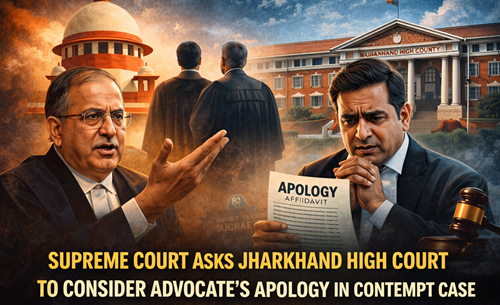
Supreme Court Asks Jharkhand High Court to Sympathetically Consider Advocate’s Apology in Contempt Case
In a notable intervention concerning judicial conduct and courtroom decorum, the Supreme Court of India on Friday asked the Jharkhand High Court to sympathetically consider an unconditional apology tendered by a practising lawyer in relation to suo-motu criminal contempt proceedings initiated against him by the High Court.
The matter arose from an incident captured on video last year, where advocate Mahesh Tiwari, practising before the Jharkhand High Court, was seen engaged in a heated exchange with a sitting judge during court proceedings.
Background of the Case
The contempt proceedings were triggered after clips from the courtroom interaction — in which the advocate reportedly told the judge “Don’t cross the limit” — went viral on social media. The Jharkhand High Court took cognisance suo motu and issued criminal contempt notice against Tiwari in October 2025, with a five-judge bench comprising Chief Justice Tarlok Singh Chauhan and Justices Sujit Narayan Prasad, Rongon Mukhopadhyay, Ananda Sen, and Rajesh Shankar initiating contempt action.
During the Supreme Court hearing, the bench — led by Chief Justice of India Surya Kant and Justice Joymalya Bagchi — considered a petition filed by the advocate challenging the contempt proceedings, and his counsel’s assertion that he did not intend disrespect nor to obstruct judicial proceedings.
Supreme Court’s Direction
The Supreme Court disposed of the petition, granting the lawyer liberty to file an affidavit of unconditional apology before the Jharkhand High Court. The Bench explicitly requested the High Court to consider the apology “sympathetically” and pass an appropriate order in the contempt matter.
Chief Justice Surya Kant observed that:
“If the petitioner feels he has done nothing wrong, then he should have the courage to contest before the High Court judges; but if he thinks he was wrong, he should apologise.”
Justice Bagchi also noted that professional frictions at different levels of the judiciary sometimes arise, but these should not erode respect for judicial decorum.
Senior Advocate Siddharth Dave, appearing for Tiwari, submitted that the lawyer was “extremely repentant” and willing to tender a full apology. Dave also highlighted broader concerns about how viral court video clips circulating on social media can distort context and impact both judicial proceedings and careers.
High Court Perspective and Next Steps
The contempt action was originally taken suo motu by the Jharkhand High Court after the video of Tiwari’s courtroom conduct was widely shared online, raising questions about courtroom behaviour and respect for judicial authority.
Now, with the Supreme Court’s direction, the High Court will have to consider whether to accept the apology and how that affects the continuation or disposal of the contempt proceedings. The matter will also test how higher judiciaries balance judicial discipline with opportunities for remedial conduct by legal practitioners.
Broader Context: Contempt in Indian Judiciary
Contempt of court in India can be initiated when conduct is seen as undermining the authority or dignity of the judiciary. Courts have sometimes accepted apologies instead of imposing penalties — as happened when a High Court rescinded contempt proceedings after an apology in another case — but such determinations depend on context, intent, and harm to judicial integrity.
The Supreme Court’s handling of this case underscores its role in moderating and guiding contempt actions, particularly when viral clips and social media amplification amplify isolated courtroom moments.
सुप्रीम कोर्ट ने झारखंड हाईकोर्ट से वकील के माफ़ी पत्र पर सहानुभूतिपूर्वक विचार करने का अनुरोध किया
नई दिल्ली / रांची | 24 जनवरी 2026 — न्याय के प्रति सम्मान और न्यायपालिका की गरिमा से जुड़े एक विवाद में सुप्रीम कोर्ट ऑफ इंडिया ने शुक्रवार को झारखंड हाईकोर्ट से अनुरोध किया कि वह एक अधिवक्ता द्वारा प्रस्तुत बिना शर्त माफ़ी पत्र पर सहानुभूति के साथ विचार करे। यह मामला उस सुओ मोटु आपराधिक अवमानना से जुड़ा है, जिसे हाईकोर्ट ने स्वयं संज्ञान में लिया था।
इस मामले में वकील महेश तिवारी ने सुप्रीम कोर्ट में याचिका दायर की थी, जिसमें उन्होंने हाईकोर्ट के निर्णय के खिलाफ खिलाफ़ अवमानना कार्रवाई को चुनौती दी थी। याचिका के दौरान उनके वकील ने कहा कि तिवारी का कोई भी इरादा किसी न्यायाधीश का अपमान करने या न्यायिक कार्य में बाधा डालने का नहीं था।
मामले का पृष्ठभूमि
यह विवाद अक्टूबर 2025 में तब शुरू हुआ जब झारखंड हाईकोर्ट की एक सुनवाई के दौरान महेश तिवारी और एक न्यायाधीश के बीच तीव्र वाक्-विनिमय का एक वीडियो क्लिप वायरल हुआ। उस वीडियो में तिवारी ने कथित रूप से न्यायाधीश से कहा था, “डोंट क्रॉस द लिमिट (सीमा पार मत करो)” — जिस पर हाईकोर्ट ने सुओ मोटु अवमानना की कार्रवाई शुरु कर दी थी।
उस समय झारखंड हाईकोर्ट के पाँच न्यायाधीशों के बेंच ने स्वयं संज्ञान लिया था और तिवारी के खिलाफ आपराधिक अवमानना का नोटिस जारी किया था।
सुप्रीम कोर्ट का निर्देश
सुप्रीम कोर्ट की बेंच, जिसका नेतृत्व मुख्य न्यायाधीश सूर्यकांत और न्यायाधीश जॉयमाल्य बागची ने किया, ने याचिका खारिज करते हुए तिवारी को बिना शर्त माफ़ी पत्र दाखिल करने की अनुमति दी। कोर्ट ने हाईकोर्ट से कहा कि वह इस माफ़ी पत्र पर सहानुभूति के साथ विचार करे।
मुख्य न्यायाधीश ने कहा कि यदि तिवारी को लगता है कि उसने कुछ गलत नहीं किया, तो उसे हाईकोर्ट में उस पर बहस करनी चाहिए; लेकिन अगर वह गलत महसूस करता है, तो उसे माफ़ी मांगनी चाहिए।
न्यायाधीश बागची ने यह भी कहा कि न्यायपालिका में प्रोफेशनल बहस और भिन्नता हो सकती है, पर न्यायिक सम्मान बनाए रखना आवश्यक है।
प्रतिनिधि वकील की दलीलें
वरिष्ठ अधिवक्ता सिद्धार्थ डेव ने कोर्ट को बताया कि महेश तिवारी “गहरा पश्चाताप” महसूस कर रहे हैं और बिना शर्त माफ़ी देने के लिए तैयार हैं। डेव ने यह भी कहा कि सोशल मीडिया पर वायरल कोर्ट वीडियो अकसर संदर्भ से बाहर होते हैं और वकीलों के करियर को प्रभावित कर सकते हैं।
क्या अब होगा?
अब झारखंड हाईकोर्ट को यह निर्णय लेना होगा कि क्या वह तिवारी की माफ़ी को स्वीकार करेगी और उसके आधार पर अवमानना मामले को समाप्त या बदलेगी। सुप्रीम कोर्ट के निर्देश यह दर्शाते हैं कि न्यायपालिका की गरिमा बनाए रखते हुए भी पुनर्विचार और सुधार के अवसर संभव हैं।
भारत में अवमानना कानून का संदर्भ
भारत में अवमानना की कार्रवाई तब शुरू की जाती है जब किसी व्यवहार को न्यायपालिका की प्रतिष्ठा या अधिकार पर अप्रिय प्रभाव डालने वाला माना जाता है। न्यायालयों ने कई बार माफ़ी स्वीकार कर मामलों को समाप्त भी किया है, पर ऐसा हर मामले में नहीं होता — स्थिति, इरादे और न्यायपालिका की गरिमा पर निर्भर करता है।