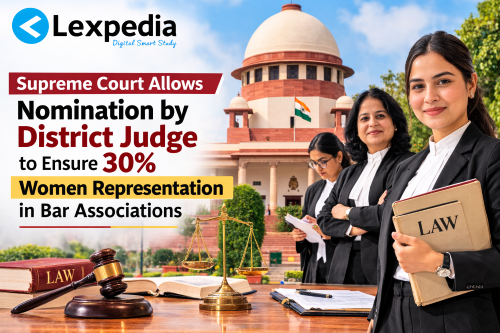
SC allows District Judges to nominate women lawyers to Bar Association executive committees to ensure 30% representation
Lexpedia News · 14 March 2026 · 4 min read
The direction was issued by a Bench comprising Chief Justice Surya Kant and Justice Joymalya Bagchi while reviewing compliance with the Court’s earlier orders mandating gender representation in Bar bodies.
Power given to District Judges
The Court clarified that District Judges may exercise this power where sufficient women advocates are available in a jurisdiction but they were unable to contest elections for the Bar Association’s executive committee.
In such situations, the District Judge may nominate eligible women advocates directly to the Executive Committee or Governing Body of the concerned Bar Association so that the mandatory 30% representation requirement is fulfilled.
The Court further directed that compliance reports should be sent to the Registrar General of the respective High Courts, who will compile the data and submit it before the Supreme Court.
Background of the case
The order forms part of the Supreme Court’s continuing effort to ensure greater representation of women in legal institutions and professional bodies.
Earlier, the Court had directed that 30% of posts in Bar Councils and Bar Association executive bodies be reserved for women advocates. In some instances, the Court also allowed co-option or nomination of women members when the election process could not ensure the required representation.
During the hearing, Senior Advocate Jayna Kothari pointed out that while some High Courts had submitted detailed compliance reports regarding women’s representation in Bar bodies, others had filed incomplete reports and several Bar Associations had still not met the 30% representation requirement.
Court’s objective
The Supreme Court emphasised that the objective behind these directions is to strengthen gender diversity and inclusivity within the legal profession, especially in leadership positions within Bar Associations.
Bar Associations play a crucial role in the functioning of the judicial system as they represent advocates, participate in professional governance and influence institutional policies within courts.
Ensuring adequate representation of women lawyers in such bodies is therefore considered an important step toward gender equality in the legal profession.
Significance of the decision
Legal experts believe the ruling will help address the persistent under-representation of women advocates in decision-making bodies of Bar Associations, even though the number of women entering the legal profession has steadily increased.
The Court’s direction also ensures that administrative obstacles or election-related issues do not prevent women from obtaining representation in professional legal bodies.
सुप्रीम कोर्ट ने जिला न्यायाधीशों को बार एसोसिएशन की कार्यकारिणी में महिला सदस्यों को नामित करने का अधिकार दिया
Supreme Court of India ने देशभर के District Judges को यह अधिकार दिया है कि वे अपने अधिकार क्षेत्र के Bar Associations की Executive Committees या Governing Bodies में महिलाओं को नामित कर सकें, ताकि इन संस्थाओं में कम से कम 30% महिला प्रतिनिधित्व सुनिश्चित किया जा सके।
यह आदेश Chief Justice Surya Kant और Justice Joymalya Bagchi की पीठ ने पारित किया। अदालत पूर्व में दिए गए आदेशों के अनुपालन की समीक्षा कर रही थी, जिनमें बार संस्थाओं में महिलाओं की भागीदारी बढ़ाने की आवश्यकता पर जोर दिया गया था।
जिला न्यायाधीशों को दी गई शक्ति
अदालत ने स्पष्ट किया कि यदि किसी क्षेत्र में पर्याप्त महिला वकील मौजूद हैं लेकिन किसी कारण से वे बार एसोसिएशन की कार्यकारिणी के चुनाव में भाग नहीं ले पाईं, तो जिला न्यायाधीश उन्हें सीधे Executive Committee में नामित कर सकते हैं।
इसका उद्देश्य यह सुनिश्चित करना है कि बार एसोसिएशन की कार्यकारिणी में 30% महिलाओं का प्रतिनिधित्व अनिवार्य रूप से पूरा हो सके।
अदालत ने यह भी निर्देश दिया कि जिला न्यायाधीश द्वारा की गई ऐसी नियुक्तियों की अनुपालन रिपोर्ट संबंधित उच्च न्यायालय के Registrar General को भेजी जाएगी, जो बाद में उसे संकलित करके सुप्रीम कोर्ट को भेजेंगे।
मामले की पृष्ठभूमि
यह आदेश सुप्रीम कोर्ट द्वारा कानूनी संस्थाओं में महिलाओं की भागीदारी बढ़ाने के लिए किए जा रहे व्यापक प्रयासों का हिस्सा है।
इससे पहले भी अदालत ने निर्देश दिया था कि बार काउंसिल और बार एसोसिएशन की कार्यकारिणी में कम से कम 30% पद महिलाओं के लिए आरक्षित हों। यदि चुनाव के माध्यम से यह प्रतिनिधित्व सुनिश्चित न हो सके, तो co-option या nomination के माध्यम से इसे पूरा किया जा सकता है।
सुनवाई के दौरान Senior Advocate Jayna Kothari ने अदालत को बताया कि कई उच्च न्यायालयों ने इस आदेश के पालन पर विस्तृत रिपोर्ट दी है, लेकिन कुछ स्थानों पर रिपोर्ट अधूरी है और कई बार एसोसिएशनों में अभी भी 30% महिला प्रतिनिधित्व का लक्ष्य पूरा नहीं हुआ है।
निर्णय का महत्व
सुप्रीम कोर्ट का यह आदेश कानूनी पेशे में लैंगिक समानता को बढ़ावा देने की दिशा में एक महत्वपूर्ण कदम माना जा रहा है।
बार एसोसिएशन न्यायिक व्यवस्था में महत्वपूर्ण भूमिका निभाते हैं, क्योंकि वे अधिवक्ताओं का प्रतिनिधित्व करते हैं और न्यायालयों की प्रशासनिक और पेशेवर गतिविधियों में सक्रिय भागीदारी रखते हैं।
इसलिए इन संस्थाओं की कार्यकारिणी में महिलाओं की पर्याप्त भागीदारी सुनिश्चित करना कानूनी क्षेत्र में समान अवसर और नेतृत्व की दिशा में महत्वपूर्ण कदम माना जा रहा है।