CJI Surya Kant At Russia Legal Forum: Equality Is The Foundation Of Law, Not The Rule Of The Powerful
Lexpedia News · 26 June 2026 · 6 min read
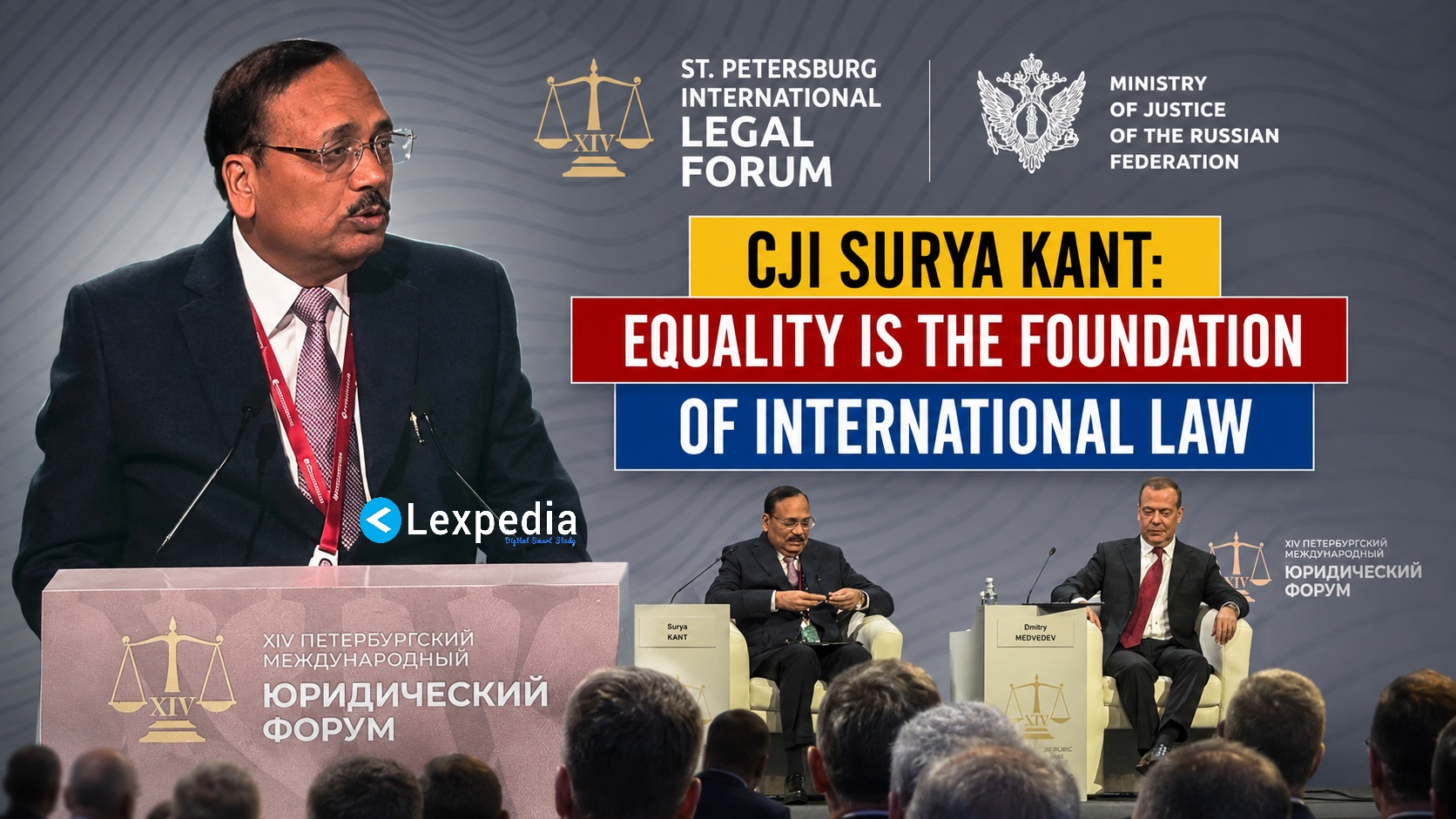
St. Petersburg (Russia) | Emphasising that equality forms the very foundation of a just legal order, Chief Justice of India (CJI) Justice Surya Kant said that "law without equality is merely the organized will of the stronger party", asserting that international law can command legitimacy only when every nation and every individual is treated equally before the law. The Chief Justice made these remarks while delivering the keynote address at the 14th St. Petersburg International Legal Forum in Russia during the plenary session titled "Equal Justice, Equal Law: Access as the Measure of International Law's Humanity."
Addressing jurists, judges and legal scholars from across the world, Justice Surya Kant said that declarations, conventions and international institutions alone cannot sustain the global legal order unless they rest upon the enduring principle of equality. Referring to the famous Bronze Horseman monument in St. Petersburg, he observed that just as every monument requires a strong foundation, international law also requires a foundation worthy of carrying the ideals of justice, and that foundation is equality.
The Chief Justice remarked that "equal justice and equal law are not ceremonial phrases. They are the conditions under which a legal order may credibly call itself law at all." He cautioned that where equality is absent, legal systems risk becoming instruments of power rather than instruments of justice.
Drawing upon India's rich legal heritage, Justice Surya Kant expressed his personal view that the idea of equality did not originate with the Magna Carta of 1215, as is often believed. Instead, he said its philosophical roots could be traced much earlier to Kautilya's Arthashastra, composed in the 4th century BCE, which recognised that a ruler who failed to remain subject to dharma and the rule of law ceased to possess the moral authority to govern.
The Chief Justice also referred to other ancient legal traditions, including Roman law, Islamic legal thought, and the African philosophy of Ubuntu, observing that different civilizations had long recognised equality before law as a universal civilisational value rather than a privilege conferred by powerful States.
Speaking about India's constitutional journey, Justice Surya Kant noted that the Constitution of India guarantees equality before law, equal protection of laws, and the right to live with dignity. However, he said the true challenge lies not merely in recognising these rights but in ensuring that they are effectively available to every citizen irrespective of geography, language, economic condition or social status.
The Chief Justice stated that equal access to law is the first step towards achieving meaningful equality, adding that access to justice cannot remain a procedural formality but must culminate in the actual enjoyment of legal rights. According to him, constitutional guarantees become meaningful only when courts remove barriers created by poverty, social disadvantage, linguistic diversity and geographical distance.
Turning to the international legal framework, Justice Surya Kant observed that many countries of the Global South and Global East continue to grapple with the historical consequences of colonialism, institution-building and widespread poverty. He cautioned that such nations are often subjected to greater scrutiny and pressure than wealthier and more influential States whose own compliance with international obligations may also be open to question.
He stressed that principles such as jus cogens, erga omnes, and pacta sunt servanda must continue to function as safeguards against arbitrary exercise of international power, ensuring that the rule of law prevails equally for all nations irrespective of their political or economic influence.
Concluding his address, Chief Justice Surya Kant called upon judges, jurists and legal institutions across jurisdictions to preserve equality as the cornerstone of international legality. He said the credibility of the global legal order would ultimately depend not upon the number of treaties or declarations adopted, but upon the consistent and equal application of law across nations and peoples.
'समानता के बिना कानून केवल शक्तिशाली की संगठित इच्छा बनकर रह जाता है': रूस में अंतरराष्ट्रीय विधि मंच पर बोले CJI न्यायमूर्ति सूर्यकांत
सेंट पीटर्सबर्ग (रूस) | भारत के मुख्य न्यायाधीश (CJI) न्यायमूर्ति सूर्यकांत ने कहा है कि "समानता के बिना कानून केवल शक्तिशाली पक्ष की संगठित इच्छा बनकर रह जाता है।" उन्होंने कहा कि अंतरराष्ट्रीय कानून तभी विश्वसनीय और न्यायसंगत माना जा सकता है जब प्रत्येक राष्ट्र और प्रत्येक व्यक्ति के साथ कानून के समक्ष समान व्यवहार किया जाए। उन्होंने यह टिप्पणी रूस में आयोजित 14वें सेंट पीटर्सबर्ग इंटरनेशनल लीगल फोरम के पूर्ण अधिवेशन "Equal Justice, Equal Law: Access as the Measure of International Law's Humanity" को संबोधित करते हुए की।
विश्वभर से आए न्यायाधीशों, विधि विशेषज्ञों और विद्वानों को संबोधित करते हुए न्यायमूर्ति सूर्यकांत ने कहा कि केवल घोषणाएं, अंतरराष्ट्रीय संधियां और संस्थागत ढांचे वैश्विक विधिक व्यवस्था को टिकाऊ नहीं बना सकते, जब तक उनका आधार समानता न हो। उन्होंने सेंट पीटर्सबर्ग के प्रसिद्ध ब्रॉन्ज हॉर्समैन स्मारक का उल्लेख करते हुए कहा कि जिस प्रकार प्रत्येक स्मारक को मजबूत आधार की आवश्यकता होती है, उसी प्रकार अंतरराष्ट्रीय कानून की वास्तविक नींव समानता है।
उन्होंने कहा कि "समान न्याय और समान कानून केवल औपचारिक शब्द नहीं हैं, बल्कि वही आधार हैं जिनके कारण कोई विधिक व्यवस्था वास्तव में कानून कहलाने योग्य बनती है।" उनके अनुसार यदि समानता अनुपस्थित हो जाए तो कानून न्याय का साधन न रहकर शक्ति का उपकरण बन जाता है।
भारत की प्राचीन विधिक परंपरा का उल्लेख करते हुए न्यायमूर्ति सूर्यकांत ने अपना व्यक्तिगत मत व्यक्त किया कि 1215 की मैग्ना कार्टा से भी कई शताब्दियों पूर्व कौटिल्य के अर्थशास्त्र में समानता की अवधारणा विकसित हो चुकी थी। उन्होंने कहा कि अर्थशास्त्र में यह स्पष्ट किया गया था कि जो शासक स्वयं धर्म और कानून के अधीन नहीं रहता, वह शासन करने का नैतिक अधिकार खो देता है।
उन्होंने रोमन विधि, इस्लामी विधि परंपरा तथा अफ्रीकी दर्शन Ubuntu का भी उल्लेख करते हुए कहा कि विभिन्न सभ्यताओं ने समानता को सदियों से विधिक व्यवस्था का मूल सिद्धांत माना है, न कि किसी शक्तिशाली राष्ट्र द्वारा प्रदान किया जाने वाला विशेषाधिकार।
भारत के संविधान का उल्लेख करते हुए मुख्य न्यायाधीश ने कहा कि संविधान प्रत्येक नागरिक को कानून के समक्ष समानता, कानूनों के समान संरक्षण तथा गरिमापूर्ण जीवन का अधिकार प्रदान करता है। उन्होंने कहा कि वास्तविक चुनौती इन अधिकारों की घोषणा करना नहीं, बल्कि उन्हें देश के प्रत्येक नागरिक तक प्रभावी रूप से पहुंचाना है, चाहे वह किसी भी क्षेत्र, भाषा, आर्थिक स्थिति या सामाजिक पृष्ठभूमि से संबंधित हो।
उन्होंने कहा कि कानून तक समान पहुंच ही वास्तविक समानता की पहली सीढ़ी है। न्याय तक पहुंच केवल प्रक्रियात्मक औपचारिकता नहीं होनी चाहिए, बल्कि नागरिकों को वास्तविक अधिकार प्राप्त होने चाहिए। उनके अनुसार न्यायपालिका का दायित्व सामाजिक, आर्थिक, भाषाई और भौगोलिक बाधाओं को दूर कर संवैधानिक अधिकारों को व्यवहारिक रूप से प्रभावी बनाना है।
अंतरराष्ट्रीय विधिक व्यवस्था का उल्लेख करते हुए न्यायमूर्ति सूर्यकांत ने कहा कि ग्लोबल साउथ और ग्लोबल ईस्ट के अनेक देश आज भी उपनिवेशवाद की विरासत, संस्थागत विकास तथा व्यापक गरीबी जैसी चुनौतियों से जूझ रहे हैं। उन्होंने कहा कि ऐसे देशों पर अक्सर अपेक्षाकृत अधिक दबाव और निगरानी रहती है, जबकि अधिक समृद्ध देशों के अनुपालन रिकॉर्ड भी हमेशा त्रुटिरहित नहीं होते।
उन्होंने कहा कि jus cogens, erga omnes तथा pacta sunt servanda जैसे अंतरराष्ट्रीय विधिक सिद्धांतों को किसी भी परिस्थिति में कमजोर नहीं किया जाना चाहिए, क्योंकि यही सिद्धांत वैश्विक विधिक व्यवस्था को निष्पक्ष बनाए रखते हैं।
अपने संबोधन के अंत में मुख्य न्यायाधीश सूर्यकांत ने विश्वभर के न्यायाधीशों, विधि विशेषज्ञों और न्यायिक संस्थानों से समानता को अंतरराष्ट्रीय कानून की आधारशिला बनाए रखने का आह्वान किया। उन्होंने कहा कि वैश्विक विधिक व्यवस्था की वास्तविक विश्वसनीयता इस बात से तय होगी कि कानून का समान रूप से पालन और अनुप्रयोग प्रत्येक राष्ट्र तथा प्रत्येक व्यक्ति के लिए सुनिश्चित किया जाता है।