
XXXXX v. XXXXX, 2026
False Birth Date, Wrong Horoscope Match: Marriage Dissolved
Judgement Details
Court
Telangana High Court
Date of Decision
10 June 2026
Judges
Justice K. Lakshman & Justice B.R. Madhusudhan Rao
Citation
Acts / Provisions
Facts of the Case
-
The parties were introduced through the online matrimonial platform "telugumatrimony.com".
-
The marriage was solemnised on 24 August 2018.
-
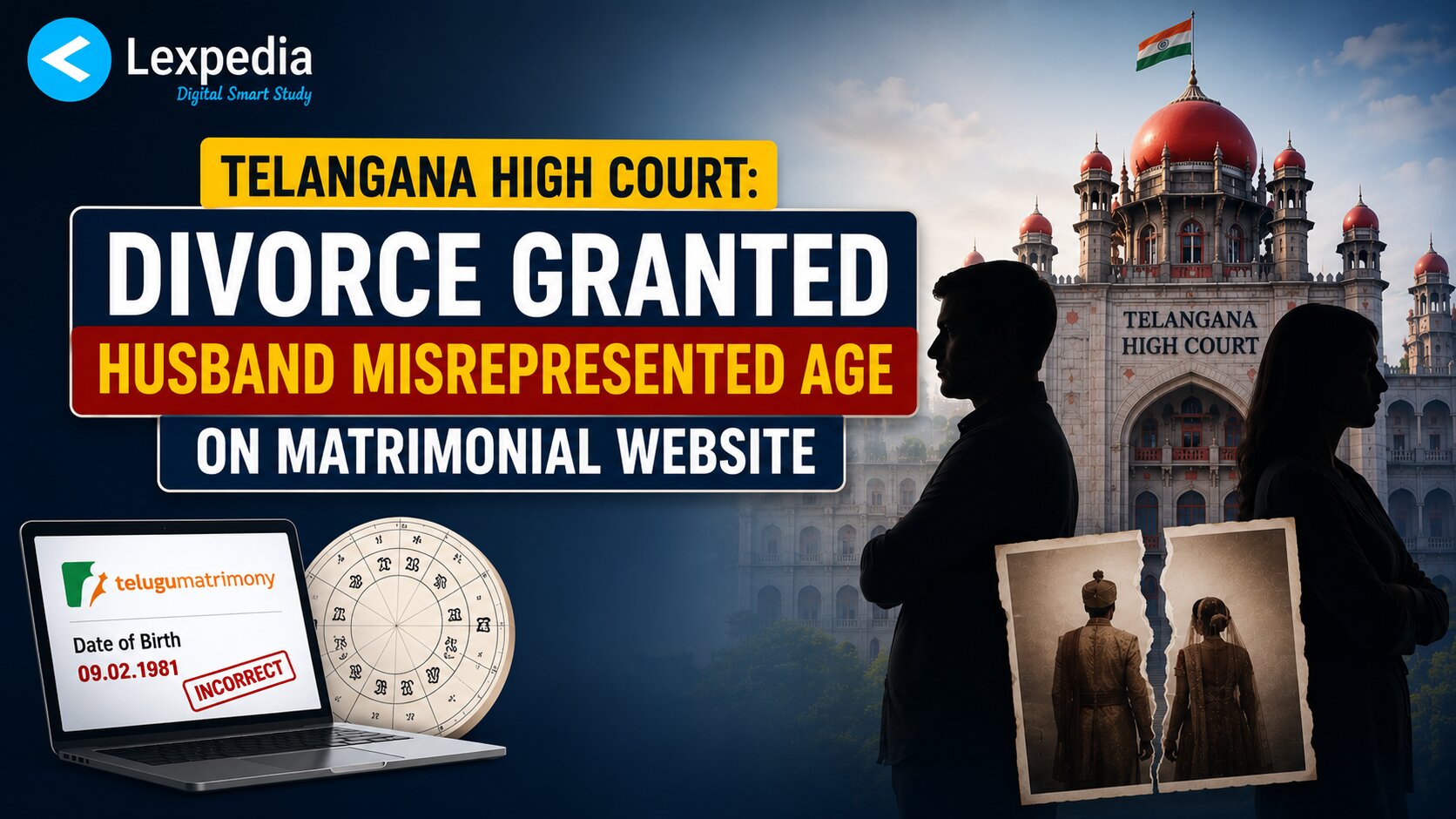
The wife alleged that the husband represented his date of birth as 09.02.1981 on the matrimonial website.
-
According to the wife, the husband's actual date of birth was 09.02.1974, making him substantially older than represented.
-
The wife belonged to an orthodox family that strongly believed in horoscope matching before marriage.
-
Based on the incorrect date of birth provided by the husband, the families conducted horoscope verification and found the horoscopes compatible.
-
The wife agreed to the marriage believing that:
-
Both parties belonged to the same age group.
-
Both were Government servants.
-
Their horoscopes were compatible.
-
-
The wife discovered the husband's actual date of birth only during marriage registration proceedings in November 2018 before the Sub-Registrar.
-
She alleged that the husband had played fraud and cheated her by concealing his true age.
-
Criminal proceedings and proceedings under the Domestic Violence Act were pending between the parties.
-
The wife expressed willingness to withdraw the criminal and domestic violence cases upon receiving a fair settlement amount and return of her gold ornaments.
-
The husband disputed the wife's claims and asserted that she was already in possession of seven tulas of gold belonging to him.
-
The Family Court, Rangareddy, dismissed the wife's petition seeking annulment of marriage on the ground of fraud.
-
Aggrieved by the dismissal, the wife filed the present appeal before the Telangana High Court.
Issues
-
Whether the husband's misrepresentation of his date of birth on the matrimonial website amounted to fraud under Section 12(1)(c) of the Hindu Marriage Act, 1955?
-
Whether the wife's consent to the marriage was obtained under a mistaken belief created by the husband's false representation regarding his age and horoscope compatibility?
-
Whether incorrect horoscope matching based on a falsely disclosed date of birth constituted a material circumstance affecting the validity of the marriage?
-
Whether the Family Court erred in dismissing the wife's petition seeking matrimonial relief on the ground of fraud?
-
Whether the absence of any possibility of reunion between the parties justified dissolution of the marriage?
-
Whether claims relating to settlement amount and return of gold ornaments could be adjudicated in the present appeal despite involving disputed questions of fact?
-
Whether permanent alimony can be granted without filing a separate application under Section 25 of the Hindu Marriage Act, 1955?
Judgement
-
The Telangana High Court allowed the appeal filed by the wife.
-
The Court observed that the husband had furnished an incorrect date of birth on the matrimonial portal.
-
The Bench noted that the horoscope matching was conducted on the basis of incorrect particulars supplied by the husband.
-
The Court found that the parties were no longer interested in continuing the marital relationship.
-
It observed that there was no possibility of reunion between the husband and wife.
-
The Court held that disputes relating to settlement amount and gold ornaments involved disputed questions of fact and therefore could not be decided in the present appeal.
-
The Bench clarified that claims for permanent alimony require a separate application under Section 25 of the Hindu Marriage Act.
-
The Court rejected the contention that permanent alimony could be granted without such an application.
-
The order of the Family Court, Rangareddy dated 03.05.2024 was set aside.
-
The marriage between the parties was dissolved by granting a decree of divorce.
-
Liberty was granted to the wife to pursue remedies regarding gold ornaments and permanent alimony before the appropriate forum.
Held
-
The appeal filed by the wife was allowed.
-
The Family Court's order dismissing the petition was set aside.
-
The marriage between the parties was dissolved by a decree of divorce.
-
Claims relating to gold ornaments and settlement amount were left open to be decided in appropriate proceedings.
-
The wife was granted liberty to pursue remedies regarding permanent alimony and return of gold before the competent forum.
-
The Court clarified that permanent alimony cannot be granted without a separate application under Section 25 HMA.
Analysis
-
The judgment underscores the importance of truthful disclosure on matrimonial platforms, where parties rely heavily on the information furnished by prospective spouses.
-
The Court implicitly recognized that a false representation regarding age can become a material fact when it influences matrimonial consent.
-
The decision acknowledges the social reality that in many arranged marriages, factors such as age compatibility and horoscope matching are significant considerations.
-
The Court treated the dispute pragmatically by focusing on the complete breakdown of the marital relationship and the absence of any possibility of reconciliation.
-
The ruling reflects a modern judicial approach that seeks to avoid prolonging marriages that have become irretrievably strained in practical terms.
-
By refusing to decide issues relating to gold ornaments and settlement amount, the Court reaffirmed the principle that disputed factual issues require proper pleadings and evidence.
-
The judgment provides important clarification regarding Section 25 HMA, emphasizing that permanent alimony is not automatic and requires a separate statutory application.
-
The decision serves as a caution to users of online matrimonial websites that misrepresentation of material facts may have serious legal consequences.
-
The judgment strengthens the principles of free consent, good faith, and transparency in matrimonial alliances.
-
It contributes to the growing jurisprudence concerning disputes arising from digital matchmaking platforms and online matrimonial services.