
Sumann Mundhara v. State of Rajasthan & Ors., 2026
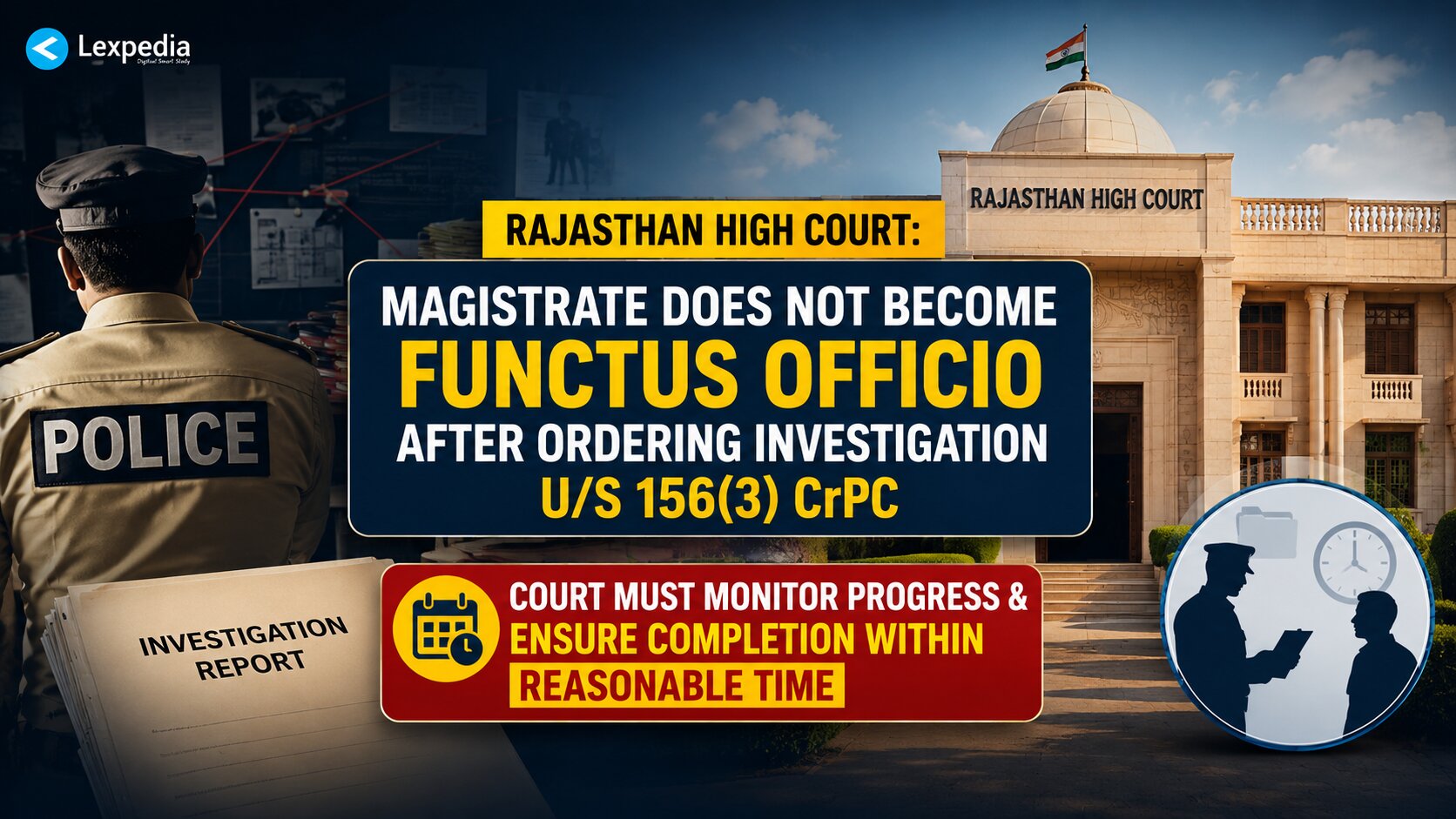
Magistrate does not become functus officio after passing an order under Section 156(3) CrPC.
Judgement Details
Court
Rajasthan High Court
Date of Decision
5 June 2026
Judges
Justice Rekha Borana
Citation
Acts / Provisions
Facts of the Case
-
The petitioner approached the Criminal Court seeking an order for investigation into the allegations raised in the complaint.
-
In April 2025, the Trial Court directed the concerned Circle Officer to conduct an investigation under Section 156(3) CrPC and submit a conclusive report by May 2025.
-
Despite the specific judicial direction, the investigating agency failed to submit any conclusive investigation report, charge-sheet, or final report within the prescribed time.
-
More than one year elapsed after the Trial Court's order, yet no report was filed.
-
The proceedings before the Trial Court continued with repeated adjournments and routine calls for status/progress reports, without effective compliance by the investigating agency.
-
Aggrieved by the prolonged delay and non-compliance of the Trial Court's order, the petitioner filed the present writ petition before the Rajasthan High Court.
-
The petitioner sought directions to ensure completion of the investigation within a reasonable time.
-
The High Court observed that numerous similar petitions are filed because investigating agencies fail to comply with directions issued under Section 156(3) CrPC.
Issues
-
Whether a Criminal Court becomes functus officio after directing investigation under Section 156(3) CrPC?
-
Whether a Magistrate or Criminal Court has a continuing obligation to supervise and monitor an investigation ordered under Section 156(3) CrPC?
-
Whether the Criminal Court is required to call for progress reports when the investigation is not completed within a reasonable time?
-
Whether prolonged delay by the investigating agency in complying with a direction issued under Section 156(3) CrPC affects the rights of the complainant and the accused?
-
Whether the Trial Court can pass appropriate orders against erring investigating officers who fail to comply with judicial directions regarding investigation?
Judgement
-
The Rajasthan High Court held that a Criminal Court does not become functus officio merely because it has passed an order directing investigation under Section 156(3) CrPC.
-
The Court observed that Magistrates should not mechanically adjourn matters while repeatedly recording that a progress report is awaited.
-
It was emphasized that the Criminal Court retains supervisory jurisdiction over the investigation ordered by it.
-
The Court noted that several writ petitions reach the High Court solely due to non-compliance of orders passed under Section 156(3) CrPC.
-
Reliance was placed on Robert Lalchungnunga Chongthu alias R.L. Chongthu v. State of Bihar, wherein the Supreme Court emphasized that investigations should be completed within a reasonable time, even though no strict timeline is prescribed under the CrPC.
-
The High Court reiterated that where there is an inordinate delay in investigation, courts must seek an explanation from the investigating agency.
-
The Court held that the Magistrate is duty-bound to call for progress reports whenever the investigation is unnecessarily delayed.
-
It was observed that prolonged investigations adversely affect both the victim/complainant and the accused.
-
The Trial Court was directed to ensure that a conclusive investigation report, charge-sheet, or final report is filed within six weeks.
Held
-
A Magistrate does not become functus officio after passing an order under Section 156(3) CrPC.
-
Criminal Courts have a continuing duty to supervise and monitor investigations directed by them.
-
Courts must actively call for progress reports where investigations are delayed beyond a reasonable period.
-
Investigating agencies cannot keep investigations pending indefinitely without reaching a logical conclusion.
-
The Trial Court was directed to secure filing of the conclusive report, charge-sheet, or final report within six weeks.
-
In case of non-compliance, the Trial Court may pass appropriate orders against the erring investigating officer.
-
The writ petition was disposed of accordingly.
Analysis
-
The judgment significantly strengthens judicial oversight over investigations initiated pursuant to Section 156(3) CrPC.
-
It clarifies that the role of a Magistrate extends beyond merely directing an investigation and includes ensuring effective implementation of that direction.
-
The Court adopted a rights-based approach by recognizing that delay prejudices both the complainant and the accused.
-
The decision reinforces the principle that criminal investigations must be completed within a reasonable time to uphold fairness, efficiency, and speedy justice.
-
By discouraging mechanical adjournments, the judgment seeks to reduce procedural delays in criminal courts.
-
The ruling promotes accountability of investigating agencies by empowering Trial Courts to take action against officers who fail to comply with judicial directions.
-
Reliance on the Supreme Court precedent aligns the judgment with broader constitutional principles of fair procedure and timely administration of justice.
-
The decision is likely to reduce unnecessary writ petitions filed solely for enforcement of orders passed under Section 156(3) CrPC.
-
The judgment contributes to the development of criminal procedural jurisprudence by affirming that judicial directions for investigation must be accompanied by meaningful monitoring and supervision.