
Shijosh v. State of Kerala, 2026
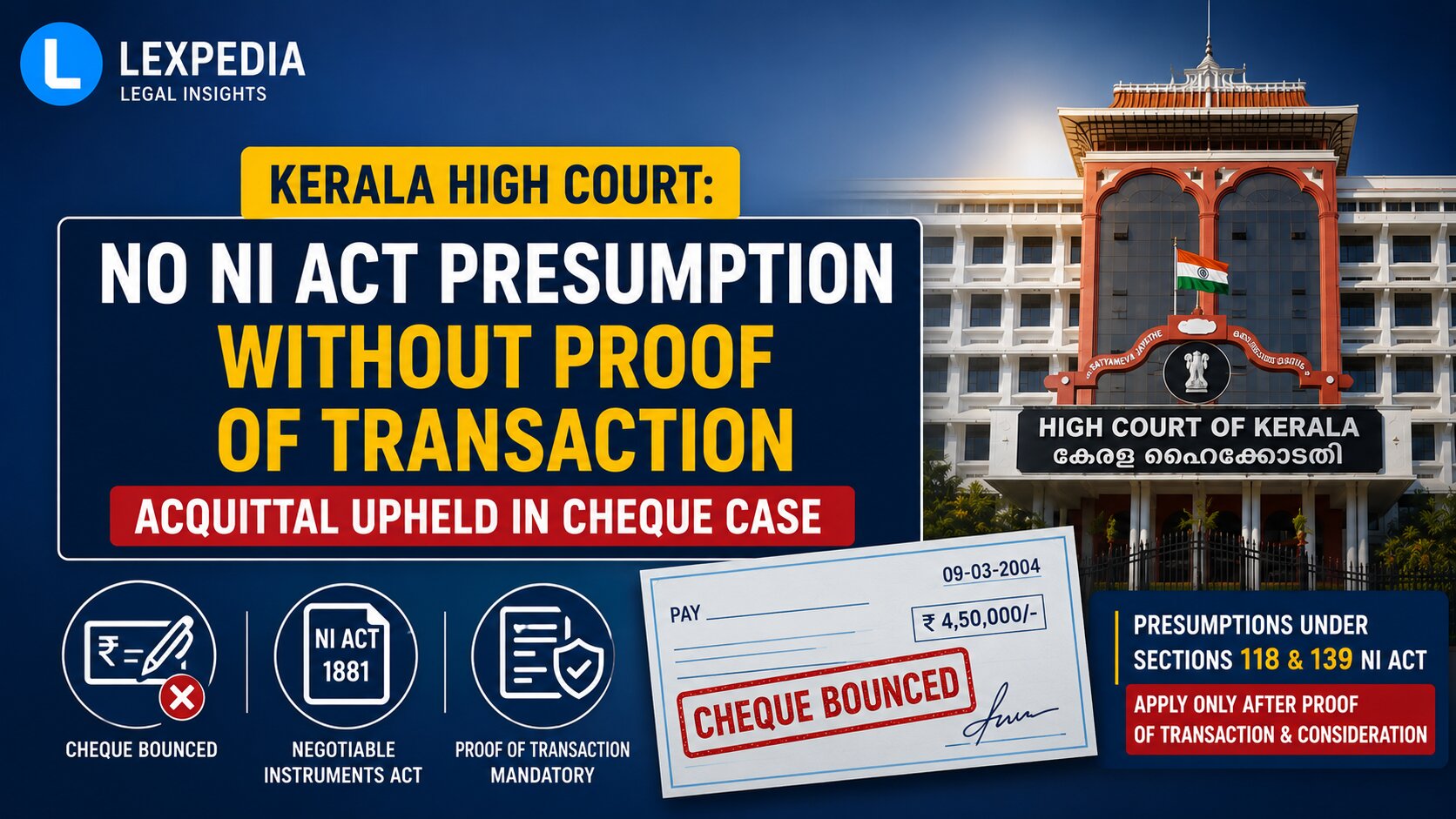
Prove Transaction First, Then Claim Presumption: Kerala HC
Judgement Details
Court
Kerala High Court
Date of Decision
9 June 2026
Judges
Justice A. Badharudeen
Citation
Acts / Provisions
Facts of the Case
-
he complainant initiated prosecution under Section 138 of the Negotiable Instruments Act after a cheque dated 09 March 2004 for ₹4,50,000 was dishonoured.
-
According to the complainant, the cheque had been issued by the accused towards repayment of money allegedly borrowed from him.
-
The Trial Court acquitted the accused after finding deficiencies in the complainant's evidence.
-
Aggrieved by the acquittal, the complainant preferred an appeal before the Kerala High Court.
-
During cross-examination, the complainant admitted that the alleged loan amount had actually been advanced by his father and not by him personally.
-
The complainant further stated that the money had been paid in five instalments by his father.
-
It was admitted that the father maintained records of the transactions in a notebook.
-
However, neither the notebook nor the father was produced before the Court as evidence.
-
The complainant also conceded that he lacked knowledge regarding several material aspects of the alleged transaction.
-
The defence contended that the complainant had failed to establish the very transaction that allegedly resulted in issuance of the cheque.
-
The complainant's counsel argued that the father did not testify because he was a police officer and was prohibited under applicable Conduct Rules from engaging in money-lending activities.
Issues
-
Whether the presumptions under Sections 118 and 139 of the Negotiable Instruments Act can be invoked without first proving the underlying transaction and execution of the cheque?
-
Whether the complainant had successfully proved the loan transaction allegedly giving rise to the cheque in question?
-
Whether evidence given by a person lacking direct knowledge of the transaction is sufficient to establish consideration and execution of the cheque?
-
Whether the complainant's failure to examine the person who allegedly advanced the money was fatal to the prosecution under Section 138 of the NI Act?
-
Whether the Trial Court was justified in acquitting the accused for failure of the complainant to discharge the initial burden of proof?
Judgement
-
The Kerala High Court upheld the acquittal of the accused.
-
The Court held that the statutory presumptions under Sections 118 and 139 of the NI Act are not automatically available to a complainant.
-
The Bench observed that the complainant must first prove the transaction and execution of the cheque in a convincing manner.
-
The Court emphasized that proof of the transaction necessarily includes proof of passing of consideration.
-
It was held that such proof should ordinarily come from a person having direct knowledge of the transaction.
-
The complainant's own evidence revealed that the money was allegedly advanced by his father.
-
Therefore, the father was the most competent witness to establish the transaction and execution of the cheque.
-
The Court noted that the father was not examined and the notebook allegedly containing records of the payments was also not produced.
-
The complainant admitted ignorance regarding several crucial aspects of the transaction.
-
Consequently, the Court found that the complainant had failed to establish the foundational facts required for invoking the statutory presumptions.
-
The Bench concluded that the complainant had miserably failed to discharge the initial burden of proof.
-
Accordingly, the appeal was dismissed and the acquittal was affirmed.
Held
-
Presumptions under Sections 118 and 139 of the NI Act arise only after the complainant proves the underlying transaction and execution of the cheque.
-
Proof of consideration is an essential component of proving the transaction.
-
Evidence must ordinarily come from a witness having direct knowledge of the transaction.
-
Failure to examine the person who actually advanced the money can be fatal to the complainant's case.
-
The complainant failed to establish foundational facts necessary to invoke statutory presumptions.
-
The acquittal of the accused was upheld.
-
The appeal was dismissed.
Analysis
-
The judgment reaffirms a fundamental principle of cheque dishonour jurisprudence that statutory presumptions do not relieve a complainant from proving foundational facts.
-
The Court clarified that Sections 118 and 139 of the NI Act operate only after the complainant establishes the existence of the transaction and execution of the cheque.
-
The decision prevents misuse of statutory presumptions by ensuring that complainants cannot rely solely on possession of a cheque without proving the underlying transaction.
-
The ruling emphasizes the evidentiary value of testimony from a witness having direct personal knowledge of the transaction.
-
By insisting on proof of consideration, the Court reinforced the distinction between proving a cheque's existence and proving the debt underlying it.
-
The judgment highlights the importance of producing the best available evidence, particularly where documentary records and key witnesses exist.
-
The Court correctly applied principles of burden of proof, ensuring that criminal liability under Section 138 is not imposed without adequate foundational evidence.
-
The ruling strengthens procedural fairness by protecting accused persons from convictions based on incomplete or hearsay evidence.
-
The decision is significant because it clarifies that statutory presumptions cannot cure deficiencies in proving the initial transaction itself.
-
The judgment serves as a caution to complainants to maintain proper records and present competent witnesses when prosecuting cheque dishonour cases.