
Sajal Parui v. State of West Bengal, 2026
Woman's Share in Ancestral Property Can Amount to Dowry Demand If Sought Under Husband's Pressure.
Judgement Details
Court
Calcutta High Court
Date of Decision
6 July 2026
Judges
Justice Arijit Banerjee and Justice Apurba Sinha Ray
Citation
Acts / Provisions
Facts of the Case
-
The case arose from the death of Chayanika, who was found hanging along with her minor daughter in her matrimonial home in June 2014.
-
The prosecution alleged that after her marriage, the deceased was subjected to continuous physical and mental cruelty by her husband and his family over demands for money.
-
According to the deceased's brother, she was repeatedly pressured to persuade him to sell the family's ancestral property and hand over her share of the sale proceeds to her husband.
-
It was alleged that the demand for her share in the ancestral property was made under persistent pressure and coercion exerted by the husband.
-
Following investigation, the husband, Sajal Parui, and his parents were charge-sheeted under Sections 498A and 304B IPC, along with other allied offences.
-
The Trial Court acquitted all the accused of the charge of murder but convicted them for cruelty and dowry death.
-
The convicted persons challenged the judgment before the Calcutta High Court.
Issues
-
Whether a demand requiring a wife to obtain and hand over her share in ancestral property can constitute a dowry demand under Section 304B IPC?
-
Whether the prosecution proved that the deceased was subjected to cruelty or harassment in connection with dowry demands soon before her death?
-
Whether sufficient evidence existed to sustain the conviction of the husband's parents under Sections 498A and 304B IPC?
-
Whether the sentence of life imprisonment imposed upon the husband required modification?
Judgement
-
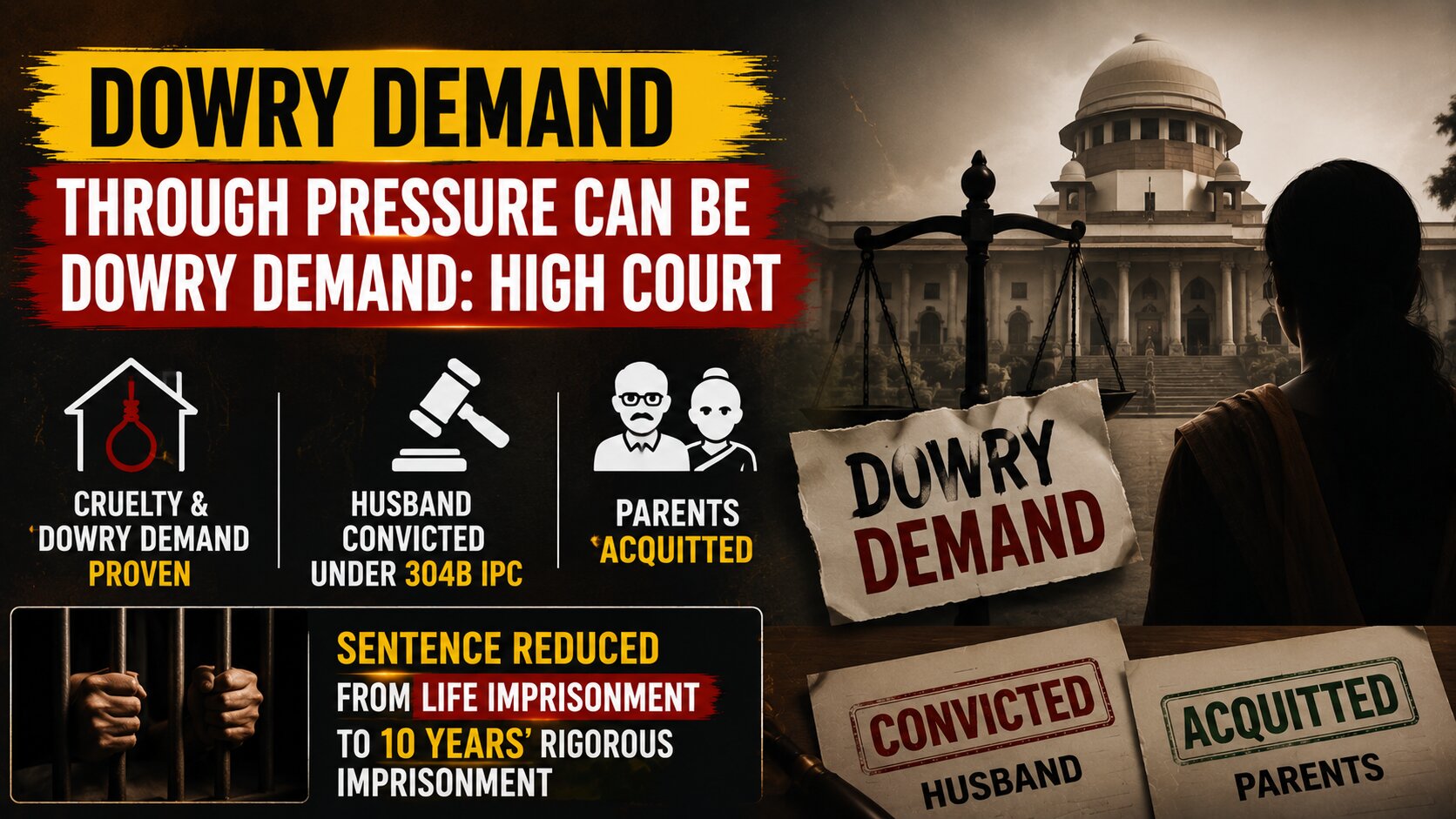
The High Court held that although a woman has a legal right to claim her share in ancestral property, such a demand may nevertheless amount to a dowry demand if it is made under the continuous pressure and coercion of the husband.
-
The Court observed that the demand made upon the deceased was not voluntary but was the result of sustained pressure exerted by her husband.
-
It held that the absence of independent witnesses to such demands was not unusual, as such demands ordinarily occur within the privacy of the matrimonial home.
-
The Court found sufficient evidence establishing that the husband had subjected the deceased to cruelty in connection with dowry demands.
-
Accordingly, the Court upheld the husband's conviction under Section 304B IPC.
-
However, the Court found that the prosecution failed to establish the involvement of the husband's parents beyond reasonable doubt.
-
In the absence of specific and reliable evidence against them, the Court acquitted the parents of all charges.
-
The Division Bench observed that life imprisonment under Section 304B IPC should ordinarily be reserved for rare cases involving exceptional circumstances.
-
Considering the facts and circumstances of the case, the Court reduced the husband's sentence from life imprisonment to ten years' rigorous imprisonment.
-
Consequently, the appeal was partly allowed, with the conviction of the husband being maintained while his sentence was modified and the parents were acquitted.
Held
-
A demand for a woman's share in ancestral property may constitute a dowry demand if made under the pressure or coercion of her husband.
-
The husband's conviction for dowry death under Section 304B IPC was upheld.
-
The conviction of the husband's parents was set aside for lack of sufficient evidence.
-
The husband's sentence was reduced from life imprisonment to ten years' rigorous imprisonment.
-
The appeal was partly allowed.
Analysis
-
The judgment adopts a substance-over-form approach by examining the purpose and circumstances behind the financial demand rather than its legal characterization.
-
The Court correctly recognized that although a woman is legally entitled to inherit ancestral property, coercing her to obtain and surrender that property for the benefit of her husband may constitute a dowry demand under Section 304B IPC.
-
The decision broadens the judicial understanding of dowry demand, emphasizing that the source of the money or property is less important than the coercive nature of the demand.
-
The Court appropriately acknowledged the practical reality that demands for dowry are rarely made in the presence of independent witnesses and often occur within the privacy of the matrimonial home.
-
By acquitting the parents, the Court reaffirmed that criminal liability cannot be imposed merely because of the familial relationship and must rest upon specific, credible, and independent evidence.
-
The reduction of the husband's sentence reflects the Court's observation that life imprisonment under Section 304B IPC should be imposed only in rare cases, thereby promoting proportionality in sentencing.
-
The judgment balances the objective of combating dowry-related violence with the necessity of individualized assessment of evidence against each accused.
-
The ruling is likely to influence future dowry death cases by clarifying that coercive demands relating to a woman's inheritance may also fall within the ambit of dowry.
-
The decision strengthens the evidentiary principle that while the offence must be proved beyond reasonable doubt, each accused's role must be independently established.
-
A notable strength of the judgment is its nuanced interpretation of dowry demand while ensuring that criminal responsibility is imposed only where supported by convincing evidence.