
Padam Mehta & Anr. v. State of Rajasthan & Ors., 2026
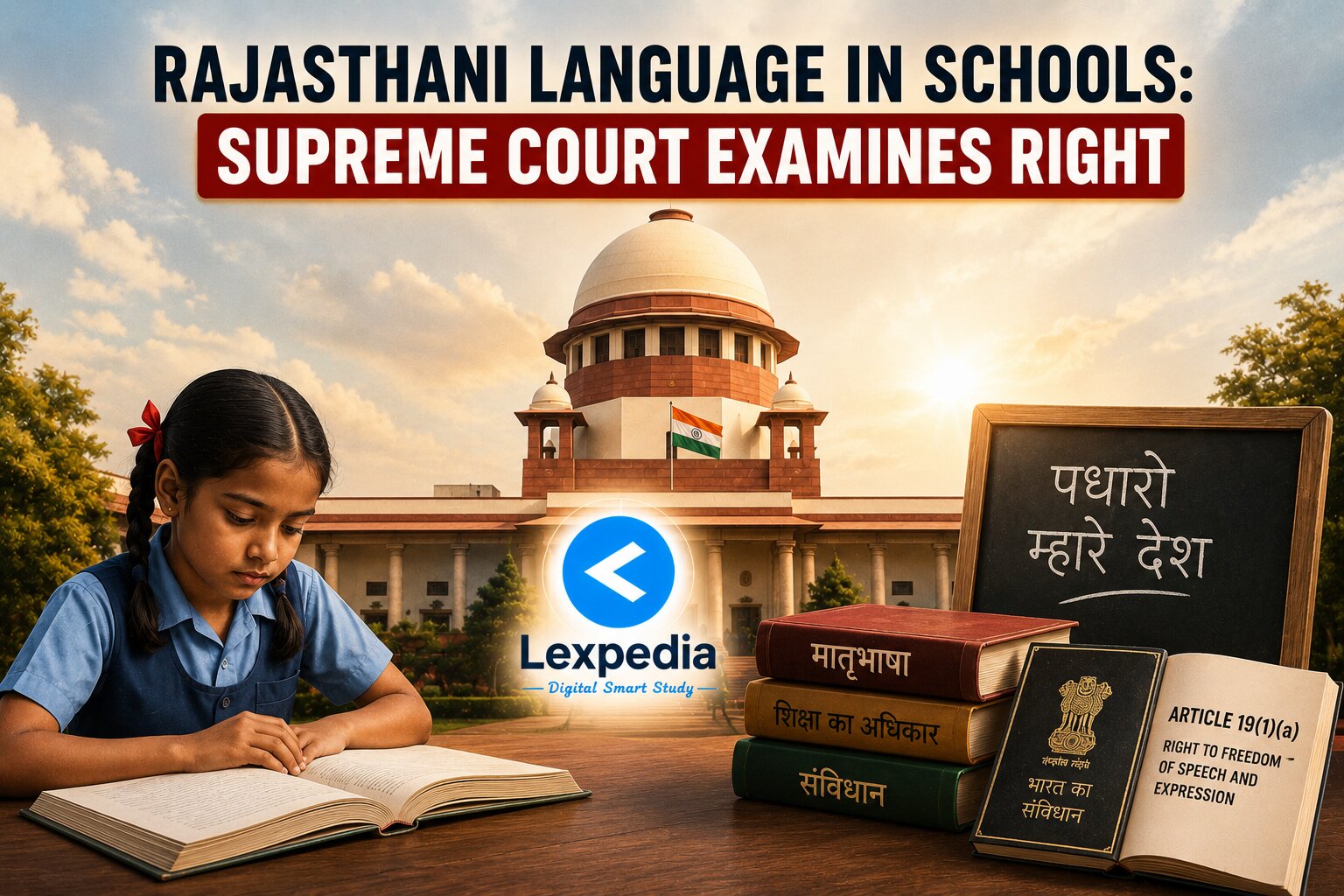
The Court expanded the scope of Article 19(1)(a) to include linguistic accessibility in education.
Judgement Details
Court
Supreme Court of India
Date of Decision
13 May 2026
Judges
Justice Vikram Nath & Justice Sandeep Mehta
Citation
Acts / Provisions
Facts of the Case
-
The petitioners challenged the lack of availability of Rajasthani language in schools across Rajasthan.
-
They sought directions for:
-
Introduction of Rajasthani as a subject in schools
-
Use of Rajasthani as a medium of instruction, especially at primary level
-
-
The State of Rajasthan was alleged to have failed to implement adequate language policy measures in education.
-
The matter raised issues regarding mother tongue education and constitutional rights of children.
-
The Supreme Court examined whether language of instruction forms part of fundamental rights under Article 19(1)(a).
Issues
-
Whether the right under Article 19(1)(a) includes the right of a child to receive education in a language of choice or mother tongue?
-
Whether the State can be directed to introduce a regional language as a subject in schools?
-
Whether denial of education in a comprehensible language violates the right to meaningful access to knowledge under Part III of the Constitution?
-
Whether State inaction in implementing language education policy violates fundamental rights of children?
Judgement
-
The Supreme Court held that the right under Article 19(1)(a) includes the right to receive information in a language that is understandable and meaningful.
-
It recognized that mother tongue education enhances comprehension, cognitive development, and effective learning.
-
The Court observed that freedom of speech and expression includes the right to receive information in an intelligible form.
-
It directed the State of Rajasthan to introduce Rajasthani as a subject in all government and private schools.
-
The Court emphasized that education must be imparted in a language best understood by the child, wherever practicable.
-
It criticized the State for inaction in implementing language-related educational policies.
-
The Court reaffirmed that fundamental rights under Part III must be interpreted dynamically to ensure meaningful access to education and knowledge.
Held
-
Petition allowed.
-
Rajasthani language must be introduced as a subject in all schools in Rajasthan.
-
Right to education in a comprehensible language is protected under Article 19(1)(a).
-
State directed to take effective steps for implementation of language instruction policy.
Analysis
-
The Court expanded the scope of Article 19(1)(a) to include linguistic accessibility in education.
-
It strengthened the principle that freedom of expression includes the right to understand information.
-
The judgment emphasizes the importance of mother tongue in early education and cognitive development.
-
It promotes regional language preservation and cultural identity within constitutional framework.
-
The Court balanced prior precedent by acknowledging choice of medium of instruction at primary level.
-
It reinforces the State’s positive obligation to ensure meaningful education access.