
Nagendra Pandey & Ors. v. State of Jharkhand & Ors., 2026
Add to any charge" includes framing an entirely new charge.
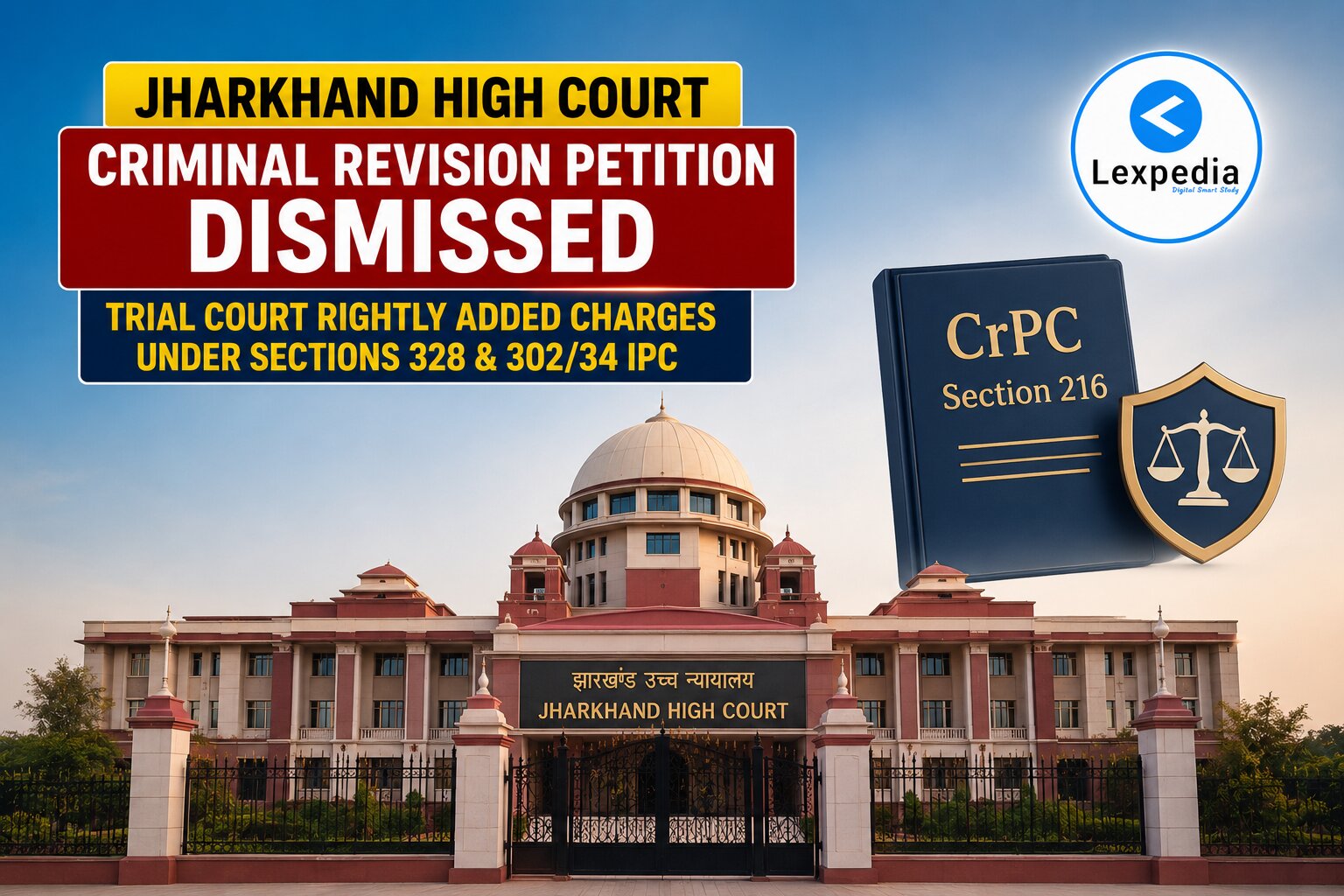
Judgement Details
Court
Jharkhand High Court
Date of Decision
2 July 2026
Judges
Hon'ble Justice Pradeep Kumar Srivastava
Citation
Acts / Provisions
Facts of the Case
-
The prosecution case arose from the death of Savita Devi, who allegedly suffered cruelty at the hands of her in-laws after her marriage.
-
It was alleged that the accused forcibly administered poison mixed with sattu to the deceased, resulting in her death.
-
Based on these allegations, the FIR was registered under Sections 328 and 302/34 IPC.
-
During investigation, however, the Investigating Officer filed a chargesheet only under Section 306 IPC, alleging abetment of suicide.
-
Accordingly, in 2017, the trial court framed charges solely under Section 306 IPC.
-
During the course of trial, the prosecution examined witnesses and produced evidence supporting the allegation that poison had been administered to the deceased.
-
The prosecution thereafter filed an application under Section 216 CrPC, seeking addition of charges under Sections 328 and 302/34 IPC.
-
The trial court independently examined the evidence on record and allowed the application, framing the additional charges.
-
Aggrieved by this order, the accused filed a criminal revision before the Jharkhand High Court, contending that the prosecution had no right to invoke Section 216 CrPC through an application.
Issues
-
Whether the prosecution has a vested right to seek alteration or addition of charges by filing an application under Section 216 CrPC?
-
Whether the trial court can exercise its power under Section 216 CrPC when the issue of alteration or addition of charges is brought to its notice by either the prosecution or the accused?
-
Whether the trial court acted illegally in entertaining the prosecution's application under Section 216 CrPC for framing additional charges?
-
Whether the evidence produced during trial justified the addition of charges under Sections 328 and 302/34 IPC?
-
Whether the order allowing additional charges suffered from any legal infirmity warranting interference in criminal revision?
Judgement
-
The Jharkhand High Court dismissed the criminal revision petition.
-
The Court held that Section 216 CrPC confers the power to alter or add charges exclusively upon the trial court.
-
It clarified that neither the prosecution nor the accused possesses a vested legal right to demand alteration or addition of charges.
-
However, the Court observed that there is no legal prohibition preventing either party from bringing relevant facts or evidence to the court's notice through an application.
-
The Bench emphasized that merely because such an application is filed by a party, the court's jurisdiction under Section 216 CrPC is not curtailed.
-
The Court explained that the power under Section 216 CrPC may be exercised at any stage before pronouncement of judgment, provided the evidence on record justifies such alteration.
-
The Court observed that the expression "add to any charge" includes framing an entirely new charge where the evidence warrants it.
-
It found that the trial court had independently evaluated the materials on record instead of mechanically allowing the prosecution's request.
-
The Bench noted that the FIR, eye-witness testimony, and the Forensic Science Laboratory (FSL) report collectively supported allegations of administration of poison.
-
Accordingly, the Court held that the trial court had rightly added charges under Sections 328 and 302/34 IPC.
Held
-
Section 216 CrPC confers the power to alter or add charges exclusively upon the court.
-
Neither the prosecution nor the accused has a vested right to invoke Section 216 CrPC.
-
Filing an application under Section 216 CrPC does not invalidate the court's exercise of jurisdiction.
-
The trial court is free to independently examine the evidence and alter or add charges wherever justified.
-
The evidence in the present case justified framing additional charges under Sections 328 and 302/34 IPC.
-
The criminal revision was dismissed.
Analysis
-
The judgment reinforces the principle that Section 216 CrPC is intended to ensure that criminal trials reflect the true nature of the offence disclosed by the evidence rather than being confined to the original charge framed at the commencement of trial.
-
The Court drew an important distinction between a party requesting consideration of additional charges and a party possessing a legal right to compel such alteration.
-
By holding that applications under Section 216 CrPC are merely informational and not determinative, the Court preserved the exclusive judicial discretion vested in the trial court.
-
The decision harmonizes procedural fairness with the objective of ensuring that serious offences are appropriately tried whenever the evidence emerging during trial so requires.
-
The Court reaffirmed that the power under Section 216 CrPC is extremely wide and may even extend to framing entirely new charges before the judgment is pronounced.
-
The judgment also demonstrates that courts must independently evaluate the evidence instead of acting solely on the prosecution's request, thereby protecting the accused from arbitrary alteration of charges.
-
The reliance upon the FIR, eye-witness testimony, and FSL report illustrates that alteration of charges must always be supported by credible material already available on record.
-
The ruling provides valuable guidance on the procedural scope of Section 216 CrPC, ensuring that criminal trials remain responsive to evidence while maintaining judicial independence.
-
The decision is significant because it clarifies that procedural applications filed by parties cannot restrict or enlarge the court's statutory powers, which remain solely governed by the requirements of law.