
ANG v. State of Maharashtra, 2026
Court carefully distinguished matrimonial discord from criminal cruelty.
Judgement Details
Court
Bombay High Court
Date of Decision
1 July 2026
Judges
Justice Ranjitsinh V. Bhonsale
Citation
Acts / Provisions
Facts of the Case
-
The complainant-wife lodged an FIR alleging that her husband had subjected her to cruelty, assaulted her, abused her, demanded dowry, and harassed her for non-fulfilment of dowry demands.
-
Apart from allegations against the husband, the complainant implicated the petitioner's sister-in-law (the wife of the husband's cousin), alleging that the husband maintained an extra-marital relationship with her.
-
The wife alleged that the husband frequently spoke and chatted with the petitioner.
-
She further alleged that the husband had engraved the name of the petitioner's son on his hand.
-
The complainant also alleged that the husband uploaded photographs of the petitioner on Facebook.
-
The prosecution relied upon Call Detail Records (CDRs) showing communication between the husband and the petitioner, but there were no transcripts or other evidence indicating the nature of those conversations.
-
The petitioner denied the allegations and approached the Bombay High Court seeking quashing of the FIR insofar as it related to her.
-
The Court examined whether the allegations, even if accepted at face value, constituted "cruelty" under Section 498A IPC.
Issues
-
Whether the husband's act of chatting or speaking with his sister-in-law (wife of his cousin) constitutes "cruelty" under Section 498A of the Indian Penal Code?
-
Whether the husband's act of engraving the name of his sister-in-law's son on his hand amounts to cruelty within the meaning of Section 498A IPC?
-
Whether mere suspicion of an alleged extra-marital relationship, unsupported by cogent evidence, is sufficient to prosecute a relative under Section 498A IPC?
-
Whether the allegations contained in the FIR disclosed a prima facie offence against the petitioner warranting continuation of criminal proceedings?
-
Whether the FIR against the petitioner was liable to be quashed for failure to disclose the essential ingredients of the offence under Section 498A IPC?
Judgement
-
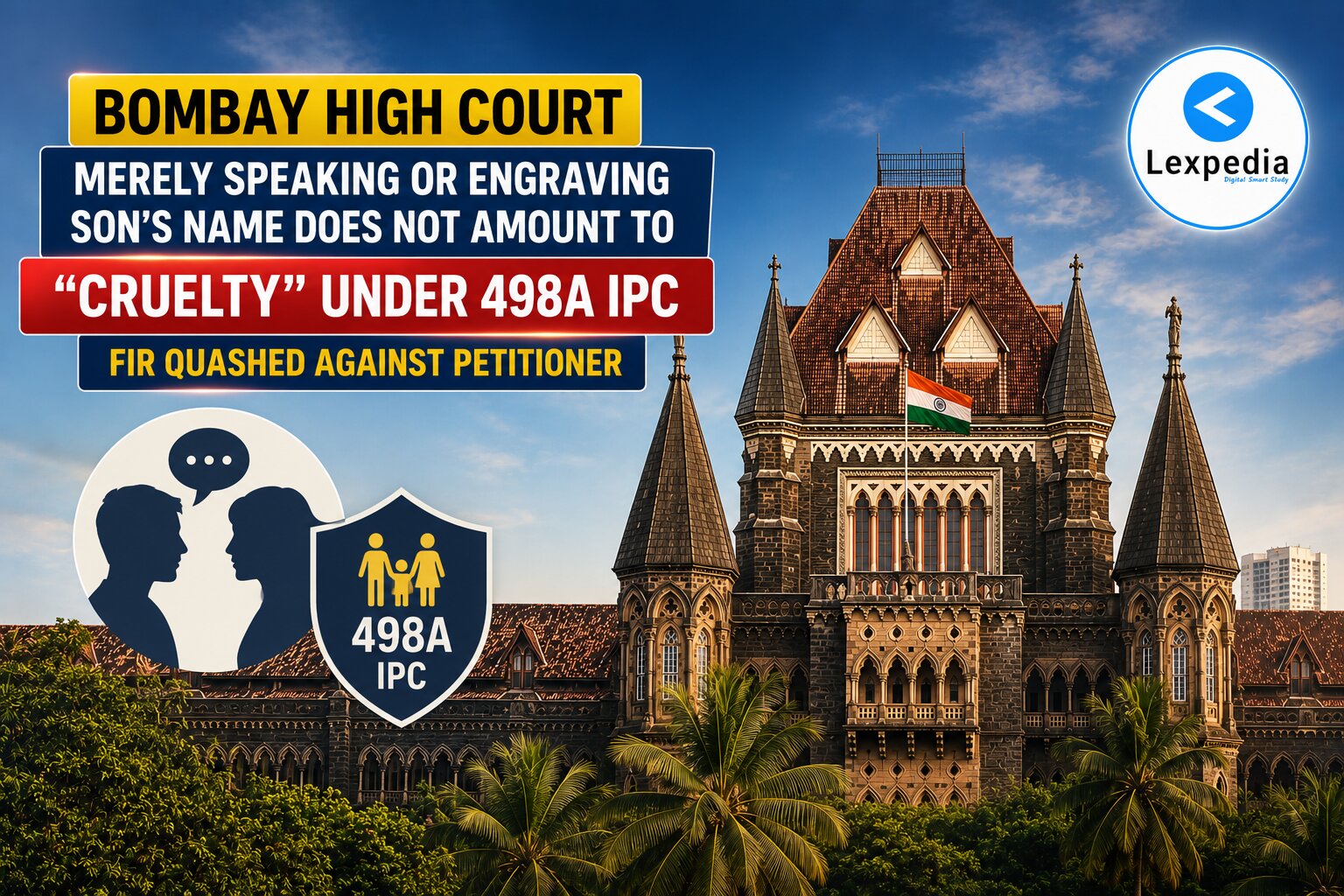
The Bombay High Court held that merely speaking or chatting with a sister-in-law or engraving her son's name on one's hand does not amount to "cruelty" as defined under Section 498A IPC.
-
The Court observed that the complainant's allegations were primarily founded on suspicion regarding the husband's relationship with the petitioner.
-
It noted that there was no basic or reliable material supporting the allegation of an extra-marital affair.
-
The Court emphasized that the petitioner's son was also the husband's nephew, making the act of engraving the child's name insufficient, by itself, to infer criminal cruelty.
-
The Court found that there were no allegations against the petitioner regarding dowry demand, harassment for dowry, or any conduct falling within the statutory definition of cruelty.
-
It observed that although Call Detail Records showed communication between the husband and the petitioner, there were no transcripts or other evidence establishing any improper conduct.
-
The Court reiterated that suspicion must be supported by cogent material capable of becoming legal evidence during trial.
-
It held that subjective moral assumptions or personal suspicions of the complainant cannot replace legal evidence necessary to establish criminal liability.
-
Consequently, the Court quashed the FIR against the petitioner.
Held
-
The allegations against the petitioner did not disclose the ingredients of cruelty under Section 498A IPC.
-
Mere conversations between the husband and his sister-in-law and engraving her son's name on his hand could not, by themselves, constitute cruelty.
-
Mere suspicion of an extra-marital relationship, unsupported by reliable evidence, is insufficient to prosecute a person under Section 498A IPC.
-
The FIR against the petitioner was quashed.
Analysis
-
The judgment reinforces that criminal liability under Section 498A IPC cannot rest upon conjectures, moral disapproval, or unsubstantiated suspicion.
-
The Court carefully distinguished matrimonial discord from criminal cruelty, emphasizing that not every objectionable or emotionally distressing marital circumstance amounts to an offence.
-
It reaffirmed that the statutory definition of "cruelty" requires conduct of sufficient gravity, such as harassment connected with unlawful demands or conduct likely to drive a woman to suicide or cause grave injury.
-
The decision highlights the importance of examining whether the essential ingredients of the offence are disclosed before permitting criminal prosecution to continue.
-
The Court stressed that suspicion must be based on objective and reliable material capable of being proved during trial rather than on subjective perceptions.
-
By quashing proceedings against the petitioner, the Court protected individuals from being unnecessarily prosecuted solely because of their relationship with the accused husband.
-
The judgment contributes to the jurisprudence discouraging the indiscriminate implication of relatives in matrimonial disputes where no specific criminal role is attributed to them.
-
It also underscores that courts must carefully scrutinize allegations before allowing criminal proceedings to proceed, thereby balancing protection of genuine victims with safeguards against misuse of criminal law.