Supreme Court Says Centre’s Undertaking To Reconsider Sedition Law Not Binding On Parliament
Lexpedia News · 27 February 2026 · 4 min read
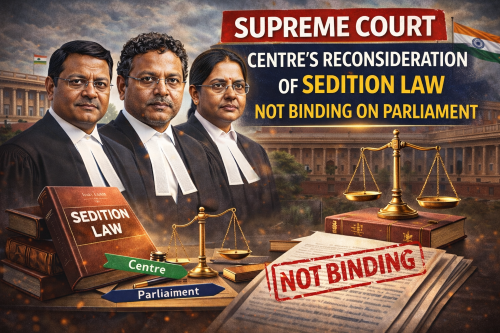
The Supreme Court of India has clarified that an undertaking given by the Union Government to reconsider the sedition law is not binding on Parliament and cannot restrict the legislature’s authority to enact laws. The comment came from a three-judge Bench headed by Chief Justice of India Surya Kant, along with Justice Joymalya Bagchi, during a hearing on constitutional challenges to the sedition-related provision in the Bharatiya Nyaya Sanhita (BNS).
The issue arose from a batch of petitions challenging Section 152 of the BNS, which critics say effectively reintroduces a sedition-like offence similar to the colonial era provision under Section 124A of the Indian Penal Code (IPC). In 2022, the Supreme Court had put prosecutions under the sedition law in abeyance and observed that the Union Government would review its operation. Petitioners argued that this undertaking should prevent Parliament from bringing back sedition-like provisions in the new code.
During the hearing, Senior Advocates appearing for the petitioners submitted that the Union Government’s 2022 assurance — that it would reconsider and potentially withdraw the sedition law — should bind Parliament and preclude re-enactment of similar offences in the BNS.
Rejecting this argument, the Supreme Court observed that while the Union Government may have given an undertaking to the Court, Parliament is not legally bound by such an undertaking and retains the exclusive prerogative to enact and amend laws under the Constitution. The Bench stated that legislative authority vests with Parliament and it cannot be restricted by assurances made by the executive in judicial proceedings.
Senior Counsel for the Union argued that Parliament must be allowed to implement its legislative agenda and that the sedition-related provision in the BNS — broadly addressing acts endangering the sovereignty, unity, or integrity of India — was within Parliament’s prerogative.
The Bench emphasised that the judiciary’s role is to examine the constitutional validity of laws, but it cannot prevent Parliament from enacting legislation based on executive assurances given earlier. It clarified that the legislative power of Parliament is a constitutional function that cannot be circumscribed by understandings given by the government before the Court.
The matter pertains to fundamental questions about the balance between legislative powers and judicial oversight, especially in the context of criminal provisions that engage free speech and public order concerns. While petitioners continue to challenge the constitutional validity of Section 152 of the BNS, the ruling affirms that legislative authority is not constrained by prior executive undertakings.
सुप्रीम कोर्ट का फैसला: केंद्र की “संशोधन पर पुनर्विचार” की undertaking संसद पर बाध्यकारी नहीं
भारत की सर्वोच्च अदालत ने स्पष्ट किया है कि सेंटर द्वारा sedition (देशद्रोह) कानून पर पुनर्विचार करने हेतु दिया गया आश्वासन संसद पर बाध्यकारी नहीं है, और यह विधानमंडल के कानून निर्माण के अधिकार को सीमित नहीं कर सकता। यह टिप्पणी मुख्य न्यायाधीश सूर्यकांत, न्यायमूर्ति जॉयमाल्या बागची की पीठ ने भारतीय न्याय संहिता (BNS) के sedition-संबंधित प्रावधानों पर संवैधानिक चुनौतियों की सुनवाई के दौरान की।
यह मामला BNS की धारा 152 से जुड़ी एक याचिका समूह से उत्पन्न हुआ, जिस पर आरोप है कि यह IPC की पुरानी sedition धारा 124A जैसा offence फिर से र्परिभाषित कर देता है। 2022 में सुप्रीम कोर्ट ने sedition कानून के तहत मुकदमों को स्थगित किया था और केंद्र सरकार से इस कानून की समीक्षा का आश्वासन लिया गया था। Petitioners का तर्क था कि यह आश्वासन संसद को ऐसे offences को नए कोड में पुनः लागू करने से रोकता है।
सुनवाई के दौरान, याचिकाकर्ताओं की ओर से वरिष्ठ अधिवक्ताओं ने कहा कि 2022 में केंद्र सरकार द्वारा अदालत को दिया गया आश्वासन — कि वह sedition कानून पर पुनर्विचार करेगी — संसद को प्रतिबद्ध करता है और इसी कारण से वह पुनः sedition-समान offences को BNS में शामिल नहीं कर सकती।
सुप्रीम कोर्ट ने इस दलील को खारिज करते हुए कहा कि यद्यपि केंद्र सरकार ने अदालत में आश्वासन दिया हो सकता है, संसद उस आश्वासन से बंधी नहीं है और संविधान के तहत कानून बनाने का उसका अधिकार स्वतंत्र रूप से जारी रहता है। अदालत ने कहा कि विधानमंडल का अधिकार संवैधानिक कार्य है और उसे कार्यपालिका द्वारा दी गयी किसी judicial आश्वासन के द्वारा प्रतिबंधित नहीं किया जा सकता।
केंद्र की ओर से वरिष्ठ वकील ने यह तर्क रखा कि संसद को अपना विधान कार्य जारी रखने दिया जाना चाहिए तथा BNS में sedition-संबंधित प्रावधान संसद के प्रशासनिक अधिकार क्षेत्र में शामिल हैं।
पीठ ने जोर देकर कहा कि न्यायपालिका का कर्तव्य कानून की संवैधानिक वैधता की समीक्षा करना है, लेकिन यह विधायिका को कानून बनाने से नहीं रोक सकती, विशेषकर तब जब कोई executive आश्वासन पहले दिया गया हो। अदालत ने स्पष्ट किया कि संसद की विधायी शक्ति एक संवैधानिक कार्य है, जो सरकार द्वारा दिए गए आश्वासनों से सीमित नहीं हो सकता।
यह मामला विधायी अधिकारों और न्यायिक निरीक्षण के बीच संतुलन से जुड़े मूल प्रश्नों को फैलाता है, खासकर तब जब ऐसा अपराधीकरण कानून मौलिक अभिव्यक्ति और सार्वजनिक व्यवस्था के हित से संबंधित हो। यद्यपि याचिकाकर्ता BNS की धारा 152 की संवैधानिकता को चुनौती देते रहते हैं, यह निर्णय यह पुष्टि करता है कि विधानमंडल का अधिकार पूर्व में दिए गए सरकारी आश्वासनों से प्रतिबंधित नहीं है।