Supreme Court: Confiscation proceedings under Bihar Special Courts Act can continue against wife after death of public servant
Lexpedia News · 21 March 2026 · 4 min read
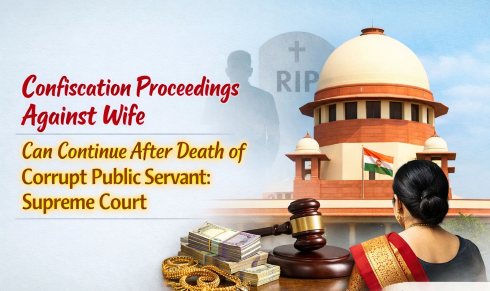
In a significant ruling, the Supreme Court of India has held that confiscation proceedings under the Bihar Special Courts Act, 2009 can continue against the wife of a public servant even after his death, if she is found to be holding assets allegedly acquired through corrupt means.
The judgment was delivered by a Bench comprising Justice Sanjay Karol and Justice N. Kotiswar Singh, which set aside a contrary decision of the Patna High Court that had held such proceedings would abate upon the death of the public servant.
The Court clarified that confiscation proceedings under the Act are distinct from criminal trials and do not automatically terminate due to the death of the accused public servant.
The case arose from vigilance proceedings against a government officer accused of amassing disproportionate assets between 1975 and 2009, with properties allegedly held in the name of his wife.
After investigation, proceedings for confiscation were initiated under the Bihar Special Courts Act, and notices were issued not only to the officer but also to his wife, as several assets were held in her name.
However, during the pendency of the case, the officer passed away, following which the Patna High Court held that the proceedings against the wife would abate. This decision was challenged by the State before the Supreme Court.
Setting aside the High Court’s ruling, the Supreme Court held that the death of the public servant does not absolve other persons who are in possession of allegedly illicit assets. It emphasized that the statutory framework allows action against “any other person” holding such property, including family members.
The Court further observed that if proceedings were initiated while the public servant was alive and notices were duly issued, then such proceedings can validly continue even after his death.
Importantly, the Bench relied on established legal principles to reiterate that non-public servants can also be proceeded against in corruption-related cases, especially where they are alleged to be beneficiaries or holders of tainted property.
The Court also drew a distinction between abatement of criminal proceedings and confiscation proceedings, noting that abatement due to death does not amount to a clean slate regarding the property in question.
This ruling is significant as it strengthens the legal framework to ensure that illegally acquired assets cannot be shielded through transfer to family members, and reinforces the principle that anti-corruption laws must be effectively enforced even beyond the lifetime of the accused public servant.
सुप्रीम कोर्ट: बिहार स्पेशल कोर्ट्स एक्ट के तहत सार्वजनिक सेवक की मृत्यु के बाद भी पत्नी के खिलाफ संपत्ति जब्ती की कार्यवाही जारी रह सकती है
Supreme Court of India ने एक महत्वपूर्ण निर्णय में कहा है कि Bihar Special Courts Act, 2009 के तहत संपत्ति जब्ती (confiscation) की कार्यवाही सार्वजनिक सेवक की मृत्यु के बाद भी उसकी पत्नी के खिलाफ जारी रह सकती है, यदि वह कथित रूप से अवैध संपत्ति की धारक पाई जाती है।
यह फैसला Justice Sanjay Karol और Justice N. Kotiswar Singh की पीठ ने दिया, जिसने पटना हाईकोर्ट के उस निर्णय को रद्द कर दिया जिसमें कहा गया था कि सार्वजनिक सेवक की मृत्यु के बाद कार्यवाही समाप्त हो जाएगी।
अदालत ने स्पष्ट किया कि इस अधिनियम के तहत संपत्ति जब्ती की कार्यवाही आपराधिक मुकदमे से अलग प्रकृति की होती है और यह मृत्यु के कारण स्वतः समाप्त नहीं होती।
मामला एक सरकारी अधिकारी के खिलाफ था, जिस पर 1975 से 2009 के बीच आय से अधिक संपत्ति अर्जित करने का आरोप था, और कई संपत्तियां उसकी पत्नी के नाम पर पाई गई थीं।
जांच के बाद अधिनियम के तहत जब्ती की कार्यवाही शुरू की गई और अधिकारी के साथ-साथ उसकी पत्नी को भी नोटिस जारी किया गया।
हालांकि, मामले के दौरान अधिकारी की मृत्यु हो गई, जिसके बाद पटना हाईकोर्ट ने कार्यवाही समाप्त मान ली। इस निर्णय को राज्य ने सुप्रीम कोर्ट में चुनौती दी।
सुप्रीम कोर्ट ने कहा कि सार्वजनिक सेवक की मृत्यु अन्य व्यक्तियों को जिम्मेदारी से मुक्त नहीं करती, विशेषकर यदि वे कथित अवैध संपत्ति के धारक हैं।
अदालत ने यह भी स्पष्ट किया कि यदि कार्यवाही की शुरुआत जीवित अवस्था में हुई थी और नोटिस जारी किया गया था, तो वह मृत्यु के बाद भी जारी रह सकती है।
साथ ही, अदालत ने कहा कि गैर-सार्वजनिक व्यक्ति (जैसे पत्नी) के खिलाफ भी कार्रवाई संभव है, यदि वे अवैध संपत्ति से जुड़े हों।
यह निर्णय महत्वपूर्ण है क्योंकि यह सुनिश्चित करता है कि अवैध संपत्ति को परिवार के नाम पर रखकर कानून से बचा नहीं जा सकता, और भ्रष्टाचार के मामलों में जवाबदेही बनी रहती है।