Sathankulam Custodial Death Case: Tamil Nadu Court Sentences 9 Police Officers to Death
Lexpedia News · 6 April 2026 · 4 min read
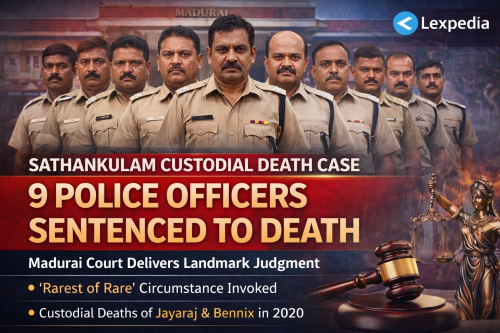
In a landmark judgment underscoring accountability for custodial violence, a Sessions Court in Madurai has sentenced nine police personnel to death in the infamous Sathankulam custodial deaths case involving a father-son duo in Tamil Nadu.
Background of the Case
The case relates to the deaths of P. Jeyaraj (59) and his son J. Bennix (31), who were arrested in June 2020 in Sathankulam, Thoothukudi district, for allegedly violating COVID-19 lockdown restrictions.
Following their arrest, the duo was subjected to severe custodial torture, which led to their deaths within days, triggering nationwide outrage and drawing comparisons with global cases of police brutality.
The incident became a turning point in discussions around police accountability and custodial violence in India.
Conviction and Sentencing
After nearly six years of trial:
- On March 23, 2026, the Madurai Sessions Court convicted all nine accused police personnel
- On April 6, 2026, the Court awarded the death penalty to all nine convicts
The Court held that:
- The case involved gross abuse of authority
- The acts constituted brutal custodial torture and murder
- The crime fell within the category of “rarest of rare”, justifying capital punishment
The Court also directed payment of compensation of ₹1.40 crore to the victims’ family.
Nature of the Crime
Evidence during trial revealed that:
- The victims were illegally detained overnight
- They were subjected to extreme physical abuse and torture
- Injuries sustained during custody directly led to their deaths
The brutality of the incident shocked the conscience of the nation and highlighted systemic issues in custodial practices.
Investigation and Trial
The case was initially handled by the Tamil Nadu Police but was later transferred to the Central Bureau of Investigation (CBI) due to widespread public pressure and judicial intervention.
- The CBI filed charges including murder, criminal conspiracy, and destruction of evidence
- A total of 10 officers were accused; one died during the investigation
- The trial spanned over five years, involving extensive witness protection and evidence examination
The Madras High Court had also taken suo motu cognisance, ensuring strict monitoring of the investigation.
Reactions and Significance
The judgment has been widely seen as:
- A rare instance of strict accountability for custodial deaths
- A strong judicial message against abuse of police power
Family members of the victims expressed relief, stating that they had finally received justice after years of struggle.
However, some human rights groups, including Amnesty International, raised concerns over the death penalty, arguing that systemic reforms are more crucial than capital punishment.
Legal and Constitutional Implications
The case raises important issues relating to:
- Article 21 (Right to Life and Personal Liberty)
- Custodial violence and police reforms
- Application of the “rarest of rare” doctrine in death penalty cases
It is expected to serve as a precedent in ensuring stricter scrutiny of custodial practices and reinforcing human rights protections.
सत्तानकुलम कस्टोडियल डेथ केस: तमिलनाडु कोर्ट ने 9 पुलिसकर्मियों को दी मौत की सजा
कस्टोडियल हिंसा के खिलाफ एक ऐतिहासिक फैसले में, मदुरै की सत्र अदालत ने सत्तानकुलम कस्टोडियल डेथ मामले में नौ पुलिसकर्मियों को मौत की सजा सुनाई है।
मामले की पृष्ठभूमि
यह मामला पी. जयराज (59) और उनके बेटे जे. बेनिक्स (31) की मौत से संबंधित है, जिन्हें जून 2020 में COVID-19 लॉकडाउन नियमों के उल्लंघन के आरोप में गिरफ्तार किया गया था।
गिरफ्तारी के बाद उन्हें पुलिस हिरासत में भयंकर यातना दी गई, जिसके कारण उनकी मौत हो गई।
इस घटना ने पूरे देश में आक्रोश पैदा किया और पुलिस अत्याचार के मुद्दे को केंद्र में ला दिया।
दोषसिद्धि और सजा
करीब छह वर्षों की सुनवाई के बाद:
- 23 मार्च 2026 को सभी 9 पुलिसकर्मी दोषी ठहराए गए
- 6 अप्रैल 2026 को सभी को मौत की सजा सुनाई गई
अदालत ने कहा कि:
- यह मामला अधिकार के गंभीर दुरुपयोग का उदाहरण है
- यह “रेयरेस्ट ऑफ रेयर” श्रेणी में आता है
साथ ही, पीड़ित परिवार को ₹1.40 करोड़ मुआवजा देने का आदेश दिया गया।
अपराध की प्रकृति
सुनवाई के दौरान सामने आया कि:
- पीड़ितों को रात भर अवैध रूप से हिरासत में रखा गया
- उन्हें गंभीर रूप से प्रताड़ित किया गया
- चोटों के कारण उनकी मृत्यु हुई
जांच और ट्रायल
इस मामले की जांच बाद में CBI को सौंप दी गई:
- हत्या, साजिश और साक्ष्य नष्ट करने के आरोप लगाए गए
- कुल 10 आरोपी थे, जिनमें से एक की मृत्यु हो गई
- ट्रायल लगभग 5 वर्षों तक चला
मद्रास हाई कोर्ट ने भी इस मामले में स्वतः संज्ञान लिया था।
प्रतिक्रिया और महत्व
इस फैसले को:
- कस्टोडियल डेथ मामलों में कड़ी जवाबदेही के रूप में देखा जा रहा है
- पुलिस अत्याचार के खिलाफ एक सशक्त संदेश माना जा रहा है
पीड़ित परिवार ने इस फैसले का स्वागत किया और इसे न्याय बताया।
हालांकि, कुछ मानवाधिकार संगठनों ने मौत की सजा पर सवाल उठाए हैं।
कानूनी महत्व
यह मामला महत्वपूर्ण है क्योंकि यह संबंधित है:
- अनुच्छेद 21 (जीवन और स्वतंत्रता का अधिकार)
- पुलिस सुधार और कस्टोडियल हिंसा
- “रेयरेस्ट ऑफ रेयर” सिद्धांत
यह फैसला भविष्य में ऐसे मामलों में न्यायिक दृष्टिकोण को प्रभावित कर सकता है।