97 Murder and Serious Crime Cases Recalled From Muzaffarnagar Judge After 22 Death Sentences in Four Months
Lexpedia News · 20 August 2026 · 31 min read
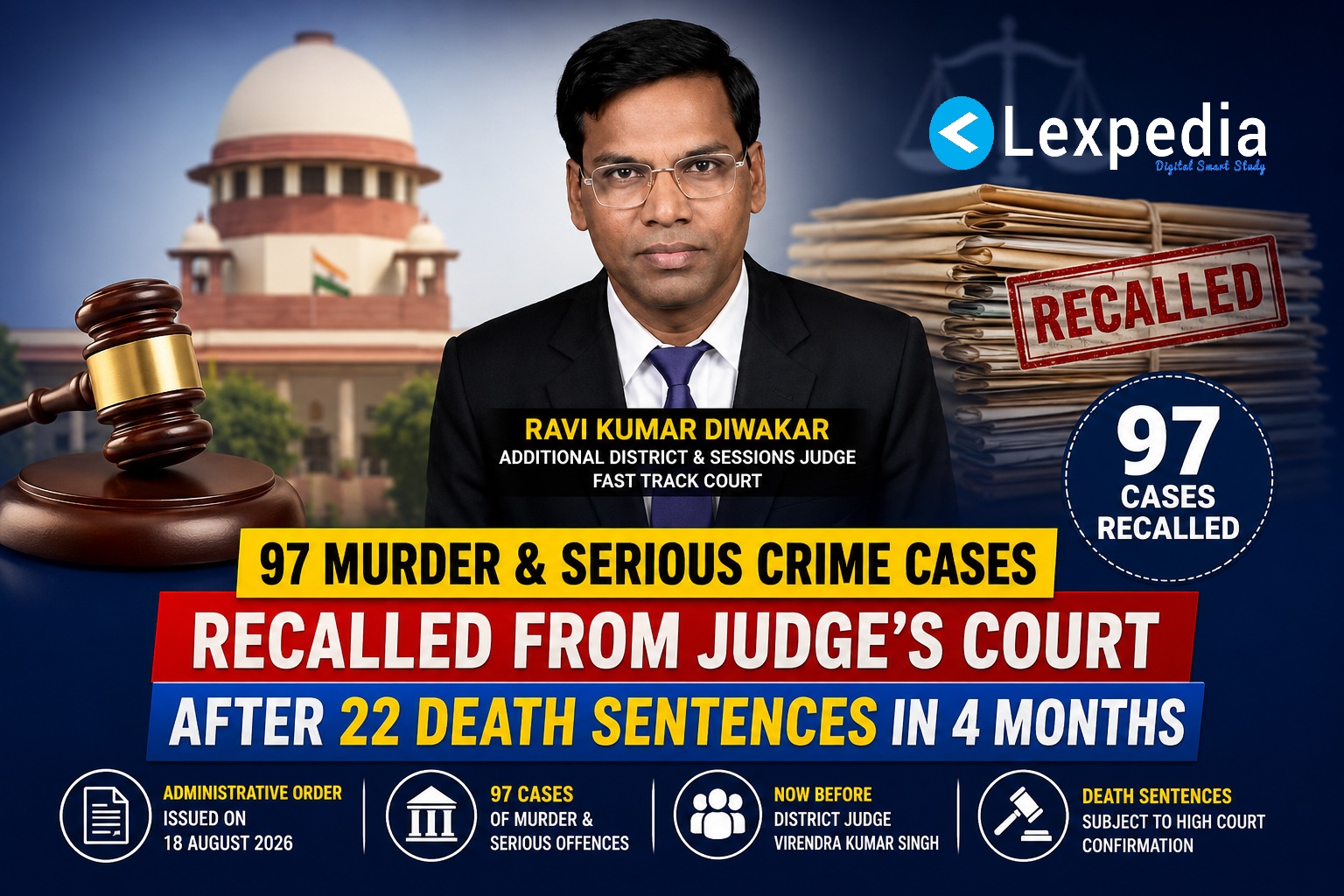
Ravi Kumar Diwakar’s court had awarded 22 death sentences in a series of cases; 97 pending files have now been recalled to District & Sessions Judge Virendra Kumar Singh
In a significant development in the Muzaffarnagar district judiciary, 97 pending criminal cases involving murder and other serious offences have been recalled from the court of Additional District & Sessions Judge Ravi Kumar Diwakar and placed before District & Sessions Judge Virendra Kumar Singh.
The administrative move comes days after Judge Diwakar's Fast Track Court No. 3 came under national attention for awarding 22 death sentences over a series of cases in a period of roughly four months. Multiple reports have described the 22 sentences as having been passed in 10 cases, although the publicly available case-by-case reporting currently identifies nine sentencing date-groups/cases. This discrepancy is explained in detail below and should not be silently presented as a resolved fact.
The cases were recalled through an administrative order issued by Muzaffarnagar District & Sessions Judge Virendra Kumar Singh on August 18, 2026. The order reportedly states that the case files pending before the Additional District & Sessions Judge/Fast Track Court No. 3 are recalled to the District & Sessions Judge's court for disposal in accordance with law.
Significantly, the administrative order does not state that the cases were recalled because Judge Diwakar had awarded 22 death sentences. Nor does the order, as reported, record any finding of misconduct against the judge.
The timing has nevertheless attracted considerable attention because the administrative recall followed the publication of reports about Judge Diwakar's unusually high number of capital-punishment verdicts.
What Has Officially Happened?
The clearest verified facts are:
- 97 pending case files have been recalled from Judge Ravi Kumar Diwakar's court.
- The cases concern murder and other serious/heinous offences, including offences punishable with death or life imprisonment.
- The recall was ordered administratively by District & Sessions Judge Virendra Kumar Singh.
- The cases have been placed before the District & Sessions Judge for further disposal.
- The order was issued on August 18, 2026.
- The order does not state the reason for the recall.
Government counsel Kuldeep Kumar told PTI that cases involving offences punishable with death or life imprisonment had been transferred from the fast-track court headed by Judge Diwakar to the court of District & Sessions Judge Virendra Kumar Singh.
Muzaffarnagar District Bar Association president Pramod Tyagi reportedly said lawyers and litigants had expressed apprehensions about the possibility of capital punishment being awarded in pending matters. He also described the allocation of cases among courts as falling within the administrative jurisdiction of the District Judge.
However, these comments should not be treated as the official reason recorded in the administrative order.
22 Death Sentences That Brought Judge Diwakar Into Focus
Before the recall of the 97 cases, Judge Diwakar's court had attracted attention for the number of death sentences pronounced within a short period.
According to PTI and several publications carrying the PTI report, the court awarded 22 death sentences to 22 persons in 10 cases between April and August 2026.
However, a subsequent detailed report by The Times of India describes the sequence as 22 death sentences in nine cases over 129 days, and its case-by-case account identifies nine sentencing events.
LiveLaw's latest report also reproduces the detailed sequence beginning on April 6 and then identifies the May 30, June 20, July 2, July 6, July 17, August 12 and August 13 cases—again producing nine identifiable case groups.
This discrepancy is important
The publicly available reports therefore contain an inconsistency:
PTI-based reports: 22 death sentences in 10 cases, including a reference to one death sentence on May 20.
Detailed reports from TOI, LiveLaw, NDTV, LawBeat and others: 22 death sentences in nine identifiable cases, with the single-accused case occurring on May 30.
Because adding a separate May 20 death sentence to the May 30 case would produce 23 death sentences, it would be inaccurate to manufacture a tenth case merely to make the numbers fit.
Accordingly, the present report treats 22 death sentences as the established aggregate reported figure, while clearly flagging the unresolved discrepancy concerning the number of underlying cases.
The Nine Case Groups That Can Be Independently Identified
The following are the cases that can be identified from the available detailed reporting.
| No. | Date | Death Sentences | Case |
|---|---|---|---|
| 1 | April 6, 2026 | 3 | Kidnapping and murder of lawyer Mohammad Sameer/Sameer Saifi in a 2019 case |
| 2 | April 28, 2026 | 4 | 2019 murder case involving a woman and her three sons |
| 3 | May 30, 2026 | 1 | Murder of Rajesh Devi and her six-year-old son Himanshu in 2011 |
| 4 | June 20, 2026 | 2 | Murder of Rajendra Saini |
| 5 | July 2, 2026 | 1 | Murder of Home Guard Ratiram while on duty |
| 6 | July 6, 2026 | 2 | 2010 murder of Rajbir Singh linked to panchayat-election rivalry |
| 7 | July 17, 2026 | 4 | 2011 highway robbery-cum-murder of farmer Raj Singh in Shamli |
| 8 | August 12, 2026 | 1 | 1999 kidnapping and ransom murder of wood trader Saleem |
| 9 | August 13, 2026 | 4 | 2014 murder of Pawan Kumar in Bhabhisa, Shamli |
Total identifiable from these detailed reports: 22 death sentences.
Editorial note: PTI's initial numerical account mentions an additional single death sentence on May 20 and calls the total 10 cases. However, detailed reports identify the single-convict case as the May 30 double-murder case and do not establish a separate May 20 case. Lexpedia therefore should not publish an invented tenth case without the underlying judgment/order.
Case 1: Three Sentenced to Death in Lawyer Mohammad Sameer's Murder
On April 6, 2026, three persons were sentenced to death in connection with the kidnapping and murder of lawyer Mohammad Sameer/Sameer Saifi.
According to the prosecution case reported by several publications, Sameer was kidnapped and subsequently murdered in a case dating back to 2019. The prosecution alleged that the killing arose from a monetary dispute involving approximately ₹45 lakh.
This was the first of the series of capital-punishment verdicts that later brought Judge Diwakar's court into national attention.
Case 2: Woman and Three Sons Sentenced to Death
On April 28, a woman and her three sons were sentenced to death in another 2019 murder case.
Reports identify the accused as a woman and her three sons. The case was among the four-person death-sentence cases included in the overall figure of 22.
Detailed public reporting does not consistently provide all the case particulars necessary to safely reproduce the entire judgment narrative. Accordingly, this report does not add unverified details.
Case 3: 2011 Double Murder of Woman and Six-Year-Old Son
On May 30, a 50-year-old man identified in reports as Rahis was sentenced to death for the murder of Rajesh Devi, aged 30, and her six-year-old son Himanshu.
The murders occurred on November 7, 2011, according to reports, making the case nearly 15 years old at the time of the judgment.
The prosecution case was that Rahis took the woman and child to a sugarcane field and killed them by repeatedly striking them with bricks.
The trial court considered the case to fall within the “rarest of rare” category.
This is particularly significant because the “rarest of rare” standard is central to Indian capital-sentencing jurisprudence.
Case 4: Two Sentenced to Death for Rajendra Saini's Murder
On June 20, two accused—identified in reports as Gajendra and Ramkiran—were sentenced to death for the murder of Rajendra Saini.
Reports state that the court treated the matter as falling within the exceptional category warranting capital punishment.
Case 5: Home Guard Ratiram Murder
On July 2, Judge Diwakar sentenced Deepak to death for murdering Home Guard Ratiram while he was on duty.
The incident reportedly took place on June 4, 2020. According to the prosecution version, Ratiram intervened after Deepak allegedly assaulted his mother, following which Deepak stabbed the Home Guard.
The court held that the circumstances warranted the maximum punishment and treated the case as falling within the “rarest of rare” category.
The court also imposed a fine of ₹1.20 lakh, according to ThePrint.
Case 6: 2010 Murder Linked to Panchayat-Election Rivalry
On July 6, former village head Pramod and his associate Sahdev were sentenced to death for the murder of Rajbir Singh, aged 60.
Rajbir Singh was shot dead on August 24, 2010, allegedly over rivalry connected with panchayat elections.
The court reportedly considered the case to fall within the “rarest of rare” category.
Case 7: Highway Robbery-Cum-Murder of Farmer
On July 17, four men were sentenced to death for the murder of a farmer during an attempted robbery in Shamli district in 2011.
According to reports, farmer Raj Singh and his friend Bijendra were travelling on a motorcycle when they were intercepted by the accused.
Raj Singh was allegedly shot after resisting the robbery, while Bijendra was tied up and thrown into a sugarcane field.
Four accused were sentenced to death in the case.
Case 8: 1999 Kidnapping and Ransom Murder of Wood Trader
On August 12, Shahnawaz was sentenced to death for the kidnapping and murder of wood trader Saleem for ransom in a case dating back nearly 27 years.
The prosecution case concerned an alleged ransom demand of approximately ₹5 lakh.
The court also imposed a fine of ₹1.10 lakh on Shahnawaz.
The verdict was particularly notable because it involved a crime committed in 1999, demonstrating the long pendency of some serious criminal trials.
Case 9: 2014 Murder of Pawan Kumar
On August 13, one day after the Shahnawaz verdict, four men—identified in reports as Ramvir, Rajiv, Rahul and Harender Kumar—were sentenced to death for the murder of Pawan Kumar.
The case arose from an incident in Bhabhisa village in Shamli district on July 14, 2014.
According to the prosecution, the accused entered Pawan Kumar's house and opened fire following an old enmity. Pawan Kumar died, while his brother Ashok Kumar sustained bullet injuries and later lodged the complaint.
The court also imposed a fine of ₹1.70 lakh on the four convicts, according to India Today.
This was the latest of the publicly identified death-sentence cases and brought the reported total to 22.
Why Is the “10 Cases” Figure Still Being Reported?
The phrase “22 death sentences in 10 cases” originated in the PTI report and has subsequently been repeated by numerous publications.
India Today, for example, reproduced the PTI numerical sequence as:
- April 6 — 3
- April 28 — 4
- May 20 — 1
- June 20 — 2
- July 2 — 1
- July 6 — 2
- July 17 — 4
- August 12 — 1
- August 13 — 4
That sequence totals 22, but it contains only nine date entries.
Meanwhile, detailed reports from The Times of India, LiveLaw, NDTV, LawBeat and LiveMint identify a May 30 death sentence involving the double murder of Rajesh Devi and Himanshu.
The detailed sequence therefore becomes:
3 + 4 + 1 + 2 + 1 + 2 + 4 + 1 + 4 = 22.
This is nine identifiable cases.
A separate May 20 death sentence plus the May 30 case would produce 23, which does not match the reported aggregate.
Therefore, the responsible editorial position is:
22 death sentences is the consistently reported total.
“10 cases” is the figure reported by PTI and repeated by several outlets.
Nine cases can presently be individually identified from the detailed publicly available reporting.
The missing tenth case/date has not been independently established from the sources reviewed.
This qualification should remain in any publication until the underlying judicial records clarify the discrepancy.
97 Pending Cases Recalled
Against this backdrop, the District & Sessions Judge's administrative order of August 18 recalled 97 pending cases from Judge Diwakar's Fast Track Court.
The Indian Express reported that it had reviewed a copy of the District Judge's direction, which details the case titles of the 97 matters recalled from the Additional District & Sessions Judge (FTC 3) court.
The order reportedly directs that the cases be brought before the District & Sessions Judge's court for disposal in accordance with law.
The matters include serious offences such as murder and offences punishable with death or life imprisonment.
The Administrative Order Does Not Give a Reason
One of the most important aspects of the story is what the order does not say.
According to LiveLaw, the administrative order does not state any reason for recalling the cases.
Therefore, it would be legally and journalistically unsafe to state as a fact that:
“The cases were recalled because Judge Diwakar gave too many death sentences.”
The available evidence only establishes that the recall occurred shortly after the reporting about the 22 death sentences.
That timing is relevant background, but it does not establish causation.
Lawyers' Apprehensions Reported
The Muzaffarnagar District Bar Association president, Pramod Tyagi, told The Indian Express that lawyers and litigants had expressed apprehensions that the court might award death penalties in pending matters.
He also described the transfer of cases as a routine administrative exercise falling within the District Judge's jurisdiction to determine which cases should be handled by which court.
This provides context for the move, but it remains a statement from a Bar Association representative, not an official explanation contained in the administrative order.
Does This Mean Judge Ravi Kumar Diwakar Has Been Transferred?
Not on the basis of the present record.
The development concerns the recall/reallocation of pending cases, not an announced transfer, suspension or removal of Judge Diwakar.
Recent reports continue to identify him as an Additional District & Sessions Judge presiding over Fast Track Court No. 3 in Muzaffarnagar.
Accordingly, a headline stating:
“Judge Ravi Kumar Diwakar Transferred After 22 Death Sentences”
would go beyond the verified facts.
A more accurate headline is:
“97 Murder & Serious-Crime Cases Recalled From Muzaffarnagar Judge After 22 Death Sentences.”
No Official Misconduct Finding Reported
There is also no reported official finding that Judge Diwakar committed misconduct in connection with the 22 death-sentence judgments or the present administrative recall.
The recall of cases should therefore not be described as disciplinary action unless a competent authority subsequently issues an order or statement establishing that position.
The New Indian Express similarly reported that the move did not amount to an official finding of misconduct against the judge.
Judge Diwakar's Judicial Background
Judge Ravi Kumar Diwakar joined the Uttar Pradesh judicial service in 2009 and has served in several districts.
According to recent reporting, his postings have included Azamgarh, Sultanpur, Budaun, Varanasi, Bareilly and Chitrakoot, before he joined Muzaffarnagar in November 2025.
He first attracted nationwide attention in 2022, when, while serving as a Civil Judge in Varanasi, he ordered a videographic survey of the Gyanvapi mosque complex.
His subsequent judicial career has also included several high-profile criminal matters.
22 Death Sentences Do Not Mean 22 Executions
Another important legal distinction is that a Sessions Court death sentence is not the final stage in a capital case.
Under Section 407 of the Bharatiya Nagarik Suraksha Sanhita, 2023 (BNSS), when a Court of Session passes a death sentence, the proceedings must be submitted to the High Court for confirmation. The sentence cannot be executed unless confirmed by the High Court.
Section 408 further empowers the High Court to direct a further inquiry or the taking of additional evidence where necessary, while Section 409 deals with the High Court's power to confirm the sentence or annul the conviction.
Thus, the 22 death sentences reported from Judge Diwakar's court are trial-court sentences, not 22 executions or finally confirmed capital sentences.
The “Rarest of Rare” Doctrine
Several of the reported judgments described the relevant cases as falling within the “rarest of rare” category.
Under India's established constitutional jurisprudence, the death penalty is intended for the most exceptional cases where the alternative punishment of life imprisonment is considered inadequate.
A Sessions Court's conclusion that a case falls within this category remains subject to appellate and confirmation scrutiny.
The mandatory High Court confirmation process is therefore particularly important in assessing the legality and proportionality of each capital sentence.
What Does the Recall Mean for the 97 Cases?
The administrative recall does not by itself:
- terminate any prosecution;
- acquit any accused;
- invalidate earlier judicial proceedings;
- set aside any conviction;
- establish misconduct by Judge Diwakar; or
- establish that any death sentence was legally erroneous.
It changes the court before which the pending matters will proceed.
The cases will now be dealt with by the District & Sessions Judge's court, subject to further administrative allocation and judicial orders.
Could the Recall Affect the 22 Death Sentences?
The 97 recalled matters are pending cases.
The death-sentence cases in which judgments have already been pronounced are a separate category.
Their judgments remain subject to the statutory process, including High Court confirmation under Section 407 BNSS.
Therefore, the administrative recall of the 97 pending cases does not automatically reopen or cancel the 22 death sentences already pronounced.
Important Distinction: Fact vs. Inference
For accurate legal reporting, the current position can be divided into three categories:
Officially established
97 pending cases were recalled from Judge Diwakar's court by an administrative order dated August 18, 2026.
The cases were placed before District & Sessions Judge Virendra Kumar Singh.
Judge Diwakar's court has awarded 22 death sentences in the recent period.
Reported
Lawyers and litigants reportedly expressed apprehension about the possibility of capital punishment in pending matters.
Not officially established
It has not been officially stated in the administrative order that the 22 death sentences were the reason for recalling the 97 cases.
It has also not been established that Judge Diwakar has been suspended, removed or transferred from Muzaffarnagar.
Current Status as of August 22, 2026
The latest available reporting supports the following position:
Judge Ravi Kumar Diwakar remains identified as an Additional District & Sessions Judge in Muzaffarnagar.
97 pending serious criminal cases have been recalled from his Fast Track Court.
The cases have been placed before District & Sessions Judge Virendra Kumar Singh.
The administrative order does not publicly state why the cases were recalled.
Judge Diwakar's court has been reported as having awarded 22 death sentences during the April–August period.
The detailed public reporting currently identifies nine case groups producing those 22 sentences, while PTI and several outlets describe them as 10 cases and mention a May 20 sentencing event that has not been independently reconciled with the detailed May 30 case.
The death sentences remain subject to the statutory High Court confirmation process.
Conclusion
The recall of 97 murder and serious-crime cases from the court of Muzaffarnagar Additional District & Sessions Judge Ravi Kumar Diwakar is a significant development in the Uttar Pradesh district judiciary.
The action follows a period in which Judge Diwakar's court attracted unusual attention for the number of capital-punishment verdicts delivered in a short period. Public reports consistently put the number at 22 death sentences, although there is an unresolved discrepancy over whether those sentences arose from nine or 10 cases.
The responsible legal-news position is therefore to report the 22-death-sentence figure, while explaining that detailed public reporting presently identifies nine case groups and that the reported tenth case has not been independently reconciled.
Equally important, the August 18 administrative order does not state that the 97 cases were recalled because of the death sentences. Nor does it establish any disciplinary action against Judge Diwakar.
The present facts establish an administrative reallocation of 97 pending cases, with the matters now before District & Sessions Judge Virendra Kumar Singh.
Meanwhile, the 22 capital-punishment judgments already pronounced by the trial court remain subject to the mandatory High Court confirmation procedure under Section 407 BNSS. No death sentence passed by the Sessions Court can be executed unless it is confirmed by the High Court.
For readers and legal professionals, the distinction between “cases recalled,” “judge transferred,” and “disciplinary action” is therefore crucial. As of August 22, 2026, only the first of these is clearly established by the publicly available record.
22 मृत्युदंड देने वाले मुजफ्फरनगर जज से 97 हत्या व गंभीर अपराधों के मामले वापस; प्रशासनिक आदेश में कारण नहीं बताया गया
रवि कुमार दिवाकर की अदालत ने हाल के महीनों में 22 मृत्युदंड दिए; अब 97 लंबित मामले District & Sessions Judge वीरेंद्र कुमार सिंह की अदालत में भेजे गए
मुजफ्फरनगर जिला न्यायपालिका में एक महत्वपूर्ण घटनाक्रम के तहत Additional District & Sessions Judge रवि कुमार दिवाकर की अदालत से हत्या और अन्य गंभीर अपराधों से संबंधित 97 लंबित आपराधिक मामले वापस ले लिए गए हैं और उन्हें District & Sessions Judge वीरेंद्र कुमार सिंह की अदालत में भेज दिया गया है।
यह प्रशासनिक कार्रवाई ऐसे समय हुई है जब Judge Diwakar की Fast Track Court No. 3 पिछले लगभग चार महीनों में बड़ी संख्या में मृत्युदंड सुनाए जाने के कारण राष्ट्रीय स्तर पर चर्चा में आई है।
विभिन्न रिपोर्टों में कहा गया है कि उनकी अदालत ने 22 व्यक्तियों को 10 मामलों में मृत्युदंड दिया। हालांकि, उपलब्ध detailed case-by-case reporting में वर्तमान में 9 identifiable case groups ही स्पष्ट रूप से सामने आते हैं। इस discrepancy को बिना जांच के छिपाना उचित नहीं होगा।
मामलों को 18 अगस्त 2026 को Muzaffarnagar के District & Sessions Judge Virendra Kumar Singh द्वारा जारी प्रशासनिक आदेश के माध्यम से recall किया गया। रिपोर्टों के अनुसार आदेश में कहा गया है कि Additional District & Sessions Judge/Fast Track Court No. 3 की अदालत में लंबित case files को District & Sessions Judge की अदालत में कानून के अनुसार निस्तारण के लिए वापस बुलाया जाता है।
महत्वपूर्ण बात यह है कि प्रशासनिक आदेश में यह नहीं कहा गया है कि 22 मृत्युदंडों के कारण 97 मामले वापस लिए गए।
आधिकारिक रूप से क्या हुआ?
वर्तमान में स्थापित तथ्य ये हैं:
- 97 लंबित case files Judge Ravi Kumar Diwakar की अदालत से recall की गई हैं।
- इनमें हत्या और अन्य गंभीर/heinous offences शामिल हैं।
- इनमें ऐसे अपराध भी हैं जिनमें मृत्युदंड या आजीवन कारावास का प्रावधान है।
- मामलों को District & Sessions Judge Virendra Kumar Singh की अदालत में भेजा गया है।
- प्रशासनिक आदेश 18 अगस्त 2026 को जारी हुआ।
- आदेश में recall का कारण नहीं बताया गया है।
Government Counsel Kuldeep Kumar ने PTI को बताया कि death या life imprisonment से दंडनीय अपराधों से संबंधित मामलों को Fast Track Court से District & Sessions Judge Virendra Kumar Singh की अदालत में भेजा गया है।
Muzaffarnagar District Bar Association के अध्यक्ष Pramod Tyagi ने कथित रूप से कहा कि lawyers और litigants के बीच pending मामलों में death penalty दिए जाने की संभावना को लेकर apprehension थी। उन्होंने यह भी कहा कि मामलों का allocation District Judge के administrative jurisdiction में आता है।
हालांकि इसे आधिकारिक आदेश का कारण नहीं माना जा सकता।
22 मृत्युदंडों के कारण Judge Diwakar चर्चा में
मामलों के recall से पहले Judge Diwakar की अदालत बड़ी संख्या में death sentences दिए जाने के कारण चर्चा में आई।
PTI और उस पर आधारित कई रिपोर्टों के अनुसार अप्रैल से अगस्त 2026 के बीच 22 व्यक्तियों को 10 मामलों में मृत्युदंड दिया गया।
लेकिन The Times of India की विस्तृत रिपोर्ट में इन्हें 129 दिनों में 9 मामलों में 22 death sentences बताया गया है।
LiveLaw की विस्तृत रिपोर्ट भी अप्रैल 6 से शुरू होने वाले मामलों में May 30, June 20, July 2, July 6, July 17, August 12 और August 13 के cases की पहचान करती है, जिससे 9 identifiable case groups बनते हैं।
यह discrepancy महत्वपूर्ण है
PTI-based reports में:
22 death sentences — 10 cases — May 20 को 1 death sentence का उल्लेख।
वहीं detailed reports में:
22 death sentences — 9 identifiable cases — May 30 को 1 death sentence।
यदि May 20 के एक अलग case को May 30 वाले case के अतिरिक्त माना जाए, तो कुल संख्या 23 हो जाएगी।
इसलिए किसी अज्ञात दसवें मामले को अनुमान से जोड़ना उचित नहीं है।
वे 9 मामले जिन्हें वर्तमान में स्पष्ट रूप से पहचाना जा सकता है
| क्रम | तारीख | मृत्युदंड | मामला |
|---|---|---|---|
| 1 | 6 अप्रैल 2026 | 3 | Lawyer Mohammad Sameer/Sameer Saifi का kidnapping और murder, 2019 |
| 2 | 28 अप्रैल 2026 | 4 | 2019 का murder case; एक महिला और उसके तीन बेटे |
| 3 | 30 मई 2026 | 1 | Rajesh Devi और उनके 6 वर्षीय बेटे Himanshu की 2011 में हत्या |
| 4 | 20 जून 2026 | 2 | Rajendra Saini की हत्या |
| 5 | 2 जुलाई 2026 | 1 | Duty पर तैनात Home Guard Ratiram की हत्या |
| 6 | 6 जुलाई 2026 | 2 | Panchayat-election rivalry से जुड़ी Rajbir Singh की 2010 में हत्या |
| 7 | 17 जुलाई 2026 | 4 | Shamli में 2011 की highway robbery-cum-murder |
| 8 | 12 अगस्त 2026 | 1 | 1999 में wood trader Saleem का kidnapping और ransom murder |
| 9 | 13 अगस्त 2026 | 4 | Shamli के Bhabhisa में 2014 में Pawan Kumar की हत्या |
कुल: 22 मृत्युदंड।
संपादकीय नोट: PTI के शुरुआती numerical account में 20 मई को एक death sentence का उल्लेख है और कुल 10 cases बताए गए हैं। लेकिन detailed reports 30 मई के double-murder case को स्पष्ट रूप से पहचानती हैं और अलग 20 मई case की पुष्टि नहीं करतीं। इसलिए बिना मूल judicial record के Lexpedia को दसवां case नहीं गढ़ना चाहिए।
Case 1: Lawyer Mohammad Sameer की हत्या
6 अप्रैल 2026 को तीन व्यक्तियों को lawyer Mohammad Sameer/Sameer Saifi के kidnapping और murder के मामले में मृत्युदंड दिया गया।
मामला 2019 का था। अभियोजन के अनुसार लगभग ₹45 लाख के monetary dispute से जुड़े विवाद के बाद Sameer का kidnapping और murder किया गया था।
यह Judge Diwakar की इस श्रृंखला का पहला प्रमुख death-sentence judgment था।
Case 2: महिला और उसके तीन बेटों को मृत्युदंड
28 अप्रैल को एक महिला और उसके तीन बेटों को 2019 के murder case में death sentence दिया गया।
रिपोर्टों में इसे चार व्यक्तियों को मृत्युदंड देने वाले cases में शामिल किया गया है।
इस case के सभी विस्तृत तथ्य public reports में समान रूप से उपलब्ध नहीं हैं, इसलिए इस रिपोर्ट में unverified details नहीं जोड़ी जा रही हैं।
Case 3: महिला और 6 वर्षीय बेटे की Double Murder
30 मई को 50 वर्षीय Rahis को Rajesh Devi और उनके छह वर्षीय बेटे Himanshu की हत्या के लिए मृत्युदंड दिया गया।
रिपोर्टों के अनुसार दोनों की हत्या 7 नवंबर 2011 को हुई थी।
अभियोजन के अनुसार Rahis महिला और बच्चे को गन्ने के खेत में ले गया और bricks से हमला करके उनकी हत्या की।
Trial court ने इसे “rarest of rare” category का मामला माना।
Case 4: Rajendra Saini Murder
20 जून को Gajendra और Ramkiran को Rajendra Saini की हत्या के मामले में मृत्युदंड दिया गया।
रिपोर्टों के अनुसार court ने मामले को capital punishment के लिए अत्यंत गंभीर माना।
Case 5: Duty पर Home Guard Ratiram की हत्या
2 जुलाई को Deepak को duty पर तैनात Home Guard Ratiram की हत्या के मामले में मृत्युदंड दिया गया।
घटना 4 जून 2020 की बताई गई है। अभियोजन के अनुसार Ratiram ने Deepak द्वारा उसकी मां के साथ कथित मारपीट में हस्तक्षेप किया था, जिसके बाद Deepak ने Home Guard पर चाकू से हमला किया।
Court ने इसे “rarest of rare” category में माना।
ThePrint के अनुसार court ने ₹1.20 लाख का fine भी लगाया।
Case 6: Panchayat Election Rivalry में Rajbir Singh की हत्या
6 जुलाई को former village head Pramod और उसके associate Sahdev को Rajbir Singh, उम्र 60 वर्ष, की हत्या के मामले में death sentence दिया गया।
Rajbir Singh की 24 अगस्त 2010 को गोली मारकर हत्या की गई थी।
मामले में पंचायत चुनाव से जुड़ी rivalry को prosecution case का हिस्सा बताया गया है।
Court ने इसे “rarest of rare” case माना।
Case 7: Highway Robbery-Cum-Murder
17 जुलाई को चार लोगों को Shamli district में 2011 के highway robbery-cum-murder मामले में मृत्युदंड दिया गया।
रिपोर्टों के अनुसार farmer Raj Singh और उनके friend Bijendra motorcycle से जा रहे थे जब आरोपियों ने उन्हें रोका।
Robbery का विरोध करने पर Raj Singh को गोली मारने और Bijendra को बांधकर गन्ने के खेत में फेंकने की prosecution story सामने आई।
Case 8: 1999 में Wood Trader Saleem का Kidnapping और Murder
12 अगस्त को Shahnawaz को wood trader Saleem के kidnapping और ransom murder के मामले में death sentence दिया गया।
मामला 1999 का था और लगभग 27 वर्ष बाद फैसला आया।
रिपोर्टों के अनुसार ransom की मांग लगभग ₹5 लाख थी।
Court ने Shahnawaz पर ₹1.10 लाख का fine भी लगाया।
Case 9: Pawan Kumar Murder
13 अगस्त को Ramvir, Rajiv, Rahul और Harender Kumar को Pawan Kumar की हत्या के मामले में death sentence दिया गया।
घटना 14 जुलाई 2014 को Shamli के Bhabhisa village में हुई थी।
Prosecution के अनुसार accused पुराने विवाद के कारण Pawan Kumar के घर में घुसे और firing की।
Pawan Kumar की मृत्यु हो गई जबकि उनके भाई Ashok Kumar गोली लगने से घायल हुए और बाद में complaint दर्ज कराई।
चारों convicts पर कुल ₹1.70 लाख का fine भी लगाया गया।
“10 Cases” की संख्या क्यों बनी हुई है?
“22 death sentences in 10 cases” वाली संख्या सबसे पहले PTI के report में सामने आई और कई publications ने उसे reproduce किया।
India Today द्वारा प्रकाशित PTI account में sequence इस प्रकार है:
- 6 April — 3
- 28 April — 4
- 20 May — 1
- 20 June — 2
- 2 July — 1
- 6 July — 2
- 17 July — 4
- 12 August — 1
- 13 August — 4
इनका total 22 है, लेकिन इसमें केवल 9 date entries हैं।
दूसरी ओर, The Times of India, LiveLaw, NDTV, LawBeat और LiveMint की detailed reporting में 30 May का Rajesh Devi-Himanshu double-murder case शामिल है।
इसलिए वर्तमान में सबसे सुरक्षित editorial position यह है:
22 death sentences — verified reported total।
10 cases — PTI द्वारा reported figure।
9 cases — detailed public reporting से presently identifiable case groups।
Missing tenth case — अभी independently established नहीं।
97 Pending Cases का Recall
इस background के बीच District & Sessions Judge के 18 अगस्त के administrative order ने Judge Diwakar की Fast Track Court से 97 pending cases recall कर लिए।
The Indian Express ने बताया कि उसके पास District Judge के direction की copy थी, जिसमें 97 recalled matters के case titles का विवरण है।
इन मामलों को District & Sessions Judge की अदालत में कानून के अनुसार disposal के लिए भेजा गया है।
Recall का कारण आदेश में नहीं बताया गया
यह इस पूरे मामले का सबसे महत्वपूर्ण पहलू है।
LiveLaw के अनुसार administrative order में cases recall करने का कोई reason नहीं दिया गया है।
इसलिए यह लिखना कि:
“22 death sentences देने के कारण Judge Diwakar से 97 cases वापस लिए गए”
वर्तमान verified record से आगे जाना होगा।
सही formulation यह है:
“22 death sentences के बाद 97 cases recall किए गए; हालांकि administrative order में recall का reason नहीं बताया गया।”
Lawyers की Apprehension की रिपोर्ट
Muzaffarnagar District Bar Association के president Pramod Tyagi ने The Indian Express को बताया कि lawyers और litigants को pending मामलों में death penalty दिए जाने की apprehension थी।
उन्होंने यह भी कहा कि किस court में कौन से cases जाएंगे, यह District Judge के administrative jurisdiction में आता है।
यह Bar Association representative का बयान है, administrative order में दर्ज official reason नहीं।
क्या Judge Ravi Kumar Diwakar का Transfer हुआ है?
वर्तमान रिकॉर्ड के आधार पर ऐसा नहीं कहा जा सकता।
अभी established development केवल pending cases के recall/reallocation का है।
Judge Diwakar को Muzaffarnagar से transfer, suspend या remove किए जाने का कोई अलग official order इस reporting review में स्थापित नहीं हुआ है।
Recent reports उन्हें अभी भी Additional District & Sessions Judge, Fast Track Court No. 3, Muzaffarnagar के रूप में identify करती हैं।
इसलिए headline:
“22 Death Sentences के बाद Judge Ravi Kumar Diwakar का Transfer”
वर्तमान facts से अधिक दावा करेगी।
Misconduct की कोई Official Finding नहीं
वर्तमान administrative recall को Judge Diwakar के खिलाफ disciplinary action के रूप में भी नहीं बताया जाना चाहिए।
कोई ऐसी reported official finding उपलब्ध नहीं है जिसमें कहा गया हो कि उन्होंने 22 death-sentence judgments में misconduct किया।
The New Indian Express ने भी स्पष्ट किया कि यह move अपने आप में Judge के खिलाफ official misconduct finding नहीं है।
Judge Ravi Kumar Diwakar कौन हैं?
Judge Ravi Kumar Diwakar ने 2009 में Uttar Pradesh judicial service join की थी।
उनकी postings में Azamgarh, Sultanpur, Budaun, Varanasi, Bareilly और Chitrakoot शामिल रहे हैं। नवंबर 2025 में उन्होंने Muzaffarnagar में charge लिया।
वर्ष 2022 में Varanasi में Civil Judge रहते हुए उन्होंने Gyanvapi mosque complex के videographic survey का आदेश दिया था, जिसके बाद वह राष्ट्रीय स्तर पर चर्चा में आए।
22 Death Sentences का मतलब 22 Executions नहीं
यहां एक महत्वपूर्ण legal distinction है।
Sessions Court द्वारा death sentence दिए जाने के बाद उसे तुरंत execute नहीं किया जा सकता।
Bharatiya Nagarik Suraksha Sanhita, 2023 की Section 407 के अनुसार Court of Session द्वारा death sentence दिए जाने पर proceedings High Court को भेजी जानी चाहिए और High Court की confirmation के बिना sentence execute नहीं किया जा सकता।
Section 408 High Court को further inquiry या additional evidence लेने का अधिकार देता है और Section 409 High Court की sentence confirm करने या conviction annul करने की power से संबंधित है।
इसलिए Judge Diwakar की अदालत द्वारा दिए गए 22 death sentences trial-court sentences हैं, 22 executions नहीं।
“Rarest of Rare” Doctrine
कई reported judgments में Court ने cases को “rarest of rare” category में माना।
भारतीय न्यायिक व्यवस्था में death penalty अत्यंत exceptional circumstances के लिए सुरक्षित है और Supreme Court की jurisprudence ने इस संबंध में कठोर safeguards विकसित किए हैं।
Trial court का rarest-of-rare assessment भी final नहीं होता। Death sentence के मामलों में High Court confirmation process महत्वपूर्ण safeguard है।
97 Cases के Recall का प्रभाव
97 recalled cases के बारे में administrative action का अर्थ यह नहीं है कि:
- prosecution समाप्त हो गया;
- accused acquit हो गए;
- पहले की proceedings invalid हो गईं;
- convictions set aside हो गईं;
- Judge Diwakar के खिलाफ misconduct साबित हो गया; या
- पहले दिए गए death sentences cancel हो गए।
इसका मुख्य प्रभाव यह है कि pending matters अब District & Sessions Judge की अदालत के समक्ष आगे बढ़ेंगे, subject to further administrative allocation और judicial orders।
क्या 22 Death Sentences पर Recall का असर पड़ेगा?
97 recalled cases और पहले से decided death-sentence cases अलग matters हैं।
Judge Diwakar द्वारा पहले सुनाए गए death sentences अपने अलग statutory process के अधीन रहेंगे।
हर Sessions Court death sentence के लिए High Court confirmation आवश्यक है।
इसलिए 97 pending cases को recall किए जाने से 22 death sentences स्वतः cancel या reopen नहीं होते।
Fact और Inference के बीच अंतर
आधिकारिक रूप से स्थापित
97 pending cases recall किए गए।
Cases District & Sessions Judge Virendra Kumar Singh की अदालत में भेजे गए।
Administrative order 18 अगस्त 2026 का है।
Judge Diwakar की अदालत ने हाल के महीनों में 22 death sentences दिए।
Reported
Lawyers और litigants ने death penalty की possibility को लेकर apprehension व्यक्त की थी।
Officially established नहीं
22 death sentences ही cases recall करने का formal reason था—यह administrative order में नहीं लिखा है।
Judge Diwakar का transfer या suspension हुआ है—यह वर्तमान record से established नहीं है।
22 अगस्त 2026 तक वर्तमान स्थिति
उपलब्ध नवीनतम reports के आधार पर:
Judge Ravi Kumar Diwakar अभी भी Muzaffarnagar में Additional District & Sessions Judge के रूप में report किए जा रहे हैं।
उनकी Fast Track Court से 97 pending serious criminal cases recall किए गए हैं।
ये मामले District & Sessions Judge Virendra Kumar Singh की अदालत में भेजे गए हैं।
Administrative order में recall का कारण नहीं बताया गया है।
Judge Diwakar की अदालत द्वारा 22 death sentences दिए जाने की रिपोर्ट व्यापक रूप से प्रकाशित हुई है।
Detailed public reporting में 22 death sentences के 9 identifiable case groups हैं, जबकि PTI-based reports इन्हें 10 cases बताती हैं और May 20 की एक additional sentencing का उल्लेख करती हैं। इस discrepancy का अभी definitive resolution नहीं मिला है।
Death sentences High Court confirmation के अधीन हैं।
निष्कर्ष
Muzaffarnagar के Additional District & Sessions Judge Ravi Kumar Diwakar की अदालत से 97 murder और serious-crime cases का recall उत्तर प्रदेश की district judiciary में एक महत्वपूर्ण administrative development है।
यह घटनाक्रम ऐसे समय आया है जब Judge Diwakar की अदालत द्वारा कम अवधि में बड़ी संख्या में capital-punishment verdicts दिए जाने की वजह से राष्ट्रीय स्तर पर चर्चा हुई।
Public reports में 22 death sentences की संख्या लगातार सामने आई है, लेकिन underlying cases की संख्या को लेकर एक महत्वपूर्ण discrepancy है। PTI और उसके आधार पर कई reports इसे 10 cases बताते हैं, जबकि detailed case reports वर्तमान में 9 identifiable cases को स्पष्ट रूप से स्थापित करती हैं।
इसलिए legal-news reporting में सबसे जिम्मेदार तरीका यही है कि 22 death sentences को reported aggregate के रूप में प्रस्तुत किया जाए, लेकिन दसवें case के बारे में बिना मूल judicial record के अनुमान न लगाया जाए।
साथ ही, 18 अगस्त के administrative order में 97 cases recall करने का कोई reason नहीं दिया गया है। इसलिए यह कहना कि cases केवल 22 death sentences के कारण recall किए गए, अभी officially established नहीं है।
वर्तमान facts केवल यह स्थापित करते हैं कि 97 pending cases administrative order के माध्यम से District & Sessions Judge Virendra Kumar Singh की अदालत में भेजे गए हैं।
Judge Diwakar के पहले से दिए गए death sentences अपनी अलग legal process के अधीन हैं और Section 407 BNSS के तहत High Court confirmation के बिना उनका execution नहीं हो सकता।