Madras High Court Acquits Woman of Husband's Murder; Rejects Presumption of Spousal Presence
Lexpedia News · 12 March 2026 · 3 min read
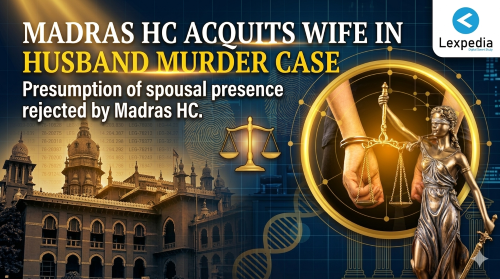
The Madras High Court has set aside the life imprisonment sentence of a woman convicted for the murder of her husband, emphasizing that the law cannot automatically assume spouses are together just because they reside in the same house. A division bench of Justice MS Ramesh and Justice Sunder Mohan delivered the judgment, noting that the prosecution failed to prove the presence of the wife at the time of the crime beyond a reasonable doubt.
Case Background The case dates back to an incident where the husband was found dead inside their residence. The trial court had initially convicted the wife, primarily relying on Section 106 of the Evidence Act, which places the burden of proof on a person when a fact is especially within their knowledge. Since the couple lived together, the lower court presumed the wife must explain how the death occurred.
Key Legal Observations The High Court disagreed with this mechanical application of the "Last Seen Theory." The bench observed:
-
No Continuous Presence: It is a fallacy to presume that a husband and wife are constantly in each other's company while at home.
-
Burden of Proof: The prosecution must first establish that the accused was present in the house when the incident took place before shifting the burden of proof to the accused.
-
Circumstantial Evidence: In this case, there was no independent evidence or witness testimony to confirm the wife was inside the house during the window of time when the murder occurred.
The court concluded that the "Last Seen" circumstance was not established, and the chain of evidence was broken. Consequently, the conviction was set aside, and the woman was ordered to be released.
मद्रास हाईकोर्ट ने पति की हत्या की आरोपी महिला को बरी किया; कहा- हमेशा साथ रहने का अनुमान नहीं लगाया जा सकता
मद्रास हाईकोर्ट ने अपने पति की हत्या के मामले में दोषी ठहराई गई एक महिला की उम्रकैद की सजा को रद्द कर दिया है। अदालत ने एक महत्वपूर्ण कानूनी टिप्पणी करते हुए कहा कि कानून स्वतः यह मानकर नहीं चल सकता कि पति-पत्नी एक ही घर में रहने के कारण हर समय साथ ही होंगे। जस्टिस एमएस रमेश और जस्टिस सुंदर मोहन की खंडपीठ ने यह फैसला सुनाया।
मामले की पृष्ठभूमि यह मामला एक व्यक्ति की उसके घर के भीतर हुई संदिग्ध मौत से जुड़ा है। निचली अदालत ने साक्ष्य अधिनियम की धारा 106 (Section 106 of the Evidence Act) के आधार पर पत्नी को दोषी माना था। इस धारा के तहत, यदि कोई तथ्य विशेष रूप से किसी व्यक्ति की जानकारी में हो, तो उसे साबित करने की जिम्मेदारी उसी की होती है। चूंकि वे साथ रहते थे, इसलिए निचली अदालत ने माना कि पत्नी को यह बताना चाहिए कि मौत कैसे हुई।
अदालत की महत्वपूर्ण टिप्पणियाँ हाईकोर्ट ने "लास्ट सीन थ्योरी" (अंतिम बार देखे जाने का सिद्धांत) के इस यांत्रिक अनुप्रयोग को खारिज कर दिया। पीठ ने कहा:
-
निरंतर उपस्थिति का अभाव: यह धारणा गलत है कि पति और पत्नी घर पर रहने के दौरान हर समय एक-दूसरे की संगति में होते हैं।
-
सबूत का बोझ: अभियोजन पक्ष को पहले यह साबित करना चाहिए कि घटना के समय आरोपी घर में मौजूद था। इसके बिना सबूत का बोझ आरोपी पर नहीं डाला जा सकता।
-
परिस्थितिजन्य साक्ष्य: इस मामले में ऐसा कोई स्वतंत्र सबूत या गवाह नहीं था जो यह पुष्टि कर सके कि जिस समय हत्या हुई, उस समय पत्नी घर के अंदर ही थी।
अदालत ने निष्कर्ष निकाला कि अभियोजन पक्ष आरोपी की मौजूदगी साबित करने में विफल रहा, जिससे साक्ष्यों की कड़ी टूट गई। इसके परिणामस्वरूप, सजा को रद्द कर दिया गया और महिला को रिहा करने का आदेश दिया गया।