Summoning Hotel Records and Call Detail Records to Prove Adultery Does Not Violate Right to Privacy: Supreme Court Upholds Delhi High Court Ruling
Lexpedia News · 4 July 2026 · 8 min read
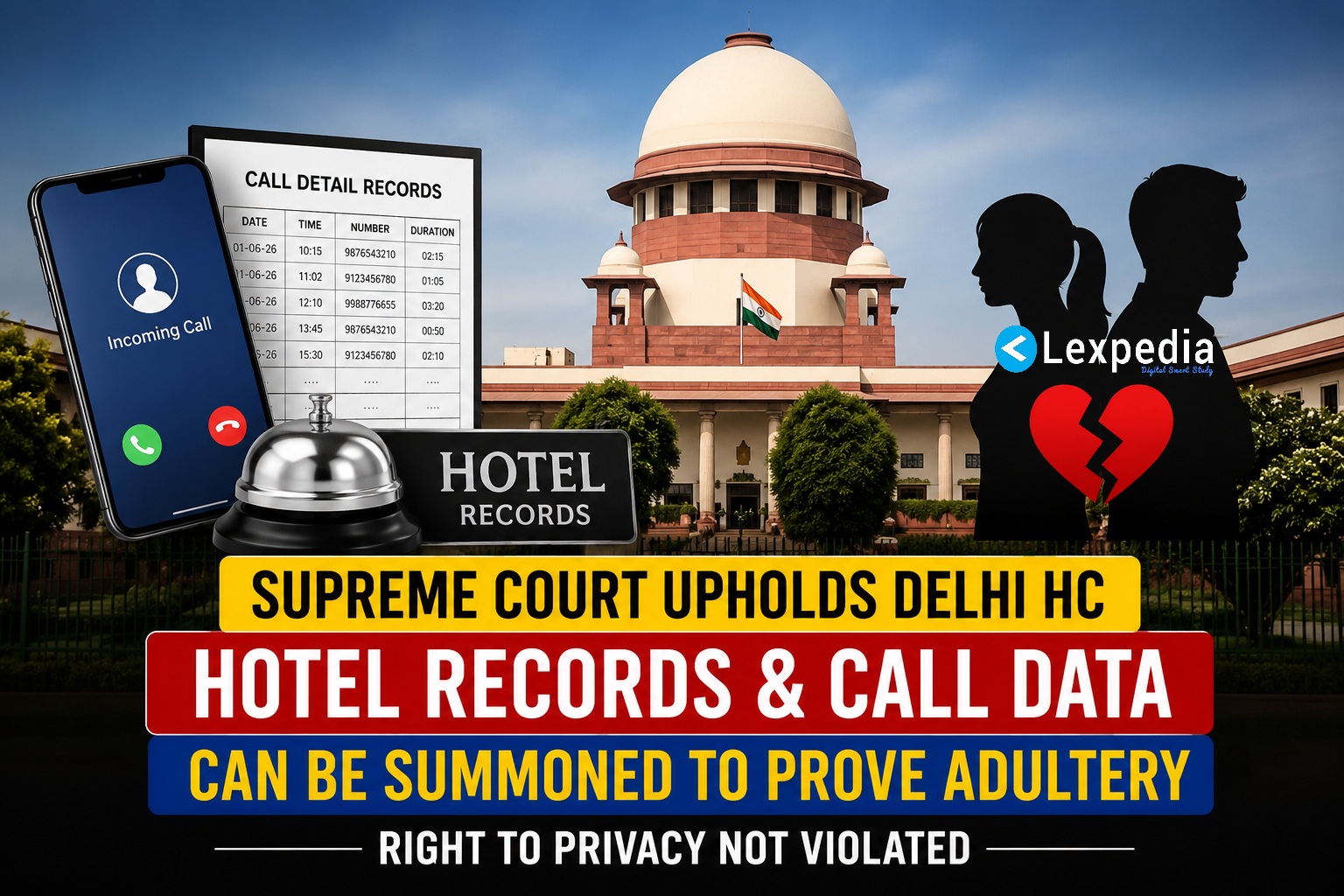
In a significant ruling clarifying the interplay between the right to privacy and the need to secure relevant evidence in matrimonial disputes, the Supreme Court of India has refused to interfere with a Delhi High Court judgment permitting a wife to summon her husband's hotel booking records and Call Detail Records (CDRs) to substantiate allegations of adultery in divorce proceedings.
A Bench comprising Justice Manmohan and Justice K. Vinod Chandran, by an order dated 2 July 2026, dismissed the husband's appeal against the Delhi High Court's 2023 judgment, holding that the Family Court's directions did not warrant interference. The Supreme Court thereby affirmed that, in appropriate matrimonial proceedings, production of such records for proving allegations of adultery does not, by itself, amount to an impermissible violation of the constitutional right to privacy under Article 21.
Background of the Case
The dispute arose from a matrimonial case in which the wife filed a petition seeking divorce on the grounds of cruelty and adultery.
To establish her allegations, she sought:
- the husband's hotel booking records relating to an alleged stay with another woman in Jaipur; and
- the husband's Call Detail Records (CDRs) for specified mobile numbers.
The Family Court allowed the application for production of these records, considering them relevant for adjudicating the allegations. The husband challenged this order before the Delhi High Court, contending that compelling disclosure of such information would infringe his fundamental right to privacy.
In May 2023, the Delhi High Court rejected his challenge and upheld the Family Court's order. The husband thereafter approached the Supreme Court.
Arguments Raised by the Husband
Before the Supreme Court, the husband argued that:
- directing disclosure of hotel booking records and CDRs constituted an invasion of his fundamental right to privacy;
- the directions amounted to an impermissible fishing inquiry into his personal life;
- compelling production of such records violated the principles laid down in Justice K.S. Puttaswamy (Retd.) v. Union of India, which recognised privacy as a fundamental right under Article 21.
He urged the Court to set aside the Delhi High Court's judgment on constitutional grounds.
Supreme Court's Decision
The Supreme Court declined to interfere with the Delhi High Court's judgment.
The Bench affirmed that the Family Court's direction permitting production of hotel records and CDRs for adjudicating allegations of adultery did not call for interference under its appellate jurisdiction.
By dismissing the appeal, the Supreme Court effectively upheld the reasoning that obtaining relevant evidence through judicial orders in matrimonial proceedings does not automatically violate an individual's privacy rights.
Delhi High Court's Reasoning Affirmed
The Delhi High Court had held that:
- allegations of adultery are ordinarily proved through circumstantial evidence rather than direct evidence;
- hotel booking records and call detail records may constitute relevant evidence in appropriate cases;
- the right to privacy is not absolute;
- where disclosure is ordered by a competent court for deciding issues directly arising in litigation, such disclosure can be legally justified.
The High Court had therefore concluded that the Family Court's order struck an appropriate balance between privacy and the administration of justice. The Supreme Court has now allowed that reasoning to stand.
Right to Privacy Not Absolute
Although the Supreme Court did not deliver a lengthy reasoned judgment while dismissing the appeal, the decision reinforces an important constitutional principle already recognised in Justice K.S. Puttaswamy (Retd.) v. Union of India:
- the right to privacy is a fundamental right under Article 21;
- however, it is not absolute;
- courts may permit disclosure of relevant information where required for fair adjudication of legal disputes, provided such disclosure is proportionate and authorised by law.
Importance in Matrimonial Litigation
The ruling is expected to have considerable significance in matrimonial disputes involving allegations of:
- adultery;
- cruelty;
- marital misconduct; and
- other issues requiring documentary or electronic evidence.
The judgment recognises that matrimonial courts may rely upon relevant electronic and documentary evidence where necessary to determine disputed facts, while ensuring that such production remains subject to judicial supervision.
Clarification on Adultery Law
The decision does not recriminalise adultery.
The offence of adultery under Section 497 of the Indian Penal Code was struck down by the Supreme Court in Joseph Shine v. Union of India (2018).
However, adultery continues to remain a recognised civil ground for divorce under personal laws governing marriage. The present ruling concerns only the admissibility of evidence in matrimonial proceedings and not criminal liability.
Present Legal Position
Officially decided
- The Supreme Court has dismissed the husband's appeal.
- The Delhi High Court judgment permitting production of hotel booking records and CDRs remains valid.
- Courts may permit such evidence in matrimonial proceedings where it is relevant to allegations such as adultery.
- The right to privacy cannot automatically be invoked to prevent judicially authorised disclosure of relevant evidence.
Not decided
The Supreme Court has not held that:
- hotel records or CDRs will be admissible in every matrimonial case; or
- privacy rights stand eliminated in matrimonial litigation.
Rather, the ruling is confined to the facts of the present case and recognises that courts may direct disclosure where it is legally justified and proportionate.
सुप्रीम कोर्ट का महत्वपूर्ण फैसला: व्यभिचार सिद्ध करने के लिए होटल रिकॉर्ड और कॉल डिटेल रिकॉर्ड (CDR) मंगाना निजता के अधिकार का उल्लंघन नहीं
सुप्रीम कोर्ट ने एक महत्वपूर्ण निर्णय में स्पष्ट किया है कि वैवाहिक विवादों में व्यभिचार (Adultery) के आरोपों को सिद्ध करने के लिए न्यायालय द्वारा होटल बुकिंग रिकॉर्ड तथा कॉल डिटेल रिकॉर्ड (CDR) मंगाने की अनुमति देना, अपने-आप में अनुच्छेद 21 के तहत प्राप्त निजता के अधिकार (Right to Privacy) का उल्लंघन नहीं माना जाएगा।
न्यायमूर्ति मनमोहन तथा न्यायमूर्ति के. विनोद चंद्रन की पीठ ने 2 जुलाई 2026 को पति द्वारा दायर अपील को खारिज करते हुए दिल्ली हाईकोर्ट के वर्ष 2023 के निर्णय में हस्तक्षेप करने से इनकार कर दिया। इसके साथ ही सुप्रीम कोर्ट ने अप्रत्यक्ष रूप से यह स्वीकार किया कि उपयुक्त मामलों में फैमिली कोर्ट द्वारा होटल रिकॉर्ड और CDR मंगाने का आदेश विधिसम्मत हो सकता है।
मामले की पृष्ठभूमि
यह मामला एक वैवाहिक विवाद से संबंधित है, जिसमें पत्नी ने क्रूरता तथा व्यभिचार के आधार पर तलाक की याचिका दायर की थी।
अपने आरोपों को सिद्ध करने के लिए पत्नी ने न्यायालय से अनुरोध किया कि—
- जयपुर के एक होटल से पति की कथित बुकिंग संबंधी रिकॉर्ड मंगाए जाएँ;
- पति के कुछ मोबाइल नंबरों के कॉल डिटेल रिकॉर्ड (CDRs) भी तलब किए जाएँ।
फैमिली कोर्ट ने इस आवेदन को स्वीकार कर लिया। पति ने इसे दिल्ली हाईकोर्ट में चुनौती दी, यह कहते हुए कि इससे उसके निजता के मौलिक अधिकार का उल्लंघन होगा।
मई 2023 में दिल्ली हाईकोर्ट ने उसकी याचिका खारिज कर दी। इसके बाद पति सुप्रीम कोर्ट पहुँचा।
पति की दलीलें
पति की ओर से तर्क दिया गया कि—
- होटल रिकॉर्ड और CDR मंगाना उसकी निजी ज़िंदगी में अनुचित हस्तक्षेप है;
- इससे अनुच्छेद 21 के तहत प्राप्त निजता के अधिकार का उल्लंघन होता है;
- Justice K.S. Puttaswamy (Retd.) v. Union of India के निर्णय के अनुसार निजता एक मौलिक अधिकार है और ऐसे आदेश असंवैधानिक हैं।
सुप्रीम कोर्ट का निर्णय
सुप्रीम कोर्ट ने इन दलीलों को स्वीकार नहीं किया और अपील खारिज कर दी।
पीठ ने कहा कि दिल्ली हाईकोर्ट द्वारा फैमिली कोर्ट के आदेश को बरकरार रखने में हस्तक्षेप करने का कोई कारण नहीं है।
इस प्रकार सुप्रीम कोर्ट ने यह स्पष्ट कर दिया कि वैवाहिक मुकदमों में न्यायालय द्वारा प्रासंगिक साक्ष्य मंगाने का आदेश केवल इस आधार पर अवैध नहीं हो जाता कि उससे किसी पक्ष की निजता प्रभावित होती है।
दिल्ली हाईकोर्ट की दलीलों को मिली स्वीकृति
दिल्ली हाईकोर्ट ने कहा था कि—
- व्यभिचार के आरोप सामान्यतः परिस्थितिजन्य साक्ष्यों से सिद्ध किए जाते हैं;
- होटल रिकॉर्ड और CDR ऐसे मामलों में महत्वपूर्ण साक्ष्य हो सकते हैं;
- निजता का अधिकार पूर्ण (Absolute) नहीं है;
- यदि सक्षम न्यायालय न्यायिक कार्यवाही के लिए आवश्यक रिकॉर्ड मंगाता है तो उसे असंवैधानिक नहीं कहा जा सकता।
सुप्रीम कोर्ट ने इस दृष्टिकोण में हस्तक्षेप करने से इनकार किया।
निजता का अधिकार पूर्ण नहीं
यह निर्णय पुनः स्पष्ट करता है कि—
- निजता का अधिकार एक मौलिक अधिकार है;
- लेकिन यह असीमित नहीं है;
- न्यायिक प्रक्रिया में सत्य की खोज तथा निष्पक्ष निर्णय के लिए आवश्यक एवं प्रासंगिक साक्ष्य न्यायालय मंगा सकता है, यदि ऐसा आदेश विधि के अनुरूप तथा अनुपातिक (Proportionate) हो।
वैवाहिक मामलों पर प्रभाव
यह निर्णय भविष्य में उन वैवाहिक मामलों में महत्वपूर्ण माना जाएगा जहाँ—
- व्यभिचार,
- क्रूरता,
- वैवाहिक दुराचार,
- अथवा अन्य विवादित तथ्यों को सिद्ध करने के लिए इलेक्ट्रॉनिक या दस्तावेजी साक्ष्य की आवश्यकता हो।
फैमिली कोर्ट आवश्यक परिस्थितियों में ऐसे रिकॉर्ड तलब कर सकते हैं, बशर्ते आदेश न्यायिक रूप से उचित और कानूनसम्मत हो।
महत्वपूर्ण स्पष्टीकरण
यह निर्णय व्यभिचार को पुनः अपराध घोषित नहीं करता।
सुप्रीम कोर्ट ने Joseph Shine v. Union of India (2018) में भारतीय दंड संहिता की धारा 497 को असंवैधानिक घोषित कर दिया था।
हालाँकि, व्यभिचार आज भी तलाक का एक वैध सिविल आधार बना हुआ है। वर्तमान निर्णय केवल साक्ष्य की स्वीकार्यता और न्यायालय द्वारा रिकॉर्ड मंगाने की शक्ति से संबंधित है, न कि किसी आपराधिक दायित्व से।
वर्तमान कानूनी स्थिति
आधिकारिक रूप से तय
- सुप्रीम कोर्ट ने पति की अपील खारिज कर दी है।
- दिल्ली हाईकोर्ट का निर्णय प्रभावी बना हुआ है।
- उपयुक्त वैवाहिक मामलों में न्यायालय होटल रिकॉर्ड और CDR मंगाने की अनुमति दे सकते हैं।
- केवल निजता के अधिकार का हवाला देकर ऐसे न्यायिक आदेशों को स्वतः रोका नहीं जा सकता।
अभी तय नहीं हुआ
सुप्रीम कोर्ट ने यह नहीं कहा है कि—
- हर वैवाहिक मामले में होटल रिकॉर्ड या CDR अनिवार्य रूप से मंगाए जाएँगे; अथवा
- निजता का अधिकार समाप्त हो गया है।
निर्णय केवल यह स्थापित करता है कि प्रत्येक मामले के तथ्यों के आधार पर न्यायालय आवश्यक, प्रासंगिक और अनुपातिक साक्ष्य प्रस्तुत करने का आदेश दे सकता है।