Supreme Court: “Wife is not a maid”; refusal to do household chores not cruelty in divorce case
Lexpedia News · 20 March 2026 · 3 min read
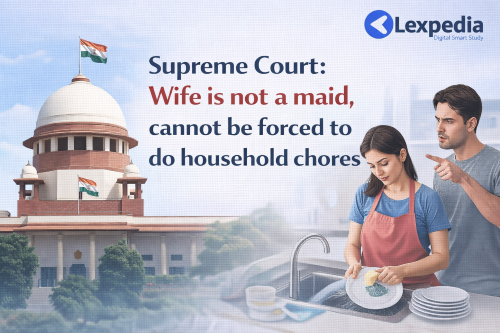
In a significant observation on evolving marital norms, the Supreme Court of India has held that a wife cannot be treated as a domestic worker, and her refusal to perform household chores cannot by itself constitute cruelty for the purpose of divorce.
The observation was made by a Bench comprising Justice Vikram Nath and Justice Sandeep Mehta while hearing a husband’s plea seeking divorce on the ground that his wife failed to perform household duties such as cooking and cleaning.
The matter arose from an appeal filed by the husband challenging a High Court decision that had set aside a trial court decree granting him divorce on grounds of cruelty. The husband had alleged that his wife did not perform household chores and that such conduct amounted to mental cruelty.
Rejecting this contention, the Court made it clear that domestic responsibilities are not the sole obligation of the wife. It observed that in modern marriages, both spouses are often educated and working, and therefore household duties must be shared. The Bench emphasised that expecting a wife to perform all domestic chores reflects an outdated mindset.
The Court categorically remarked that a man is not marrying a maid but a life partner, underscoring that marriage is a relationship based on equality, mutual respect, and cooperation rather than servitude.
It further noted that disagreements over household work fall within the realm of normal wear and tear of married life and do not meet the legal threshold of cruelty required for granting divorce.
The Court also took into account that the couple has a young child and both parties are educated and financially independent. In this context, it indicated the possibility of reconciliation and directed both parties to appear in person on the next date of hearing.
This ruling reinforces the principle that domestic chores cannot be used as a ground for divorce and highlights the judiciary’s recognition of changing social realities, where marriage is viewed as a partnership of equals rather than a one-sided obligation.
सुप्रीम कोर्ट: “पत्नी नौकरानी नहीं है”; घरेलू काम न करना तलाक का आधार नहीं
Supreme Court of India ने एक महत्वपूर्ण टिप्पणी में कहा है कि पत्नी को नौकरानी की तरह नहीं माना जा सकता और घरेलू काम न करना तलाक के लिए क्रूरता का आधार नहीं बनता।
यह टिप्पणी Justice Vikram Nath और Justice Sandeep Mehta की पीठ ने उस मामले की सुनवाई के दौरान की, जिसमें पति ने पत्नी के घरेलू कार्य न करने को क्रूरता बताते हुए तलाक की मांग की थी।
मामला उस अपील से संबंधित था जिसमें पति ने हाईकोर्ट के उस फैसले को चुनौती दी थी, जिसने ट्रायल कोर्ट द्वारा दिए गए तलाक के आदेश को रद्द कर दिया था। पति का आरोप था कि उसकी पत्नी घरेलू काम नहीं करती और यह मानसिक क्रूरता के बराबर है।
अदालत ने इस तर्क को खारिज करते हुए कहा कि घरेलू कार्य केवल पत्नी की जिम्मेदारी नहीं है। आधुनिक समाज में दोनों पति-पत्नी शिक्षित और कार्यरत होते हैं, इसलिए घरेलू जिम्मेदारियां साझा होनी चाहिए।
अदालत ने स्पष्ट रूप से कहा कि व्यक्ति नौकरानी से नहीं बल्कि जीवनसाथी से विवाह करता है, और विवाह समानता, सम्मान और सहयोग पर आधारित होता है, न कि सेवा पर।
अदालत ने यह भी कहा कि घरेलू काम को लेकर मतभेद वैवाहिक जीवन का सामान्य हिस्सा हैं और इन्हें क्रूरता नहीं माना जा सकता।
साथ ही, अदालत ने यह भी ध्यान में रखा कि दंपति का एक छोटा बच्चा है और दोनों पक्ष शिक्षित एवं आर्थिक रूप से सक्षम हैं। इस संदर्भ में अदालत ने सुलह की संभावना पर विचार करते हुए दोनों पक्षों को अगली तारीख पर व्यक्तिगत रूप से उपस्थित होने का निर्देश दिया।
यह निर्णय स्पष्ट करता है कि घरेलू कार्यों को तलाक का आधार नहीं बनाया जा सकता और यह विवाह में समानता तथा आधुनिक सामाजिक मूल्यों को मजबूत करता है।