Delhi High Court: Husband Cannot Use Voluntary Retirement to Avoid Paying Maintenance
Lexpedia News · 19 March 2026 · 3 min read
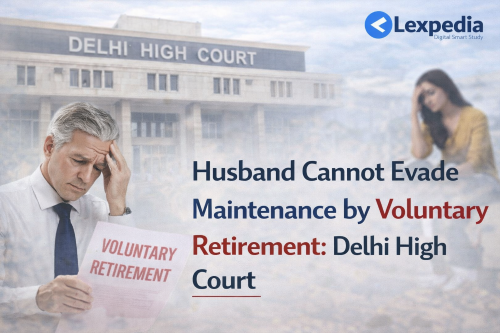
The Delhi High Court has ruled that a husband cannot evade his legal obligation to pay maintenance to his wife by opting for voluntary retirement (VRS), reaffirming that financial responsibilities in matrimonial relationships cannot be avoided through self-induced reduction of income.
The Court emphasized that maintenance is a statutory obligation, and a husband cannot deliberately diminish his earning capacity to escape this duty.
Background of the Case
The case arose from a matrimonial dispute where the husband sought to avoid paying maintenance by citing that he had taken early voluntary retirement, thereby reducing his income.
He argued that:
- His financial condition had changed after retirement
- He was no longer earning a regular salary
- Therefore, he should not be compelled to pay maintenance at the earlier level
Court’s Observations
Rejecting the husband’s contention, the High Court made significant observations:
- A person cannot voluntarily reduce income and then plead inability to maintain a spouse
- Maintenance obligations are based on earning capacity, not merely actual income
- A husband cannot use self-created financial constraints as a defence
The Court underscored that:
👉 “Legal duty towards spouse cannot be avoided by stepping away from employment voluntarily.”
Principle of Earning Capacity
The Court reiterated an important principle in maintenance law:
- Courts assess real earning potential and standard of living, not just current income
- If a person is capable of earning but chooses not to, it does not absolve liability
This aligns with consistent judicial reasoning that maintenance ensures dignity and financial security of the dependent spouse.
No Escape Through Personal Decisions
The judgment makes it clear that:
- Decisions like early retirement, resignation, or career change cannot be used to deny maintenance
- Such actions, if voluntary, will not be considered valid grounds to reduce or avoid financial responsibility
Significance of the Judgment
This ruling strengthens the legal position that:
- Maintenance is a continuing obligation
- Courts will prevent misuse of legal processes to circumvent spousal responsibilities
- Financial accountability in marriage cannot be manipulated through strategic income reduction
It also serves as a deterrent against attempts to artificially lower income to escape maintenance liability.
दिल्ली हाईकोर्ट: स्वैच्छिक सेवानिवृत्ति लेकर पति भरण-पोषण देने से बच नहीं सकता
Delhi High Court ने महत्वपूर्ण फैसला देते हुए कहा है कि कोई पति स्वैच्छिक सेवानिवृत्ति (VRS) लेकर अपनी पत्नी को भरण-पोषण देने की जिम्मेदारी से बच नहीं सकता।
अदालत ने स्पष्ट किया कि भरण-पोषण एक कानूनी दायित्व (statutory obligation) है, जिसे व्यक्तिगत निर्णयों के आधार पर टाला नहीं जा सकता।
मामले की पृष्ठभूमि
मामले में पति ने यह तर्क दिया कि:
- उसने स्वेच्छा से नौकरी छोड़ दी है
- उसकी आय कम हो गई है
- इसलिए उसे भरण-पोषण देने से राहत दी जानी चाहिए
हाईकोर्ट की टिप्पणी
अदालत ने इस तर्क को खारिज करते हुए कहा:
- कोई व्यक्ति जानबूझकर अपनी आय कम करके जिम्मेदारी से नहीं बच सकता
- भरण-पोषण का निर्धारण केवल वर्तमान आय से नहीं, बल्कि आय अर्जित करने की क्षमता से होता है
अदालत ने कहा कि:
👉 पति अपने निर्णयों के आधार पर अपनी जिम्मेदारी से मुक्त नहीं हो सकता।
महत्वपूर्ण सिद्धांत
अदालत ने स्पष्ट किया कि:
- भरण-पोषण का उद्देश्य पत्नी को सम्मानजनक जीवन (dignified life) देना है
- यदि पति में कमाने की क्षमता है, तो वह जिम्मेदारी से बच नहीं सकता
निर्णय का महत्व
यह फैसला महत्वपूर्ण है क्योंकि:
- यह भरण-पोषण कानून के दुरुपयोग को रोकता है
- पति द्वारा आय कम दिखाकर जिम्मेदारी से बचने की कोशिश पर रोक लगाता है
- यह सुनिश्चित करता है कि पत्नी को आर्थिक सुरक्षा और सम्मानजनक जीवन मिले