WhatsApp Chats Alone Not Enough To Grant Divorce: Bombay High Court
Lexpedia News · 5 March 2026 · 4 min read
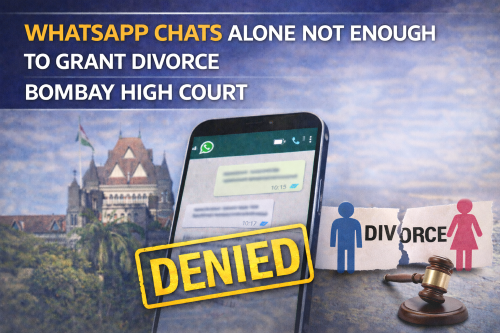
The Bombay High Court has ruled that divorce cannot be granted solely on the basis of WhatsApp chat messages, emphasising that such digital communications must be properly proved and tested through evidence during trial. The Court set aside an ex-parte divorce decree granted by a Nashik Family Court, observing that the decision relied almost entirely on WhatsApp and SMS chats without giving the other spouse an opportunity to contest the evidence.
The judgment was delivered by a Division Bench comprising Justice Bharati H. Dangre and Justice Manjusha Deshpande, while hearing an appeal filed by a wife challenging the divorce decree granted in favour of her husband under the Hindu Marriage Act, 1955.
Background Of The Case
The dispute originated before the Nashik Family Court, where the husband sought divorce on the ground of mental cruelty. To support his allegations, he produced WhatsApp and SMS chats exchanged between the spouses, claiming that the messages showed emotional blackmail, derogatory language and pressure tactics used by the wife.
The Family Court accepted these chats as sufficient proof and granted the husband an ex-parte decree of divorce, concluding that the wife’s messages constituted mental cruelty and made it impossible for the husband to continue the marriage.
High Court’s Observations
The Bombay High Court found serious procedural shortcomings in the Family Court’s approach. It noted that the wife was not given an opportunity to rebut the WhatsApp chats or present her own evidence, thereby violating principles of natural justice.
The Bench clearly stated:
“Merely relying on the WhatsApp chat, the divorce decree cannot be granted, since it is not proved by leading evidence.”
The Court stressed that electronic communications alone cannot conclusively establish cruelty unless they are tested through proper evidence and adversarial proceedings.
Divorce Decree Set Aside
In light of these findings, the High Court set aside the Family Court’s divorce decree and remanded the case back for a fresh hearing. The Court directed that the wife must be given a fair opportunity to:
- challenge the WhatsApp messages,
- present her own evidence, and
- participate fully in the trial process.
The Bench also recorded that the parties may explore settlement through mediation before the Family Court if they wish to resolve the dispute amicably.
Significance Of The Judgment
Legal experts note that the ruling reinforces two key principles in matrimonial litigation:
- Digital evidence must be properly proved and cannot automatically establish allegations such as cruelty.
- Natural justice requires that both parties be given a fair opportunity to contest evidence before a divorce decree is granted.
The judgment also highlights the growing challenges courts face in dealing with digital communications such as WhatsApp messages in matrimonial disputes, where context and authenticity often require careful scrutiny.
सिर्फ WhatsApp चैट के आधार पर तलाक नहीं दिया जा सकता: बॉम्बे हाई कोर्ट
बॉम्बे हाई कोर्ट ने कहा है कि केवल WhatsApp चैट के आधार पर तलाक का आदेश नहीं दिया जा सकता। अदालत ने नासिक के फैमिली कोर्ट द्वारा दिए गए एकतरफा तलाक के आदेश को रद्द करते हुए कहा कि डिजिटल संदेशों को उचित सबूत और सुनवाई के बिना तलाक का आधार नहीं बनाया जा सकता।
यह फैसला न्यायमूर्ति भारती एच. डांगरे और न्यायमूर्ति मंजुषा देशपांडे की डिवीजन बेंच ने दिया। मामला एक पत्नी की अपील पर सुनवाई के दौरान सामने आया, जिसने फैमिली कोर्ट के उस आदेश को चुनौती दी थी जिसमें उसके पति को हिंदू विवाह अधिनियम, 1955 के तहत तलाक दे दिया गया था।
मामले की पृष्ठभूमि
पति ने फैमिली कोर्ट में तलाक की याचिका दाखिल करते हुए पत्नी पर मानसिक क्रूरता का आरोप लगाया था। अपने दावे के समर्थन में उसने WhatsApp और SMS चैट अदालत में पेश किए और कहा कि इन संदेशों से पत्नी द्वारा किए गए दबाव, भावनात्मक ब्लैकमेल और अपमानजनक भाषा का पता चलता है।
फैमिली कोर्ट ने इन चैट को पर्याप्त सबूत मानते हुए पति के पक्ष में एकतरफा तलाक का आदेश पारित कर दिया।
हाई कोर्ट की टिप्पणी
हाई कोर्ट ने पाया कि पत्नी को इन चैट्स का जवाब देने या अपने सबूत पेश करने का मौका नहीं दिया गया, जो कि प्राकृतिक न्याय के सिद्धांतों के खिलाफ है।
अदालत ने स्पष्ट कहा:
“सिर्फ WhatsApp चैट के आधार पर तलाक का आदेश नहीं दिया जा सकता, क्योंकि इसे साक्ष्य द्वारा सिद्ध नहीं किया गया है।”
तलाक का आदेश रद्द
इन कारणों से हाई कोर्ट ने फैमिली कोर्ट के तलाक के आदेश को रद्द कर दिया और मामले को दोबारा सुनवाई के लिए फैमिली कोर्ट को वापस भेज दिया। पत्नी को अब सबूत पेश करने और अपना पक्ष रखने का पूरा अवसर दिया जाएगा।
अदालत ने यह भी कहा कि यदि दोनों पक्ष चाहें तो मध्यस्थता (mediation) के माध्यम से विवाद का समाधान तलाश सकते हैं।