
Zahirul Haque Laskar v. State of Assam & Anr., 2026
Gauhati High Court Quashes Section 145 CrPC Proceedings Where Possession Was Admitted.
Judgement Details
Court
Gauhati High Court
Date of Decision
6 July 2026
Judges
Justice Sanjeev Kumar Sharma
Citation
Acts / Provisions
Facts of the Case
-
The dispute related to possession of a piece of land situated in Hailakandi, Assam.
-
The respondent claimed to be the lawful owner of the disputed land by virtue of inheritance and alleged that the petitioner was originally inducted into the premises as a tenant for carrying on business.
-
According to the respondent, the petitioner initially paid monthly rent but later stopped paying rent while continuing to occupy the premises.
-
The respondent alleged that when he intended to expand the existing shop and godown, the petitioner and his brothers obstructed him and attempted to dispossess him, creating a likelihood of breach of public peace.
-
Based on the complaint, the Additional District Magistrate, Hailakandi, sought a police report regarding the dispute.
-
The police reported that a land dispute existed between the parties and stated that both sides were likely to disturb public peace, recommending preventive action.
-
Acting on the police report, the Additional District Magistrate initiated proceedings under Sections 145 and 146(1) CrPC and ordered attachment of the disputed property.
-
The petitioner challenged the proceedings before the High Court under Section 482 CrPC, contending that the respondent's own pleadings admitted that the petitioner was already in possession of the land.
-
It was argued that since possession itself was never disputed, the Magistrate lacked jurisdiction to initiate proceedings under Section 145 CrPC.
Issues
-
Whether proceedings under Section 145 CrPC can be initiated when the respondent himself admits that the petitioner is in possession of the disputed land?
-
Whether the existence of a dispute regarding ownership alone is sufficient to invoke jurisdiction under Section 145 CrPC?
-
Whether attachment of the disputed property under Section 146(1) CrPC is valid when the essential conditions under Section 145 CrPC are absent?
-
Whether continuation of proceedings under Sections 145 and 146 CrPC amounts to an abuse of the process of law when there is no bona fide dispute regarding possession?
Judgement
-
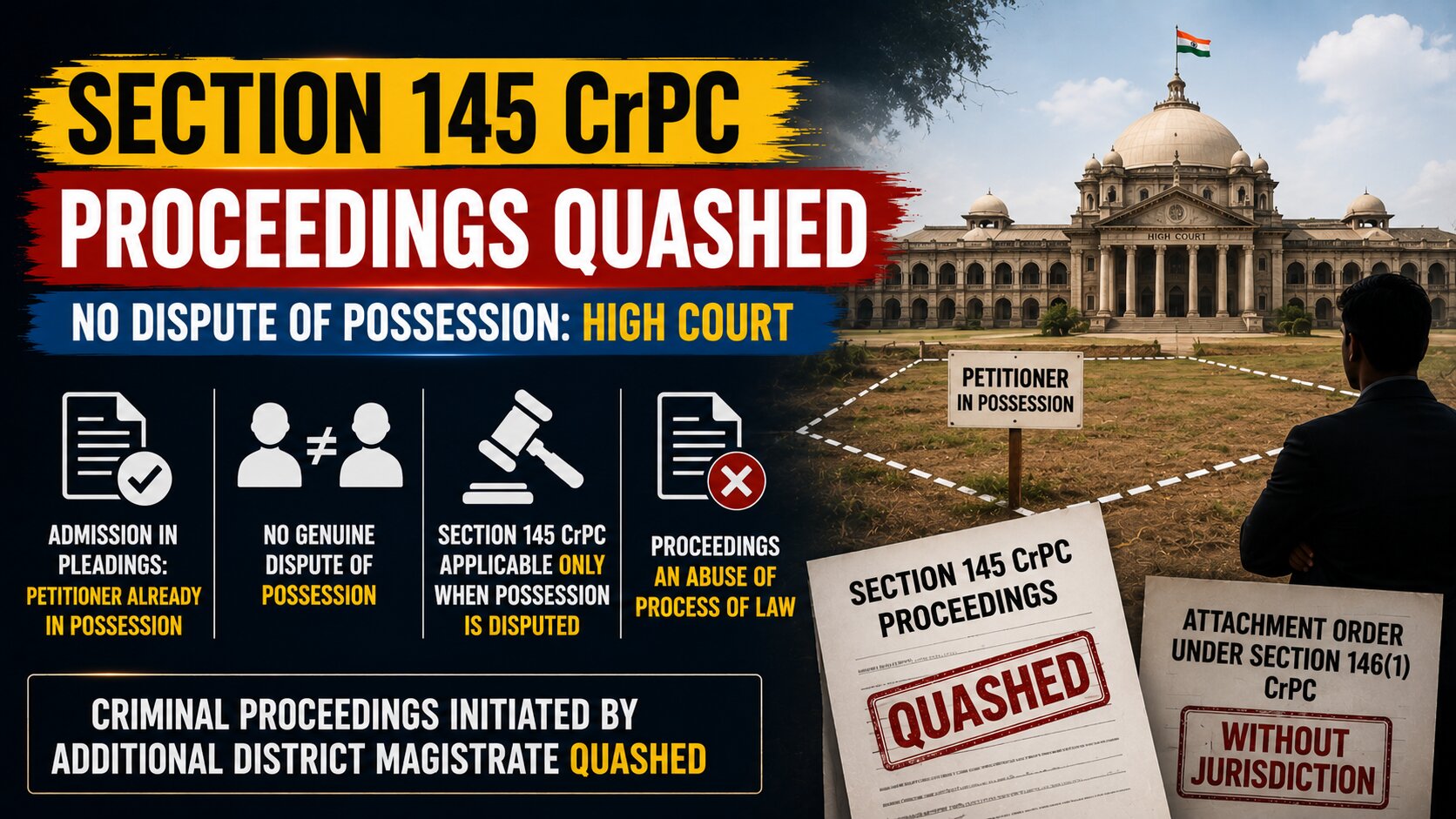
The High Court held that the respondent's own pleadings clearly admitted that the petitioner was already in possession of the disputed land.
-
The Court observed that there was no genuine or bona fide dispute regarding the fact of possession between the parties.
-
It emphasized that Section 145 CrPC can be invoked only when there exists a real dispute concerning actual possession which is likely to result in a breach of peace.
-
The Court explained that the primary function of the Magistrate under Section 145 CrPC is to determine who was in actual possession of the property at the relevant time.
-
Since possession was already admitted, there remained no issue requiring adjudication by the Magistrate under Section 145 CrPC.
-
The Court held that the police report indicating a likelihood of breach of peace could not by itself confer jurisdiction where the statutory requirements of Section 145 CrPC were absent.
-
It observed that a Magistrate cannot invoke Section 145 CrPC merely to resolve disputes relating to ownership or tenancy when actual possession is undisputed.
-
The Court found that the attachment order passed under Section 146(1) CrPC was also without jurisdiction because it was dependent upon a valid proceeding under Section 145 CrPC.
-
The Court further held that permitting such proceedings to continue would amount to an abuse of the process of law.
-
Accordingly, the High Court allowed the criminal petition and quashed the proceedings initiated by the Additional District Magistrate.
Held
-
Proceedings under Section 145 CrPC are not maintainable where possession of the disputed property is an admitted fact.
-
The essential jurisdictional requirement for invoking Section 145 CrPC was absent in the present case.
-
The attachment order under Section 146(1) CrPC was without legal basis.
-
Continuation of the proceedings amounted to an abuse of the process of law.
-
The criminal petition was allowed and the impugned proceedings were quashed.
Analysis
-
The judgment reiterates that Section 145 CrPC is a preventive provision intended to maintain public order and not to adjudicate civil disputes relating to ownership or title.
-
The Court correctly distinguished between a dispute over title and a dispute over actual possession, emphasizing that only the latter attracts the jurisdiction of Section 145 CrPC.
-
The decision reinforces that the Magistrate must first satisfy himself that a genuine dispute regarding possession exists before exercising jurisdiction.
-
The Court underscored that the existence of a police report alleging possible breach of peace cannot substitute the statutory conditions prescribed under Section 145 CrPC.
-
By relying on the respondent's own pleadings, the Court applied the evidentiary principle that admitted facts require no further proof and cannot simultaneously be treated as disputed.
-
The judgment safeguards individuals against misuse of preventive criminal proceedings for settling private civil disputes involving tenancy or ownership.
-
The ruling strengthens the principle that criminal preventive jurisdiction should not be invoked where civil remedies are more appropriate.
-
The decision also reinforces the High Court's inherent powers under Section 482 CrPC to prevent abuse of judicial process and to secure the ends of justice.
-
The judgment is likely to serve as an important precedent discouraging unnecessary invocation of Sections 145 and 146 CrPC in cases where possession is admitted.
-
A notable strength of the decision is its insistence on strict compliance with jurisdictional prerequisites before curtailing possessory rights through preventive criminal proceedings.