
Y. Gnana Ganesh and Another v. State of Tamil Nadu, 2026
Section 15(2) ITP Act Search Safeguards Apply Only to Residential Premises, Not Commercial Establishments
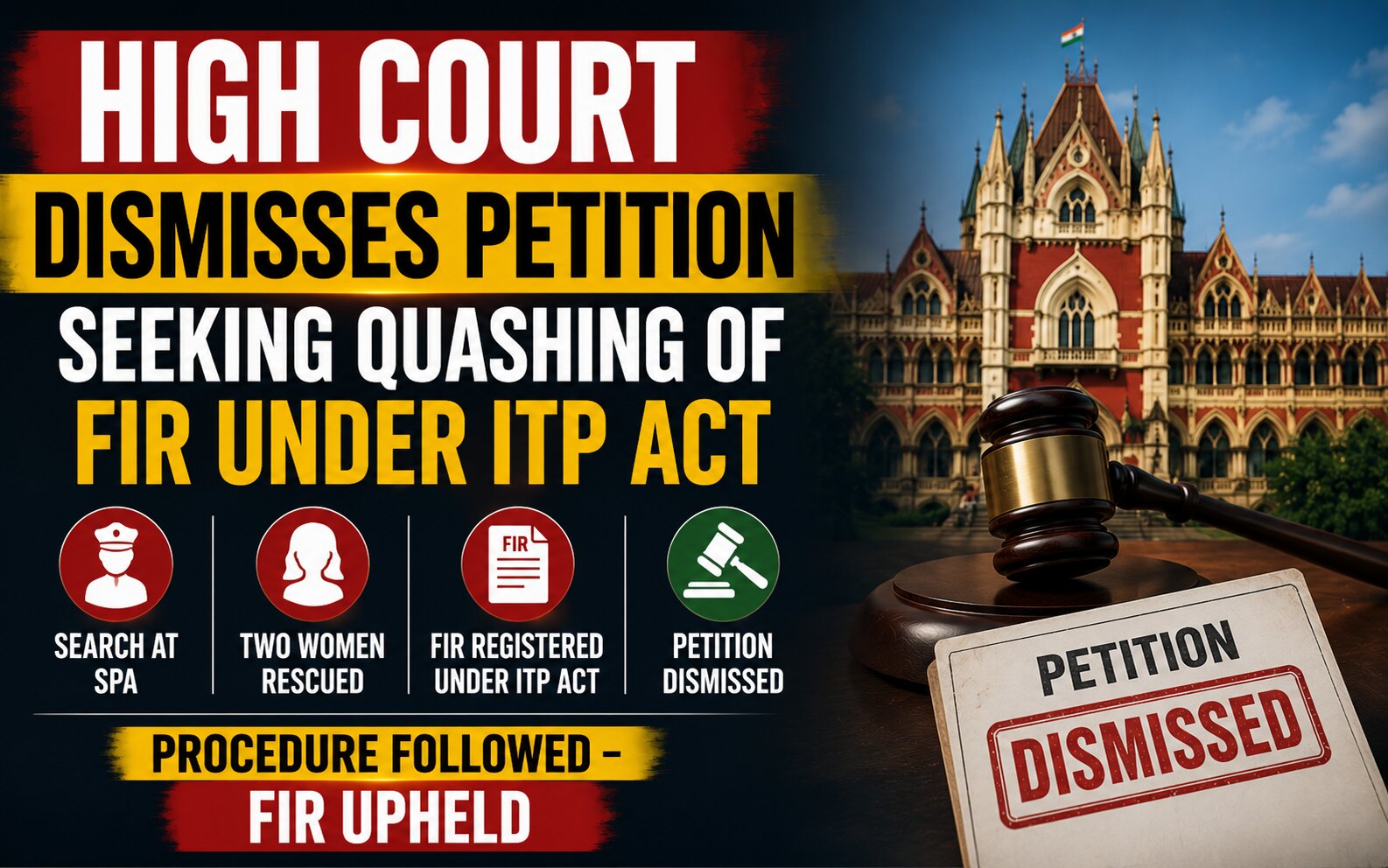
Judgement Details
Court
Madras High Court
Date of Decision
6 July 2026
Judges
Justice R. Vijayakumar
Citation
Acts / Provisions
Facts of the Case
-
The petitioners sought quashing of the FIR registered against them for offences under the Immoral Traffic (Prevention) Act, 1956.
-
According to the prosecution, on 4 November 2024, the Special Sub-Inspector of Police, accompanied by two Lady Head Constables, acted upon secret information regarding illegal activities being carried on in a Spa.
-
After obtaining permission from the Assistant Commissioner of Police, the police conducted a search at the Spa.
-
During the search, two women from Nagaland and Assam were allegedly found in a half-nude condition in separate rooms.
-
The women allegedly informed the police that they had been brought to the Spa under the guise of employment and were being forced into prostitution.
-
Based on these allegations, an FIR was registered against the petitioners under various provisions of the ITP Act.
-
The petitioners contended that the search was illegal because it was not conducted by a Special Police Officer and because two respectable inhabitants of the locality were not called to witness the search as required under Section 15(2) of the Act.
-
They further alleged that the victims' statements were recorded in a language they did not understand and that their signatures were obtained through coercion.
-
The State opposed the petition, contending that the Inspector of Police conducting the search had been duly appointed as a Special Police Officer and that the victims' statements had subsequently been recorded under Section 164 CrPC.
Issues
-
Whether the requirement under Section 15(2) of the Immoral Traffic (Prevention) Act, 1956 to associate two respectable inhabitants during a search applies to commercial premises?
-
Whether the search conducted at the Spa was invalid because independent witnesses were not present?
-
Whether the search was conducted by a competent Special Police Officer under the ITP Act?
-
Whether the alleged irregularities in recording the victims' statements justified quashing of the FIR?
Judgement
-
The High Court held that the procedure prescribed under Section 15(2) of the ITP Act is mandatory only when the search is conducted at a residential premises.
-
The Court observed that Section 15(1) refers to premises where a person is living, thereby indicating that the safeguards under Section 15(2) are intended to protect searches of residential premises and not commercial establishments.
-
It held that the statutory requirement of calling two respectable inhabitants, including one woman, does not extend to searches conducted at commercial premises, such as a Spa.
-
The Court explained that the object of Section 15(2) is to protect the privacy and dignity of victims and to avoid unnecessary stigma to residents of a locality, rather than to create a defence for accused persons.
-
It held that the accused could not seek quashing of the FIR merely because independent witnesses had not been associated during the search of a commercial establishment.
-
The Court further found that the search had been conducted by an Inspector of Police who had been validly appointed as a Special Police Officer under the Government Order issued by the Social Welfare Department.
-
It also noted that the victims' statements had subsequently been recorded by the Jurisdictional Magistrate under Section 164 CrPC.
-
The Court declined to rely upon the affidavit produced by the accused alleging that the victims did not understand the language in which their statements were recorded, holding that such disputed questions could not be examined in proceedings seeking quashing of the FIR.
-
Finding no legal infirmity in the investigation or the registration of the FIR, the Court dismissed the petitions seeking quashing.
Held
-
Section 15(2) of the ITP Act applies only to residential premises and not to commercial establishments.
-
The absence of independent witnesses during the search of a commercial premises does not invalidate the search.
-
The search was conducted by a competent Special Police Officer.
-
The allegations regarding the victims' statements could not justify quashing of the FIR at the preliminary stage.
-
The petitions seeking quashing of the FIR were dismissed.
Analysis
- The judgment adopts a purposive interpretation of Sections 15(1) and 15(2) of the Immoral Traffic (Prevention) Act, harmonizing both provisions according to their legislative object.
-
The Court correctly distinguished between residential premises and commercial premises, thereby limiting the mandatory procedural safeguards to situations where privacy concerns are most significant.
-
The decision clarifies that the purpose of Section 15(2) is to protect the privacy and dignity of occupants and victims, rather than to create technical defences for accused persons.
-
By refusing to quash the FIR solely on procedural objections, the Court reaffirmed that minor or disputed procedural irregularities ordinarily require appreciation of evidence during trial.
-
The Court also strengthened the legal position that Inspectors of Police appointed through a valid Government Order may function as Special Police Officers under the ITP Act.
-
The judgment appropriately relied upon the recording of the victims' statements under Section 164 CrPC, recognizing such statements as an important safeguard during criminal investigation.
-
The ruling discourages attempts to invoke Section 482 CrPC (quashing jurisdiction) for adjudicating disputed questions of fact requiring evidence.
-
The decision is likely to guide future prosecutions under the ITP Act by clarifying the scope of procedural safeguards applicable during searches.
-
A notable strength of the judgment is its emphasis on legislative purpose, ensuring that procedural protections intended for victims are not misused to defeat legitimate criminal investigations.
-
The ruling reinforces the balance between individual privacy, effective law enforcement, and fair criminal procedure.