
Veerapaneni Venkata Subhashini & Anr. v. Arikatla Venkata Rathnam & Anr., 2026
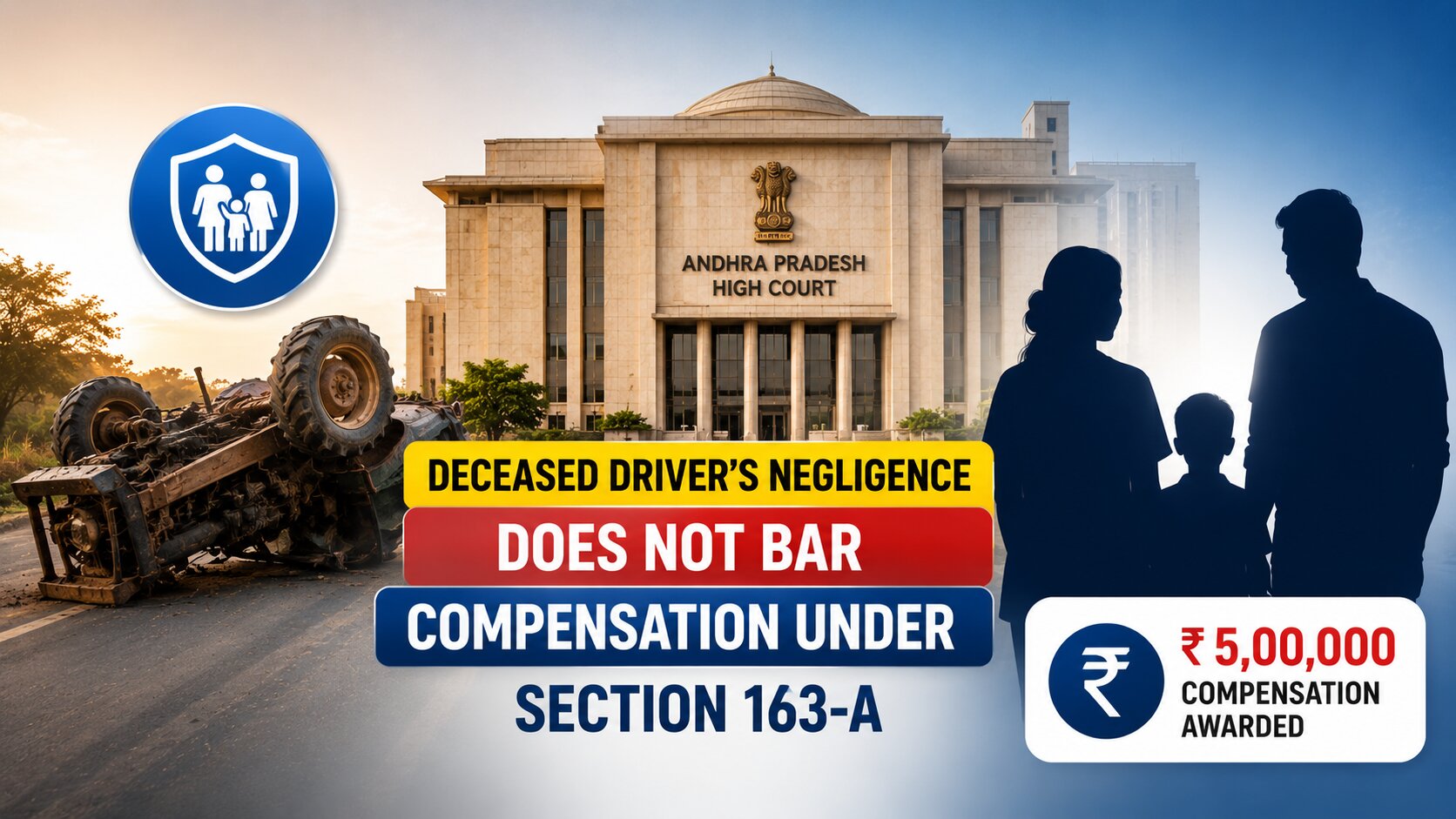
Compensation under Section 163-A Cannot Be Denied Due to Deceased Driver's Negligence.
Judgement Details
Court
Andhra Pradesh High Court
Date of Decision
2 July 2026
Judges
Justice Venkateswarlu Nimmagadda
Citation
Acts / Provisions
Facts of the Case
-
The deceased was employed as a tractor driver and died in 2012 after the tractor overturned during the course of employment.
-
The deceased's widow and minor son filed a claim petition seeking compensation under Section 163-A of the Motor Vehicles Act, 1988.
-
They asserted that the deceased was employed by the first respondent and earned ₹10,000 per month.
-
The Motor Accidents Claims Tribunal (MACT) held that the accident occurred due to the deceased's own negligence.
-
The Tribunal further observed that there was no documentary evidence proving the deceased's employment or salary.
-
Consequently, the Tribunal restricted compensation to ₹50,000 under Section 140 of the Motor Vehicles Act.
-
Aggrieved by the award, the claimants preferred an appeal before the Andhra Pradesh High Court seeking enhancement of compensation.
-
The insurer also failed to produce evidence showing that the deceased did not possess a valid driving licence.
Issues
-
Whether the negligence of the deceased driver bars his legal heirs from claiming compensation under Section 163-A of the Motor Vehicles Act, 1988?
-
Whether proof of negligence is relevant while deciding a claim under Section 163-A of the Motor Vehicles Act, 1988?
-
Whether the Tribunal was justified in rejecting the widow's unrebutted oral evidence regarding the deceased's employment merely because documentary proof of salary was unavailable?
-
Whether the claimants were entitled to the enhanced statutory compensation of ₹5,00,000 under Section 164 of the Motor Vehicles Act, 1988 despite the accident having occurred prior to the 2019 Amendment?
-
Whether the Tribunal erred in restricting compensation to ₹50,000 under Section 140 of the Motor Vehicles Act, 1988?
Judgement
-
The Andhra Pradesh High Court allowed the appeal and set aside the Tribunal's findings restricting compensation.
-
The Court held that Section 163-A is a beneficial welfare provision under which proof of negligence is irrelevant.
-
It observed that even if the deceased himself was negligent, his legal heirs are not disentitled from claiming compensation under Section 163-A.
-
The Court held that the Tribunal erred in rejecting the widow's unrebutted oral testimony regarding the deceased's employment merely because documentary proof of salary was unavailable.
-
It observed that in the agricultural sector, wages are frequently paid through informal arrangements, making documentary proof difficult.
-
The Court further noted that the insurer failed to establish that the deceased did not possess a valid driving licence.
-
Considering the beneficial object of the Motor Vehicles Act, the Court held that the claimants were entitled to the enhanced statutory compensation of ₹5,00,000 under Section 164, introduced by the Motor Vehicles (Amendment) Act, 2019.
-
The Court awarded ₹5,00,000 as compensation together with 9% interest per annum from the date of filing of the claim petition until realization.
Held
-
The appeal was allowed.
-
The compensation was enhanced from ₹50,000 to ₹5,00,000.
-
The legal heirs of the deceased driver are entitled to compensation under Section 163-A even if the deceased himself was negligent.
-
Proof of negligence is not a relevant consideration under Section 163-A.
-
The claimants were held entitled to the enhanced compensation under Section 164 along with 9% interest per annum.
Analysis
-
The judgment reinforces that Section 163-A embodies the principle of No-Fault Liability, under which establishing negligence is unnecessary.
-
It reiterates that the Motor Vehicles Act is a beneficial and social welfare legislation intended to provide speedy and effective compensation to victims and their families.
-
The Court adopted a liberal interpretation to ensure just and reasonable compensation in line with the welfare objective of the Act.
-
The judgment recognizes the practical realities of employment in the agricultural sector, where wages are often paid without formal documentation.
-
The Court clarified that the absence of documentary salary records cannot automatically discredit otherwise reliable oral evidence.
-
By extending the benefit of Section 164 despite the accident preceding the 2019 Amendment, the Court emphasized the importance of awarding maximum statutory benefit during final adjudication.
-
The decision strengthens the rights of dependents of deceased drivers by ensuring that compensation is not denied merely because the deceased contributed to the accident.
-
The judgment is likely to serve as an important precedent in cases involving No-Fault Liability, Motor Accident Compensation, and Beneficial Interpretation of welfare statutes.