
Tapish Sharma v. State of U.P. through Addl. Chief Deptt. of Home Govt. of U.P. and 2 Others, 2026
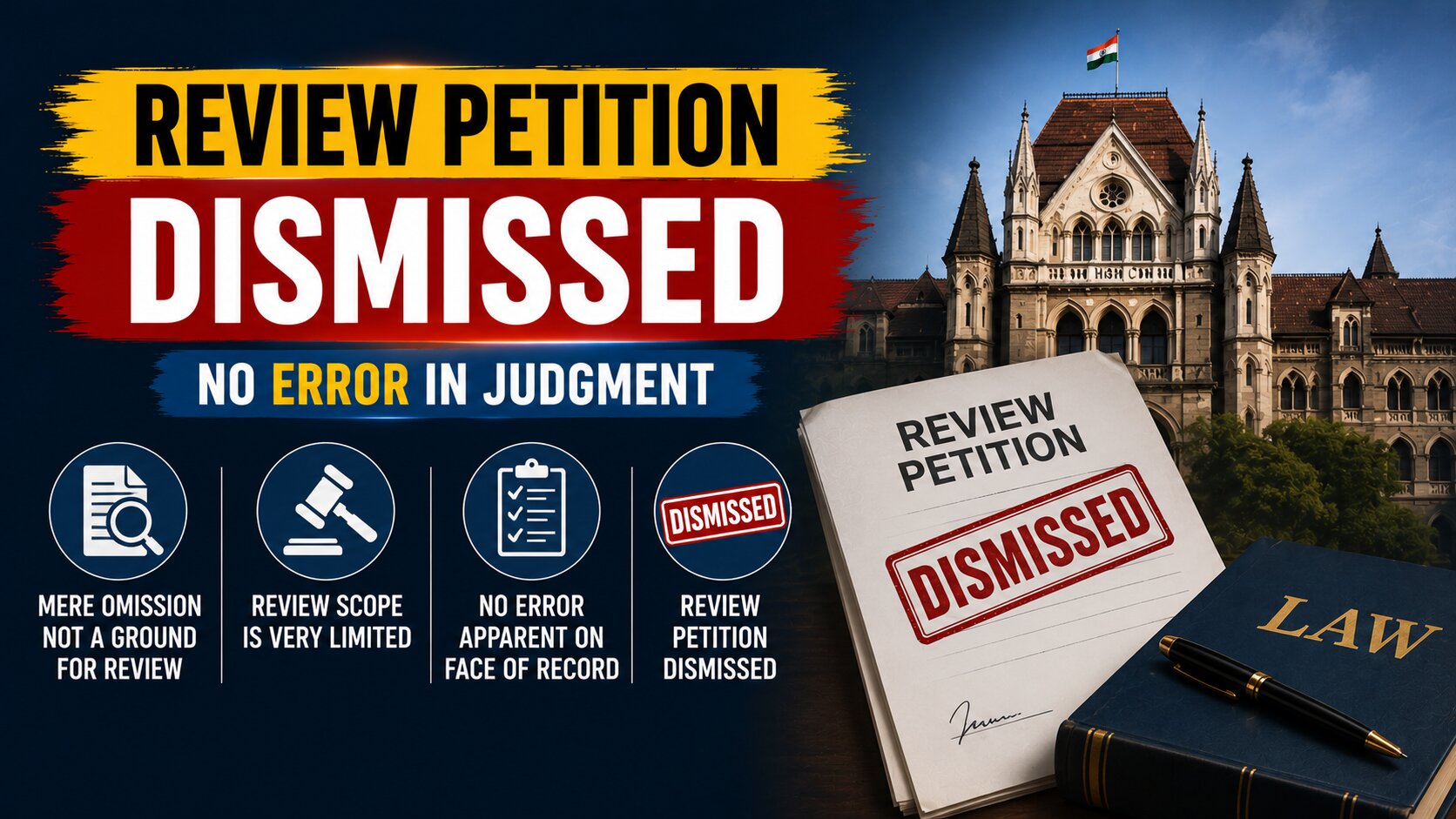
Mere Omission or Non-Tagging of Documents Is No Ground for Review Unless It Causes Apparent Error or Manifest Injustice
Judgement Details
Court
Allahabad High Court
Date of Decision
6 July 2026
Judges
Justice Karunesh Singh Pawar
Citation
Acts / Provisions
Facts of the Case
-
The petitioner applied for appointment to the post of Assistant Operator (Radio Cadre).
-
Before the Writ Court, the petitioner contended that although he had secured higher marks than the last selected Economically Weaker Section (EWS) candidate, he was not considered under the EWS category.
-
The writ petition was dismissed by the High Court.
-
The petitioner thereafter filed a review application, alleging that the writ petition had been decided on the basis of incomplete and manipulated written instructions.
-
He contended that a page containing his EWS certificate had been omitted or not tagged with the written instructions placed before the Court.
-
The petitioner argued that the omission materially affected the outcome of the writ petition and warranted review of the judgment.
-
The State opposed the review, contending that the petitioner was attempting to seek a rehearing on merits under the guise of review.
-
The State further submitted that all relevant documents had been produced before the Writ Court and that the petitioner had actually applied under the Unreserved (UR) category, while the uploaded EWS certificate was not in the prescribed format.
-
The High Court examined the original record and considered the scope of its review jurisdiction.
Issues
-
Whether mere omission, misplacement, or non-tagging of a document is sufficient to review a judgment?
-
Whether the alleged omission of the EWS certificate constituted an error apparent on the face of the record?
-
Whether the Court could undertake reappreciation of evidence while exercising its review jurisdiction?
-
Whether the petitioner established any ground warranting review of the earlier judgment?
Judgement
-
The High Court held that mere omission, misplacement, or non-tagging of a particular page does not automatically render a judgment erroneous.
-
It observed that a judgment can be reviewed only if such omission results in a patent error apparent on the face of the record or causes manifest miscarriage of justice.
-
The Court reiterated that review jurisdiction is extremely limited and cannot be invoked to correct every procedural irregularity or defect in presentation of documents.
-
Relying upon settled Supreme Court precedents, the Court observed that review is maintainable only in cases involving discovery of new evidence, error apparent on the face of the record, or any other analogous sufficient reason.
-
It emphasized that a review petition is not an appeal in disguise and cannot be used for rehearing or reappreciation of evidence.
-
The Court held that determining whether the disputed page formed part of the original written instructions or was omitted deliberately or inadvertently would require detailed factual examination, which falls outside the scope of review proceedings.
-
Upon examining the original record, the Court found that the disputed page did form part of the record.
-
The Court further observed that the petitioner had applied under the Unreserved category and that the EWS certificate uploaded by him was not in the prescribed format.
-
It held that the grounds raised by the petitioner did not disclose any manifest, self-evident, or apparent error warranting exercise of review jurisdiction.
-
Accordingly, the High Court dismissed the review application.
Held
-
Mere omission, misplacement, or non-tagging of documents does not justify review of a judgment.
-
Review is maintainable only where there is an error apparent on the face of the record, discovery of new evidence, or other analogous grounds.
-
The petitioner failed to establish any ground falling within the limited scope of review jurisdiction.
-
The review application was dismissed.
Analysis
-
The judgment reaffirms the limited scope of review jurisdiction, distinguishing it from appellate jurisdiction.
-
The Court correctly reiterated the settled principle that review cannot become a rehearing on merits or an opportunity to reargue the case.
-
The decision reinforces that procedural defects, such as omission or non-tagging of documents, do not by themselves invalidate a judgment unless they produce a manifest and self-evident error.
-
By emphasizing the requirement of an error apparent on the face of the record, the Court preserved the finality of judicial decisions while maintaining the narrow statutory scope of review.
-
The judgment appropriately prevents parties from converting review proceedings into a second round of litigation through factual reappreciation.
-
The Court's examination of the original record before rejecting the review demonstrates a balanced approach between ensuring procedural fairness and maintaining judicial discipline.
-
The ruling also clarifies that disputes requiring detailed factual adjudication cannot be resolved in review proceedings.
-
The judgment strengthens judicial certainty by reiterating that review jurisdiction exists only to correct obvious and patent errors, not to reconsider conclusions already reached.
-
The decision is likely to discourage frivolous review petitions based on minor procedural irregularities lacking substantive prejudice.
-
A notable strength of the judgment is its faithful application of settled Supreme Court principles governing review jurisdiction.