
Syed Iftikhar Andrabi v. National Investigation Agency, Jammu, 2026
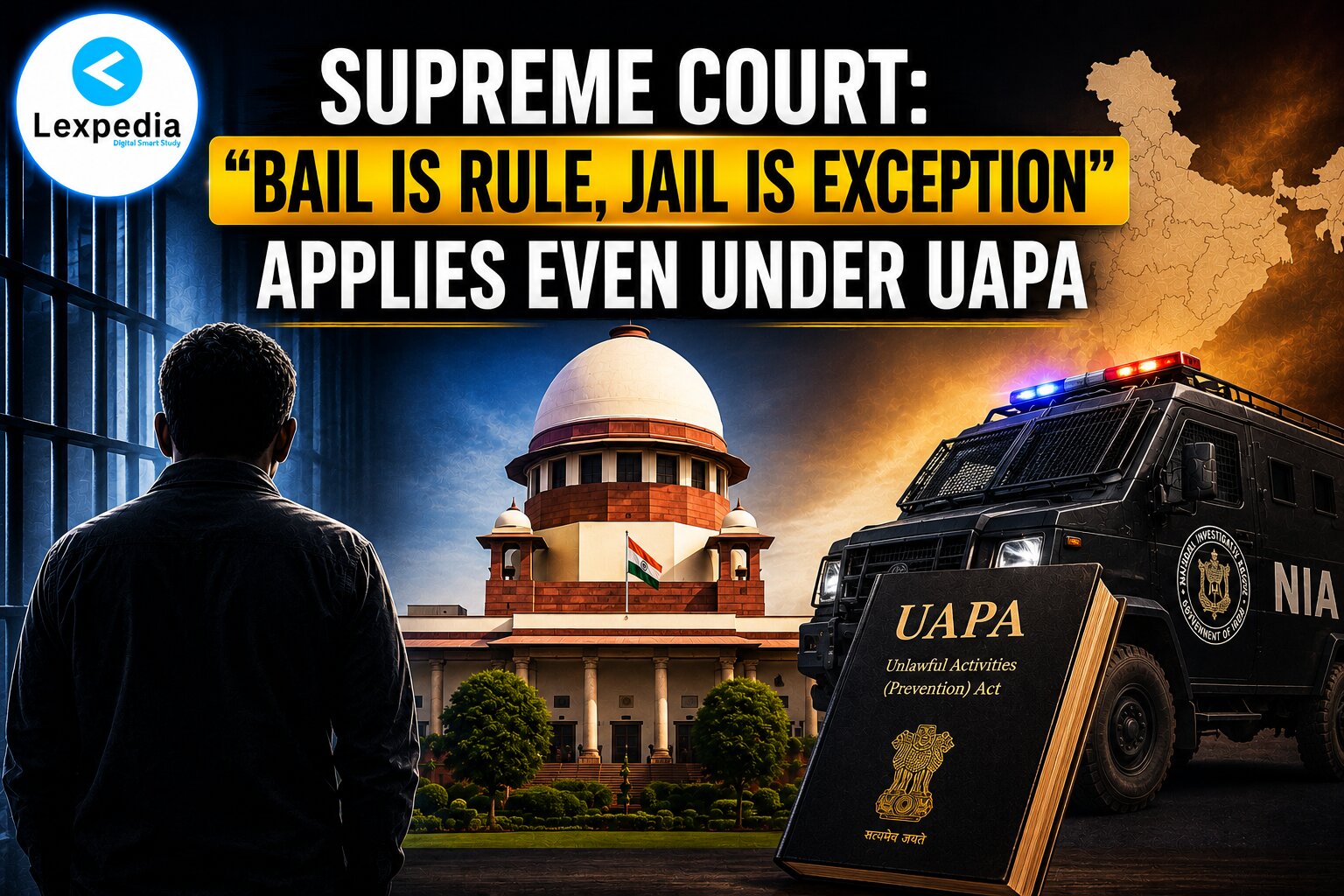
Supreme Court: “Bail is Rule, Jail is Exception” Applies Even Under UAPA
Judgement Details
Court
Supreme Court of India
Date of Decision
18 May 2026
Judges
Justice Ujjal Bhuyan & Justice BV Nagarathna
Citation
Acts / Provisions
Facts of the Case
-
The accused, a man from Jammu & Kashmir, was arrested in a narco-terror investigation conducted by the National Investigation Agency (NIA).
-
He sought bail during the pendency of investigation/trial under stringent provisions of the UAPA.
-
Lower courts denied bail relying heavily on Section 43D(5) of UAPA.
-
The matter reached the Supreme Court to determine whether statutory restrictions override constitutional liberty.
Issues
-
Whether the principle that “bail is the rule and jail is the exception” applies even in cases under the UAPA?
-
Whether Section 43D(5) of UAPA can override the fundamental rights guaranteed under Articles 21 and 22 of the Constitution?
-
Whether prolonged incarceration and statutory restrictions can justify continued detention without violating constitutional liberty and presumption of innocence?
-
Whether previous judicial interpretations have diluted the constitutional safeguards in bail jurisprudence under special statutes?
Judgement
-
The Court held that bail is not merely a statutory principle but a constitutional guarantee rooted in Articles 21 and 22.
-
It reaffirmed that presumption of innocence is a fundamental cornerstone of criminal jurisprudence.
-
The Court ruled that Section 43D(5) UAPA cannot override constitutional protections, and must be applied in a restricted and balanced manner.
-
It clarified that even under special laws like UAPA, statutory restrictions cannot invert the relationship between liberty and detention.
-
The Court relied on the precedent in Union of India v. K.A. Najeeb, emphasizing the right to speedy trial and personal liberty.
-
It expressed concerns over inconsistent bail jurisprudence in cases like Umar Khalid and Sharjeel Imam, particularly prolonged pre-trial detention.
-
The Court also referred to low conviction rates under UAPA (1.5%–4% nationally; below 1% in J&K) as reinforcing the need for cautious detention standards.
-
Accordingly, the Court granted bail to the accused.
Held
-
Bail granted.
-
Section 43D(5) UAPA held subordinate to constitutional guarantees.
Analysis
-
The ruling strongly reinforces the constitutional primacy of personal liberty under Article 21 over statutory restrictions.
-
It clarifies that special laws like UAPA cannot create absolute barriers to bail.
-
The Court elevated the doctrine of “bail is rule, jail is exception” from procedural law to a constitutional principle.
-
It strengthens the jurisprudence laid down in K.A. Najeeb, particularly on speedy trial and excessive pre-trial detention.
-
The judgment also highlights systemic concern over low conviction rates under UAPA, questioning prolonged incarceration practices.
-
It signals judicial resistance to automatic or mechanical denial of bail in national security cases.