
Sunil Kumar Singh v. State of Jharkhand, 2026
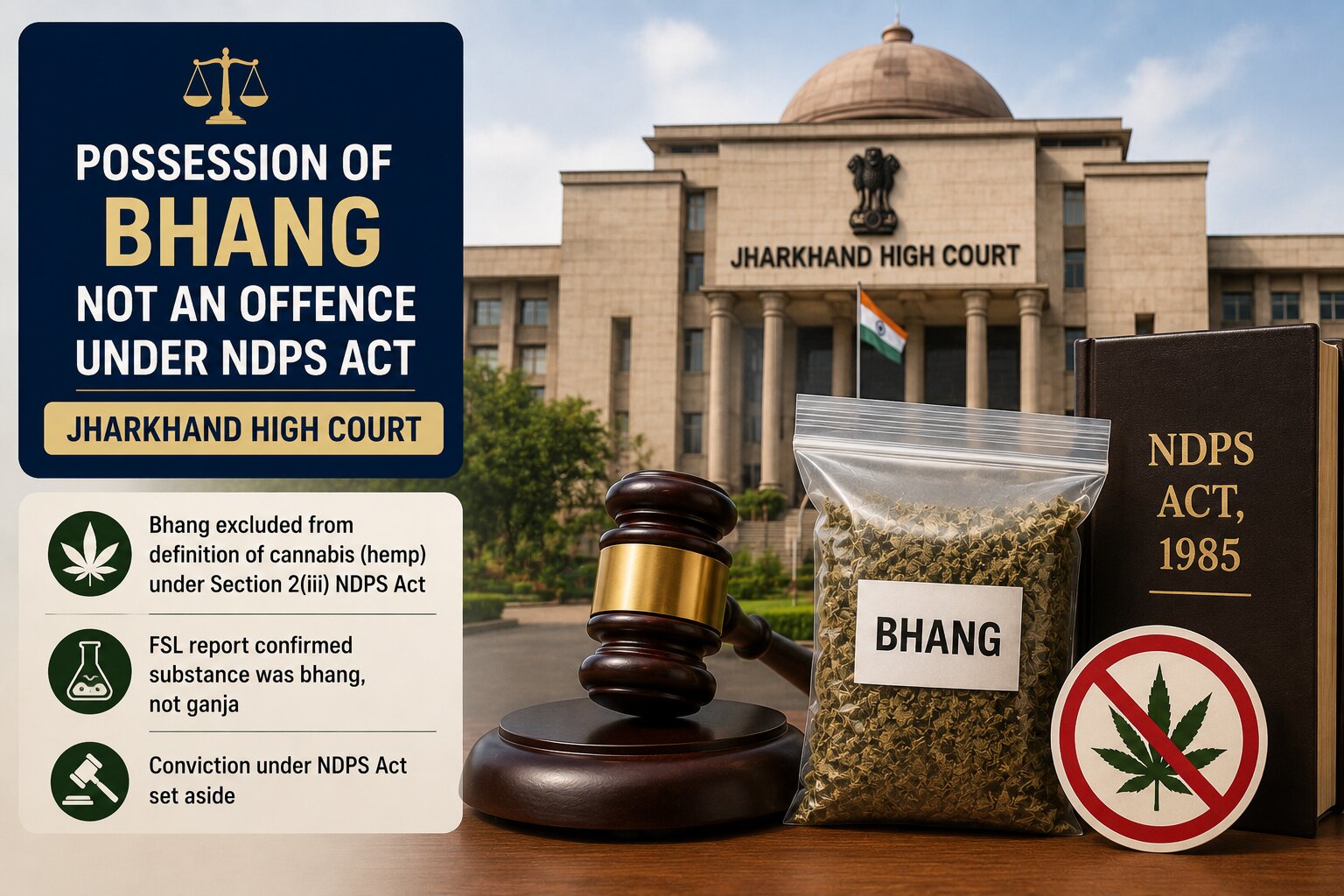
Bhang is excluded from the statutory definition of "Cannabis (Hemp)" under Section 2(iii).
Judgement Details
Court
Jharkhand High Court
Date of Decision
2 July 2026
Judges
Justice Pradeep Kumar Srivastava
Citation
Acts / Provisions
Facts of the Case
-
The appellant was intercepted by a police patrol party near Chaibasa Bus Stand on 17 October 2000 after he allegedly attempted to flee on seeing the police.
-
The police searched a VIP briefcase carried by the appellant in the presence of independent witnesses and a Gazetted Officer.
-
During the search, the police allegedly recovered 12 polythene packets containing about 11 kilograms, which they claimed to be ganja.
-
The appellant was prosecuted and convicted under the NDPS Act.
-
During the appeal, the appellant relied upon the Forensic Science Laboratory (FSL) Report dated 29 November 2002, which concluded that the seized substance was bhang and not ganja.
-
The appellant contended that bhang is specifically excluded from the definition of "Cannabis (Hemp)" under Section 2(iii) of the NDPS Act, and therefore its possession is not punishable under the Act.
-
The State argued that since the FSL report stated that both ganja and bhang are forms of cannabis, the offence would still fall within the scope of the NDPS Act.
Issues
-
Whether possession of Bhang constitutes an offence under the NDPS Act, 1985?
-
Whether Bhang falls within the definition of "Cannabis (Hemp)" under Section 2(iii) of the NDPS Act?
-
Whether the conviction under Sections 20(b), 22(b), and 11(b) of the NDPS Act could be sustained after the FSL Report identified the seized substance as Bhang and not Ganja?
-
Whether the FSL Report conclusively established that the prosecution failed to prove possession of a prohibited narcotic substance?
Judgement
-
The Jharkhand High Court allowed the criminal appeal.
-
The Court held that bhang is not included within the statutory definition of "Cannabis (Hemp)" under Section 2(iii) of the NDPS Act.
-
It observed that the Act specifically includes only Charas, Ganja, and mixtures thereof, while Bhang has been consciously excluded.
-
The Court relied upon decisions of the Karnataka High Court, Punjab & Haryana High Court, Bombay High Court, and Rajasthan High Court, which consistently held that bhang is outside the scope of the NDPS Act.
-
The Court found no scientific evidence establishing that bhang is prepared from charas or ganja.
-
It further noted that neither the NDPS Act nor any Government Notification treats bhang as a prohibited narcotic substance.
-
Since the FSL Report conclusively established that the seized material was bhang and not ganja, the conviction under the NDPS Act became legally unsustainable.
-
Accordingly, the Court set aside the appellant's conviction and sentence.
Held
-
The appeal was allowed.
-
The appellant's conviction and sentence under the NDPS Act were set aside.
-
Possession of Bhang does not constitute an offence under the NDPS Act, 1985.
-
Bhang is excluded from the statutory definition of "Cannabis (Hemp)" under Section 2(iii).
-
Once the FSL Report confirmed that the seized substance was bhang, conviction under the NDPS Act could not be sustained.
Analysis
-
The judgment reinforces the principle of strict interpretation of penal statutes, holding that criminal liability cannot be extended beyond the clear language of the statute.
-
The Court emphasized that Section 2(iii) specifically defines "Cannabis (Hemp)", and courts cannot enlarge the definition by implication.
-
The decision highlights the crucial role of Forensic Science Laboratory (FSL) Reports in prosecutions under the NDPS Act.
-
The Court clarified the legal distinction between Ganja, Charas, and Bhang, rejecting the prosecution's argument that all cannabis products are automatically covered under the Act.
-
The ruling reiterates that where the legislature intentionally excludes a substance from the statutory definition, courts cannot treat it as prohibited.
-
The judgment protects individuals from wrongful conviction based on an incorrect assumption regarding the nature of the seized substance.
-
It is likely to serve as an important precedent in future prosecutions involving Cannabis, Bhang, and interpretation of Section 2(iii) of the NDPS Act.