
State of Tamil Nadu v. Ponnusamy & Ors., 2026
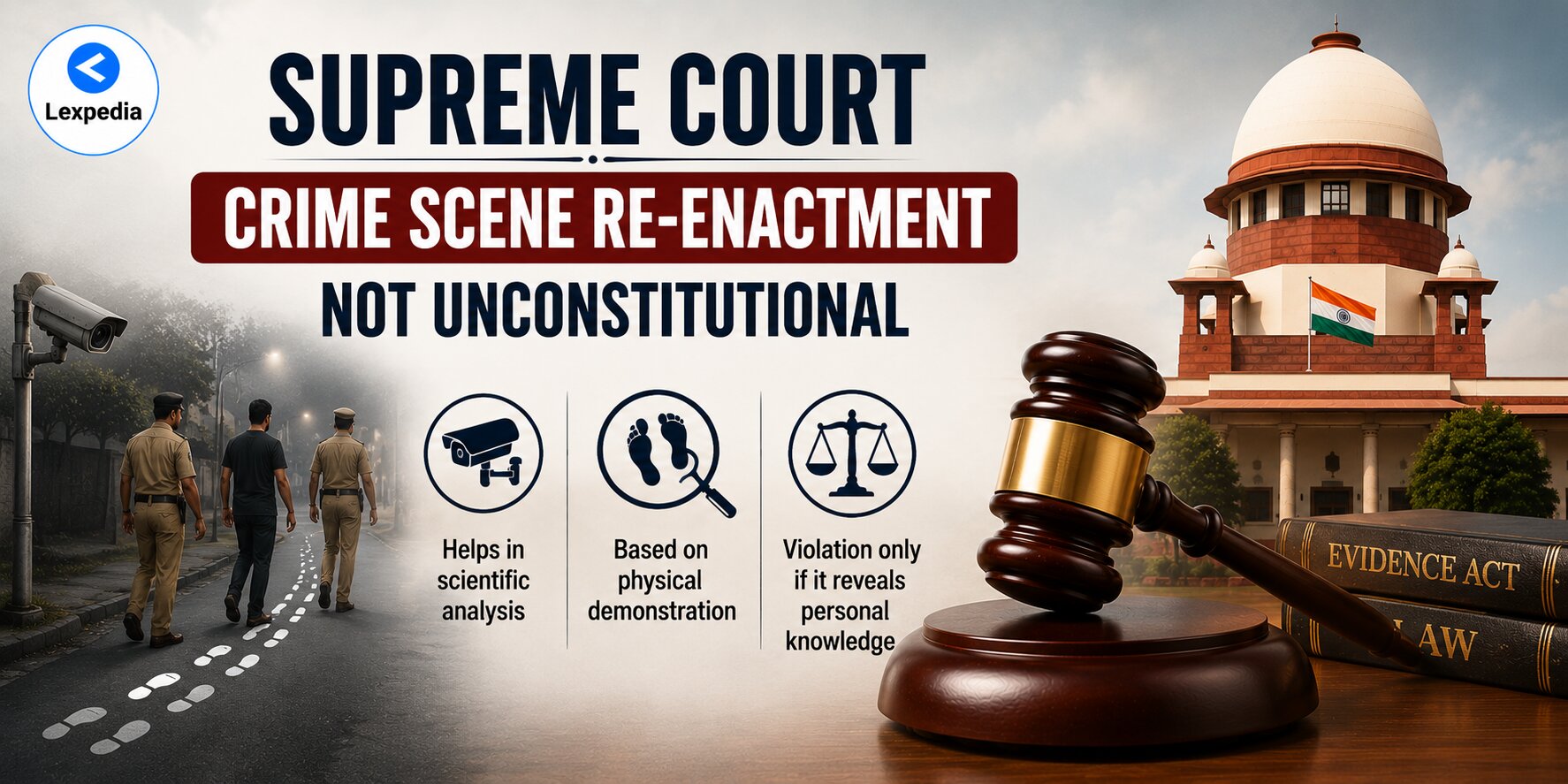
Crime Scene Re-Enactment Not Unconstitutional If It Is Only A Physical Demonstration.
Judgement Details
Court
Supreme Court of India
Date of Decision
23 May 2026
Judges
Justice M.M. Sundresh & Justice Satish Chandra Sharma
Citation
Acts / Provisions
Facts of the Case
- The case arose from the murder of a woman whose body was discovered near a water body in Tamil Nadu.
-
The prosecution alleged that the accused had sexually assaulted and murdered the victim before disposing of the body.
-
During investigation, the police relied heavily on CCTV footage obtained from cameras near the crime scene and surrounding roads.
-
The CCTV footage mainly captured the movement and gait of the accused persons.
-
After arrest, the investigating agency conducted a crime scene re-enactment.
-
During the exercise, the accused were allegedly directed to walk and imitate movements visible in the CCTV footage.
-
The re-enactment video was sent for forensic gait analysis to compare the walking pattern of the accused with the individual seen in the CCTV footage.
-
Before the Madras High Court, the accused challenged the exercise as violating Article 20(3) of the Constitution.
-
The High Court accepted the argument and treated the re-enactment as a form of testimonial compulsion equivalent to a confession in police custody.
-
Aggrieved by the High Court’s findings, the State of Tamil Nadu approached the Supreme Court.
Issues
-
Whether crime scene re-enactment involving participation of the accused violates Article 20(3) of the Constitution?
-
Whether directing an accused to physically imitate movements amounts to testimonial compulsion?
-
Whether evidence derived from crime scene re-enactment is admissible in criminal proceedings?
-
Whether forensic gait analysis based on re-enactment constitutes personal testimony of the accused?
-
Whether the Madras High Court erred in rejecting the entire re-enactment exercise as unconstitutional?
Judgement
-
The Supreme Court allowed the appeal filed by the State of Tamil Nadu.
-
The Court held that crime scene re-enactment cannot be declared unconstitutional merely because it involves participation of the accused.
-
The bench clarified that not every re-enactment amounts to personal testimony or self-incrimination.
-
The Court observed that if the accused is merely directed to walk, move, or imitate a visual sequence for scientific analysis, it does not amount to disclosure of personal knowledge.
-
The bench emphasized that such directed physical demonstrations are distinct from testimonial statements.
-
The Court clarified that forensic gait analysis is based on physical attributes of the accused and not on personal testimony.
-
The Supreme Court held that re-enactment becomes unconstitutional only when the accused is compelled to disclose incriminating facts from personal memory or knowledge.
-
The Court observed that such compelled disclosure would violate Article 20(3) as well as Sections 25 and 26 of the Evidence Act.
-
The judgment stressed that crime scene re-enactment is merely “recreated evidence” used to assist scientific investigation and judicial understanding.
-
The Court warned against adopting a blanket prohibition on re-enactment techniques, observing that such a rule would destroy an important scientific investigative tool.
-
Consequently, the Supreme Court set aside the findings of the Madras High Court.
Held
-
Crime scene re-enactment is not per se unconstitutional.
-
Directed physical demonstrations by an accused do not automatically amount to testimonial compulsion.
-
Article 20(3) is violated only when the accused is compelled to disclose incriminating facts based on personal knowledge.
-
Forensic gait analysis is admissible as scientific evidence based on physical attributes.
-
Re-enactment evidence can be used as an investigative and identification tool in criminal trials.
Analysis
-
The judgment is a landmark ruling on the intersection of constitutional protections and modern forensic investigation techniques.
-
The Supreme Court adopted a balanced and technologically progressive approach by recognizing the evidentiary value of scientific investigative methods.
-
The Court carefully distinguished between physical evidence and testimonial evidence, which is central to the interpretation of Article 20(3).
-
By allowing crime scene re-enactment under limited safeguards, the judgment strengthens the use of forensic science in criminal investigations.
-
The ruling acknowledges the growing importance of CCTV analysis, gait recognition, and scientific reconstruction techniques in modern criminal justice systems.
-
The Court correctly rejected the High Court’s broad interpretation that every form of participation by the accused amounts to self-incrimination.
-
The judgment preserves the constitutional guarantee against compelled testimony while simultaneously ensuring that investigators are not deprived of legitimate scientific tools.
-
The distinction drawn between “re-enactment” and “evidence derived from re-enactment” is legally significant and may guide future courts dealing with forensic evidence.
-
The ruling may have long-term implications in cases involving digital surveillance, biometric identification, and AI-assisted forensic analysis.
-
Overall, the judgment modernizes Indian criminal jurisprudence by harmonizing constitutional rights with scientific advancements in investigation.