
SK v. KS, 2026
One-Year Waiting Period Under Special Marriage Act Can Be Waived Where a Notional Marriage Causes Exceptional Hardship.
Judgement Details
Court
Delhi High Court
Date of Decision
25 June 2026
Judges
Justice Vivek Chaudhary and Justice Renu Bhatnagar
Citation
Acts / Provisions
Facts of the Case
-
The parties, belonging to different faiths, solemnized their marriage under the Special Marriage Act, 1954 on 25 August 2025.
-
According to both parties, disclosure of the marriage resulted in severe opposition from their respective families.
-
The husband stated that his father allegedly collapsed from shock after learning about the marriage and was later diagnosed with liver failure.
-
The wife asserted that she feared similar consequences from her own family and, therefore, chose to keep the marriage concealed from them.
-
The parties never cohabited, the marriage was never consummated, and it never received social or familial recognition.
-
No child was born from the marriage, and the parties never resided together as husband and wife.
-
They jointly sought waiver of the statutory one-year waiting period under Section 29 and the cooling-off period prescribed under Section 28(2) of the Special Marriage Act to obtain a decree of mutual consent divorce.
-
The Family Court rejected the application, holding that the case did not disclose exceptional hardship and that the parties had not made sufficient efforts to preserve the marriage.
-
Aggrieved by the rejection, the husband filed an appeal before the Delhi High Court.
Issues
-
Whether the one-year statutory bar under Section 29 of the Special Marriage Act, 1954 can be waived in cases involving exceptional hardship?
-
Whether a non-consummated, purely notional marriage without cohabitation or social recognition justified waiver of the statutory waiting period?
-
Whether the Family Court adopted an unduly restrictive interpretation of Section 29 while rejecting the waiver application?
-
Whether compelling the parties to wait for one year would defeat the object of the Special Marriage Act?
Judgement
-
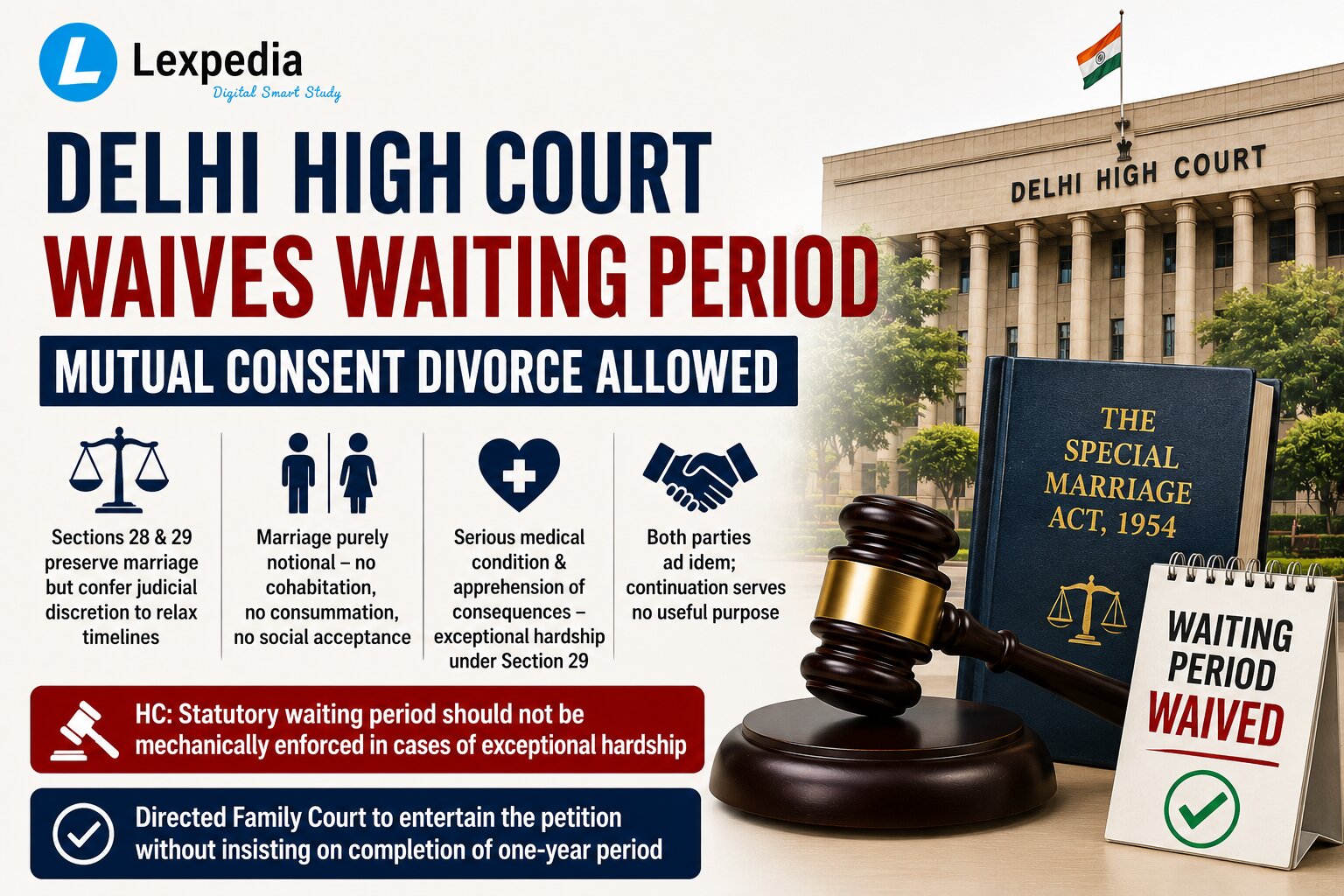
The Delhi High Court allowed the appeal and set aside the Family Court's order refusing waiver of the statutory waiting period.
-
The Court held that Sections 28 and 29 of the Special Marriage Act are intended to preserve the institution of marriage but simultaneously confer judicial discretion to relax the statutory timelines in appropriate cases.
-
It observed that the marriage between the parties remained purely notional, as they had never cohabited, never consummated the marriage, and the marriage had received no social or familial acceptance.
-
The Court found that the husband's father's serious medical condition and the wife's apprehension of similar consequences from her own family constituted exceptional hardship within the meaning of Section 29.
-
It held that both parties were ad idem regarding dissolution of the marriage and had mutually agreed that continuation of the marital relationship served no useful purpose.
-
The Bench observed that compelling the parties to observe the statutory waiting period would merely prolong their mental agony and would be inconsistent with the legislative intent underlying the Act.
-
The Court criticized the Family Court for adopting a restrictive and hyper-technical interpretation of the statutory provisions.
-
It held that the statutory waiting period should not be mechanically enforced where the facts clearly establish exceptional hardship.
-
Accordingly, the High Court directed the Family Court to entertain the petition for mutual consent divorce without insisting upon completion of the one-year statutory period.
Held
-
The one-year waiting period under Section 29 of the Special Marriage Act may be waived in exceptional circumstances.
-
A non-consummated, purely notional marriage accompanied by exceptional hardship justifies exercise of judicial discretion.
-
The Family Court erred by adopting an unduly restrictive interpretation of the statutory provisions.
-
The parties were permitted to proceed with their mutual consent divorce petition without waiting for one year.
Analysis
-
The judgment affirms that the Special Marriage Act balances the objective of preserving marriage with the need to prevent unnecessary hardship where the marital relationship has irretrievably failed at its inception.
-
The Court correctly recognized that the statutory waiting period is directory rather than inflexible, permitting judicial intervention in genuinely exceptional cases.
-
By considering the absence of cohabitation, non-consummation, lack of social recognition, and mutual agreement between the parties, the Court adopted a pragmatic and purposive interpretation of Section 29.
-
The decision appropriately distinguishes cases involving genuine attempts at preserving marriage from situations where the marriage has remained purely legal in form without any substantive matrimonial relationship.
-
The Court's emphasis on exceptional hardship reflects the legislative intent that procedural requirements should not become instruments of avoidable suffering.
-
The criticism of the Family Court's hyper-technical approach reinforces the principle that matrimonial disputes require equitable and purposive adjudication, rather than rigid adherence to procedural formalities.
-
The judgment also strengthens the principle that mutual consent and the absence of any possibility of reconciliation are significant considerations while exercising judicial discretion under the Special Marriage Act.
-
The ruling is likely to guide Family Courts in adopting a more balanced approach while deciding applications seeking waiver of statutory waiting periods.
-
A notable strength of the judgment is its harmonious interpretation of individual autonomy, judicial discretion, and the legislative objective of protecting marriage without compelling parties to continue a relationship that exists only on paper.
-
The decision contributes to the evolving jurisprudence favouring substantive justice over mechanical procedural compliance in matrimonial matters.