
Shyam Bihari Mishra v. Sanju Devi, 2026
The Court also clarified that ex parte proceedings do not dilute the burden of proof on the petitioner seeking divorce.
Judgement Details
Court
High Court of Judicature at Patna
Date of Decision
8 May 2026
Judges
Justice Nani Tagia & Justice Alok Kumar Pandey
Citation
Acts / Provisions
Facts of the Case
-
The appellant-husband filed a divorce petition alleging adultery and marital misconduct by the respondent-wife.
-
The parties were married, and the husband claimed that after about two years of marriage, the wife’s behaviour changed significantly.
-
He alleged that on 15 October 2012, the wife left home at 11 a.m. and returned at 9 p.m., during which he allegedly saw her coming out of a cinema hall with another man.
-
He further alleged that the wife had an earlier romantic relationship with a person named Dhananjay Tiwary before marriage.
-
The husband also claimed that the wife frequently visited markets without informing the family and had become “indisciplined.”
-
The wife did not appear before the Family Court despite service of notice, and the proceedings were conducted ex parte.
-
The Family Court dismissed the divorce petition despite ex parte proceedings.
-
The husband challenged this dismissal before the Patna High Court.
Issues
-
Whether vague and unsubstantiated allegations of adultery without specific particulars can sustain a decree of divorce?
-
Whether a divorce can be granted ex parte solely on the basis of unchallenged pleadings?
-
Whether evidence beyond pleadings can be relied upon to grant relief in matrimonial disputes?
-
Whether failure of the wife to appear despite service automatically entitles the husband to a divorce decree?
-
Whether allegations must include specific details such as time, place, and identity of the alleged adulterous partner?
-
Whether non-joinder of the alleged paramour affects the validity of adultery allegations in divorce proceedings?
Judgement
-
The Patna High Court dismissed the husband’s appeal and upheld the decision of the Family Court rejecting the divorce petition.
-
The Court held that the allegations of adultery were vague, general, and unsubstantiated.
-
The Court observed that the divorce petition failed to disclose specific details such as time, place, and identity of the alleged adulterous partner.
-
The Court noted that the alleged paramour, Dhananjay Tiwary, was not made a party to the proceedings.
-
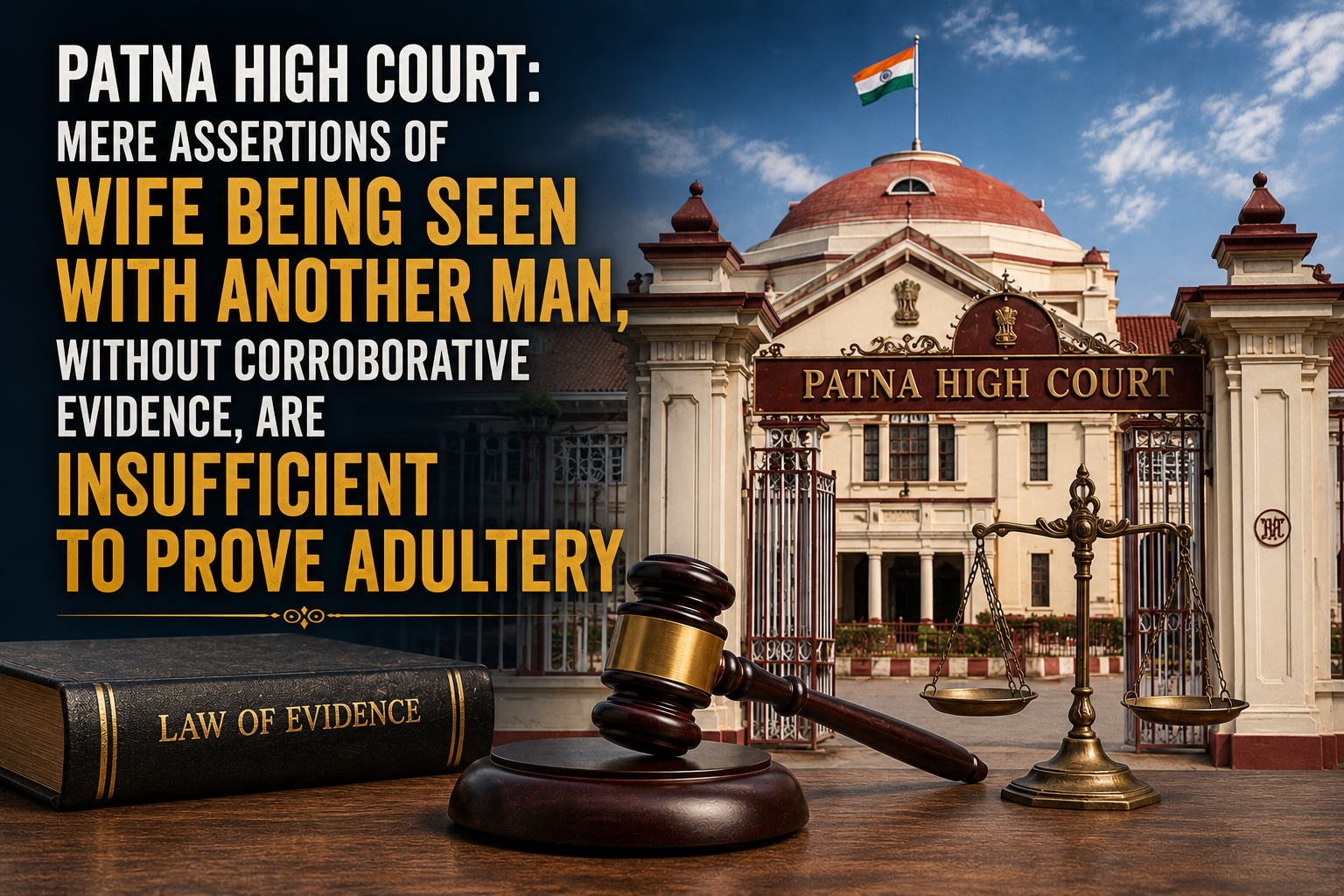
The Court held that mere assertions of the wife being seen with another man, without corroborative evidence, are insufficient to prove adultery.
-
The Court emphasized that no witnesses from the relevant locality were examined to substantiate the allegations.
-
The Court reiterated that evidence beyond pleadings cannot be considered, and parties cannot introduce new facts through evidence that were not pleaded.
-
The Court held that allowing such practice would violate principles of fair trial and procedural justice.
-
The Court found that the Family Court had correctly appreciated the evidence and rightly dismissed the divorce petition.
-
Accordingly, the High Court upheld the Family Court’s order and dismissed the appeal.
Held
-
The Court held that vague allegations of adultery without specific particulars cannot form the basis of divorce.
-
The Court held that ex parte proceedings do not automatically entitle a party to a decree of divorce.
-
The Court held that evidence beyond pleadings cannot be relied upon in adjudication.
-
The Court held that allegations must include clear details of time, place, and identity of the alleged adulterous partner.
-
The Court held that non-joinder of the alleged paramour weakens adultery allegations.
-
The Court upheld the dismissal of the divorce petition.
Analysis
-
The judgment reinforces the fundamental principle of pleading specificity in matrimonial litigation.
-
The Court strongly upheld the rule that pleadings form the foundation of a case, and evidence cannot travel beyond them.
-
The decision protects parties from surprise allegations introduced during trial without prior notice in pleadings.
-
By rejecting vague accusations, the Court emphasized the need for strict proof in adultery-based divorce claims.
-
The ruling ensures that matrimonial disputes are not decided on speculation or moral suspicion, but on legally admissible evidence.
-
The Court also clarified that ex parte proceedings do not dilute the burden of proof on the petitioner seeking divorce.
-
The judgment aligns with established civil procedure principles under the Code of Civil Procedure, 1908, particularly regarding consistency between pleadings and evidence.
-
The decision promotes procedural fairness and prevents misuse of divorce law based on unsubstantiated allegations.
-
It also indirectly reinforces the protection of matrimonial dignity by requiring clear and credible evidence before dissolving a marriage.
-
Overall, the ruling strengthens judicial discipline in family law proceedings by emphasizing precision, proof, and procedural integrity.