
Sanjay Singh v. State, 2026
Intention required to attract the offence of murder under Section 300 IPC.
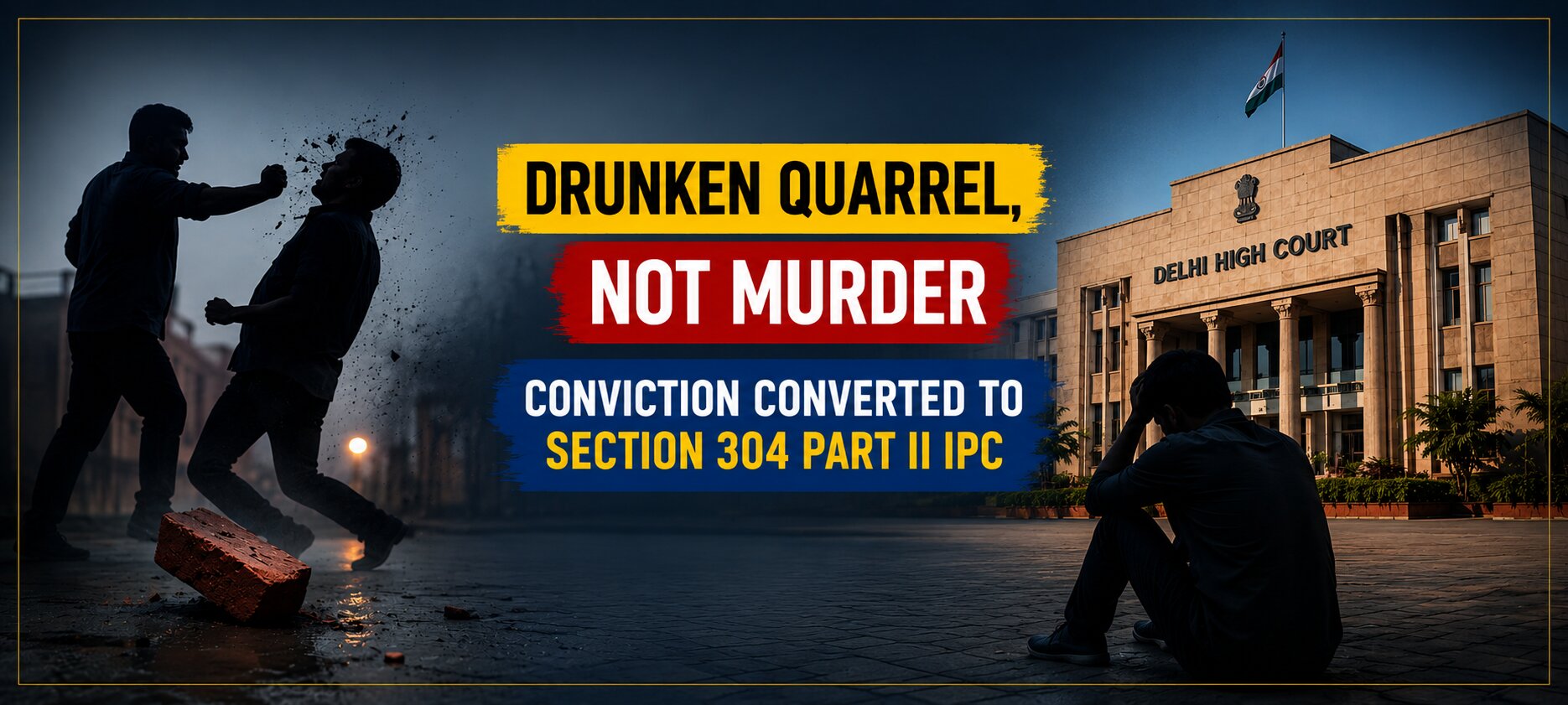
Judgement Details
Court
Delhi High Court
Date of Decision
26 May 2026
Judges
Justice Prathiba M. Singh and Justice Madhu Jain
Citation
Acts / Provisions
Facts of the Case
-
The accused and the deceased were close friends who consumed alcohol together on the date of the incident.
-
A quarrel suddenly erupted between them regarding payment for liquor during the drinking session.
-
During the altercation, the deceased allegedly slapped the accused, which escalated the dispute further.
-
Both individuals were heavily intoxicated at the time of the incident.
-
In the heat of passion, the accused picked up a brick available at the spot and repeatedly assaulted the deceased on the head.
-
Due to the injuries sustained from the brick blows, the deceased died.
-
The Trial Court convicted the accused under Section 302 IPC and sentenced him to life imprisonment.
-
The accused challenged the conviction before the Delhi High Court contending that there was no intention to commit murder and that the incident occurred suddenly without premeditation.
Issues
-
Whether the accused had the intention necessary to constitute murder under Section 300 IPC?
-
Whether the incident occurred in the heat of passion during a sudden quarrel without premeditation?
-
Whether the act of the accused would fall under Section 302 IPC or Section 304 Part II IPC?
-
Whether the slap by the deceased constituted grave and sudden provocation?
-
Whether the absence of prior enmity and motive to kill could negate the charge of murder?
Judgement
-
The Delhi High Court held that the prosecution had successfully proved that the accused caused the death of the deceased.
-
The Court observed that the crucial issue was not the act of causing death itself, but whether the accused possessed the intention required to attract the offence of murder under Section 300 IPC.
-
The Court found that there was no prior enmity between the parties and no pre-planned intention to kill the deceased.
-
It noted that the quarrel arose suddenly during a drunken altercation over payment for liquor.
-
The Court emphasized that both the accused and the deceased were intoxicated at the time of the incident.
-
The Bench held that although the accused assaulted the deceased repeatedly with a brick, the circumstances demonstrated absence of intention to commit murder.
-
The Court observed that repeatedly striking a person on the head with a brick would certainly give rise to knowledge that death was likely to occur.
-
Reliance was placed on the Supreme Court judgment in Sudam Prabhakar Achat v. State of Maharashtra, wherein it was held that sudden assaults arising without premeditation and prior enmity may not amount to murder.
-
The Court also considered the injuries sustained by the accused during the incident.
-
It held that the slap given by the deceased amounted to grave and sudden provocation in the peculiar facts of the case.
-
Accordingly, the conviction was altered from Section 302 IPC to Section 304 Part II IPC.
-
The sentence of life imprisonment imposed by the Trial Court was reduced to eight years’ rigorous imprisonment.
Held
-
The offence committed by the accused amounted to culpable homicide not amounting to murder under Section 304 Part II IPC.
-
The accused did not possess the intention necessary to constitute murder under Section 300 IPC.
-
The accused, however, had the knowledge that repeatedly hitting the deceased with a brick was likely to cause death.
-
The conviction under Section 302 IPC was set aside.
-
The sentence was reduced from life imprisonment to eight years’ rigorous imprisonment.
Analysis
-
The judgment reinforces the legal distinction between “intention” and “knowledge” under the Indian Penal Code.
-
The Court carefully analyzed the mental element required for murder under Section 300 IPC and distinguished it from culpable homicide under Section 304 Part II IPC.
-
The ruling highlights that sudden quarrels arising in the heat of passion, especially under intoxication, may reduce criminal liability where there is no premeditated intention to kill.
-
The Court appropriately applied the doctrine of grave and sudden provocation in evaluating the accused’s mental state during the occurrence.
-
By relying upon the Supreme Court precedent in Sudam Prabhakar Achat v. State of Maharashtra, the judgment strengthens consistency in judicial interpretation regarding sudden fight cases.
-
The decision demonstrates a balanced approach between punishing unlawful violence and recognizing mitigating circumstances affecting mens rea.
-
The judgment contributes significantly to criminal jurisprudence concerning exceptions to murder under Section 300 IPC.
-
The reduction of sentence reflects the Court’s recognition that the act, though serious, lacked the gravest criminal intention ordinarily associated with murder.