
Rouf Ahmad Mir & Ors. v. Adfara Rahman, 2026
It reinforces that DV proceedings are meant for immediate protection, not strict evidentiary determination.
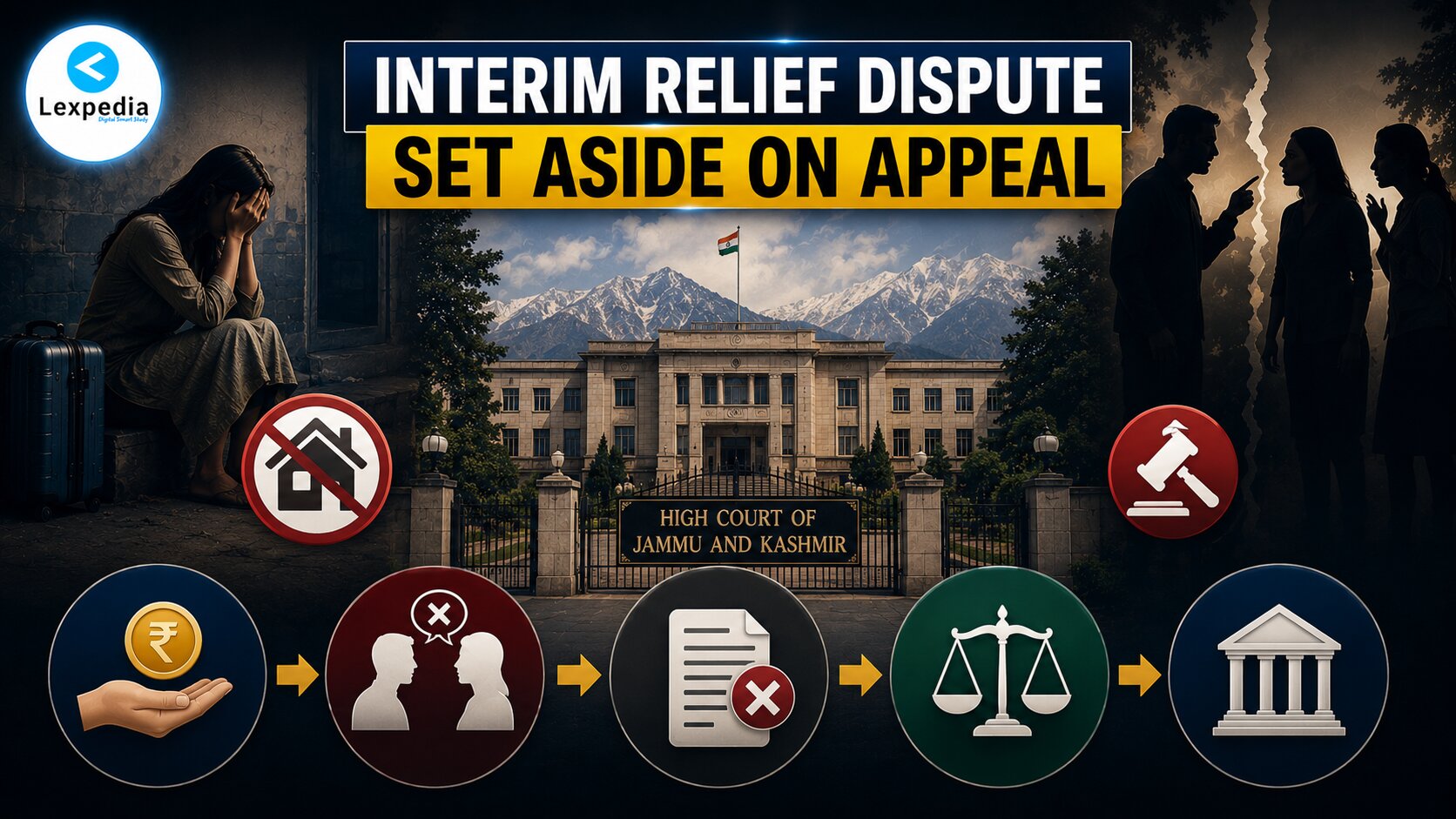
Judgement Details
Court
High Court of Jammu & Kashmir and Ladakh
Date of Decision
13 May 2026
Judges
Justice Sanjay Dhar
Citation
Acts / Provisions
Facts of the Case
-
The aggrieved woman (wife) filed an application under Section 12 of the DV Act alleging domestic violence, cruelty, and harassment after her marriage in 2020.
-
She stated that she joined her matrimonial home on 10 October 2021 and was thereafter subjected to continuous mental, physical, and verbal abuse.
-
She further alleged that her husband and in-laws frequently quarrelled with her over trivial issues, leading to severe mental distress.
-
She also alleged that her father-in-law behaved inappropriately and molested her, causing humiliation and psychological trauma.
-
ANcourt’s order and restored interim relief.
-
The husband and father-in-law then challenged the appellate order before the High Court.
Issues
-
Whether at the stage of considering an application under Section 23 of the DV Act, the Court is required to conduct a detailed examination of evidence or only form a prima facie satisfaction?
-
Whether minor inconsistencies in the statement of the aggrieved person can justify denial of interim relief under the DV Act?
-
Whether non-filing or alleged deficiency of affidavit of assets and liabilities can defeat a claim for interim relief under the DV Act?
-
Whether the existence of alleged divorce during the proceedings affects the entitlement to relief at the interim stage?
Judgement
-
The High Court held that at the stage of Section 23 DV Act, the Court is required only to arrive at a prima facie satisfaction regarding the existence of a domestic relationship and likelihood of domestic violence.
-
It clarified that the Court must not undertake a meticulous scrutiny or detailed evaluation of evidence at this preliminary stage.
-
The Court observed that the trial Magistrate erred by focusing on minor inconsistencies in dates and statements made by the aggrieved woman.
-
It held that such inconsistencies are natural at the initial stage and cannot be used to reject interim protection.
-
The Court emphasized that the DV Act is a beneficial legislation intended to provide immediate relief and protection.
-
The Court found that the trial Magistrate had exceeded jurisdiction by conducting a mini-trial while deciding interim relief.
-
It further held that non-filing of affidavit regarding assets and liabilities cannot be treated as fatal, especially when such material is already available on record.
-
The Court noted that the alleged divorce deed relied upon by the petitioners was executed after the trial court’s order, and therefore could not affect its validity.
-
The Court clarified that the issue of whether divorce actually took place and its legal effect must be examined at the final stage of proceedings under Section 12 DV Act.
-
The High Court found no illegality or perversity in the order passed by the Additional Sessions Judge.
-
Accordingly, the petition filed by the husband and father-in-law was dismissed as lacking merit.
Held
-
At the interim stage under Section 23 DV Act, only prima facie satisfaction is required.
-
Courts must avoid detailed appreciation of evidence or cross-examination-like scrutiny.
-
Minor contradictions in statements cannot defeat interim relief claims.
-
Procedural lapses such as affidavit issues cannot override substantive rights under DV Act.
-
Alleged divorce or subsequent documents must be examined only at final adjudication stage.
-
The appellate court’s order granting relief was upheld in full.
-
The petition challenging the order was dismissed.
Analysis
-
The judgment strengthens the protective and welfare-oriented framework of the DV Act.
-
It clearly limits the scope of judicial scrutiny at the interim stage under Section 23.
-
The ruling prevents courts from conducting a mini-trial at the stage of interim relief.
-
It reinforces that DV proceedings are meant for immediate protection, not strict evidentiary determination.
-
The Court prioritizes prima facie credibility over technical inconsistencies.
-
It ensures that victims are not denied urgent relief due to procedural or minor factual disputes.
-
The decision maintains a clear distinction between interim relief stage and final adjudication stage.
-
It also strengthens judicial consistency in interpreting the DV Act as a remedial statute.