
Ravi Kant v. Central Bureau of Investigation, 2026
The Court clarifies an important doctrinal distinction between grounds of arrest and reasons for arrest, strengthening arrest jurisprudence.
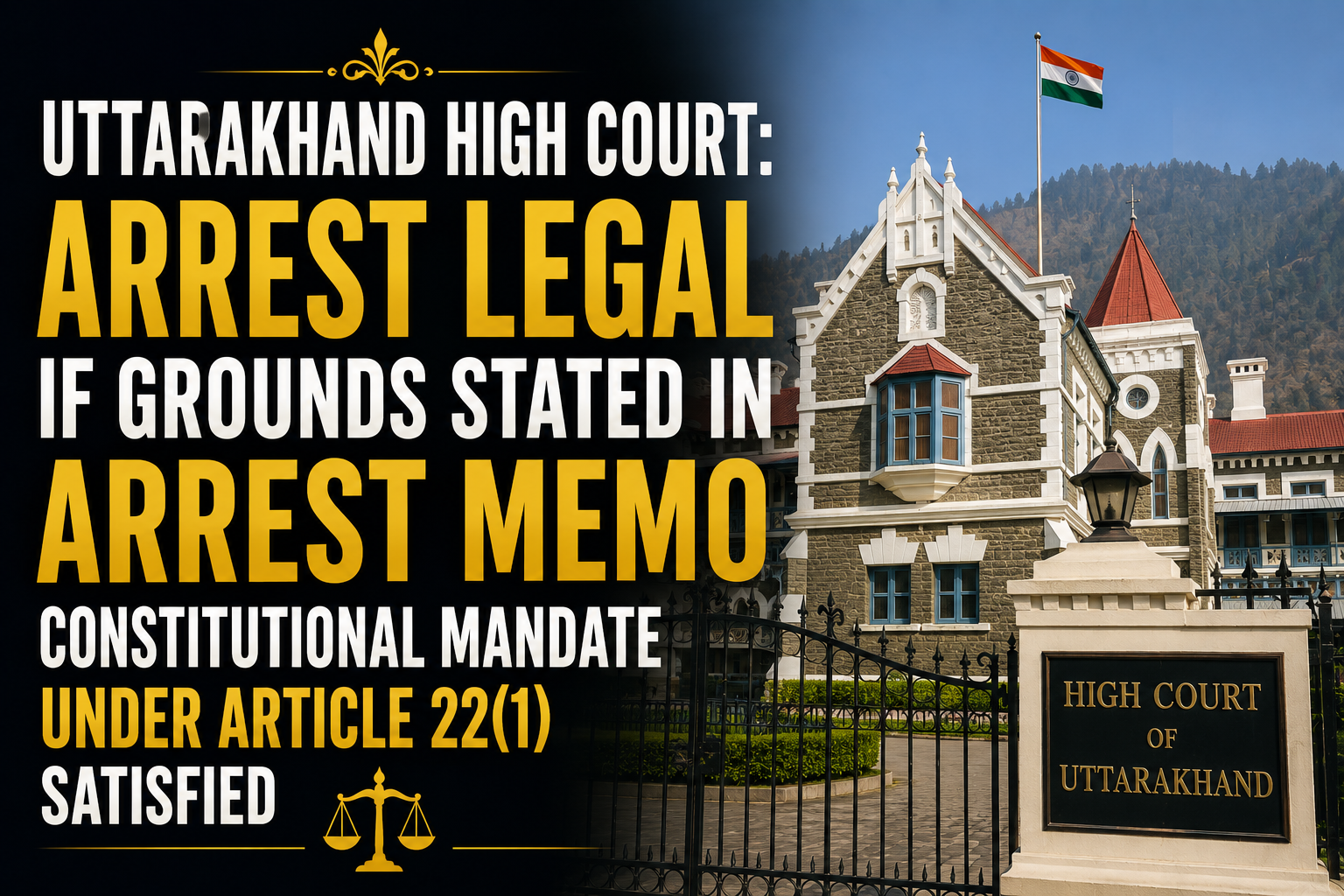
Judgement Details
Court
Uttarakhand High Court
Date of Decision
9 May 2026
Judges
Justice Ashish Naithani
Citation
Acts / Provisions
Facts of the Case
-
An FIR was registered by the Central Bureau of Investigation (CBI) relating to offences of criminal conspiracy and forgery under the Indian Penal Code.
-
The revisionist was arrested during the course of investigation.
-
After arrest, he was produced before the Magistrate and remanded to judicial custody on 09.10.2024.
-
The revisionist challenged the arrest and remand order, claiming violation of constitutional safeguards under Articles 21 and 22.
-
It was contended that:
-
The grounds of arrest were not communicated in writing.
-
Failure to supply written grounds violated Article 22(1).
-
Consequently, the arrest and remand were illegal.
-
-
Reliance was placed on Supreme Court decisions including:
-
Pankaj Bansal v. Union of India
-
Prabir Purkayastha v. State (NCT of Delhi)
-
Mihir Rajesh Shah v. State of Maharashtra
-
-
The CBI opposed the plea, stating that:
-
The arrest memo contained essential factual allegations.
-
The accused was duly informed of the basis of arrest at the time of detention.
-
There is no requirement of a separate document if communication is otherwise meaningful.
-
Issues
-
Whether non-supply of a separate written document containing grounds of arrest violates Article 22(1) of the Constitution of India?
-
Whether communication of grounds of arrest through an arrest memo satisfies constitutional requirements?
-
Whether distinction exists between “reasons of arrest” and “grounds of arrest” under Article 22(1)?
-
Whether the arrest and subsequent remand of the revisionist were illegal for violation of constitutional safeguards?
Judgement
-
The Uttarakhand High Court dismissed the criminal revision and upheld the legality of the arrest and remand.
-
The Court held that the object of Article 22(1) is to ensure that the arrested person is made aware of the substance of the accusations.
-
It observed that the constitutional requirement is of meaningful communication, not rigid compliance through a separate document.
-
The Court distinguished between:
-
Reasons for arrest
-
Grounds of arrest (essential factual allegations)
-
-
It held that the arrest memo, containing essential factual allegations, satisfies the requirement of communicating grounds of arrest.
-
Relying on Vihaan Kumar v. State of Haryana, the Court clarified that written communication is valid if the substance of allegations is conveyed effectively.
-
The Court observed that the accused had been supplied with the arrest memo at the time of arrest, which contained the relevant facts.
-
Therefore, there was substantial compliance with Article 22(1).
-
The Court held that no illegality or violation of constitutional safeguards was made out.
Held
-
The requirement under Article 22(1) is satisfied if the arrested person is informed of the essential factual grounds of arrest.
-
A separate written document is not mandatory if the arrest memo contains sufficient details.
-
The distinction between reasons of arrest and grounds of arrest is crucial and must be maintained.
-
The arrest and remand were held to be lawful and valid.
-
The criminal revision was dismissed.
Analysis
-
The judgment adopts a balanced interpretation of constitutional safeguards, prioritising substance over form.
-
It reinforces that the purpose of Article 22(1) is to ensure awareness of allegations, not procedural rigidity.
-
The Court clarifies an important doctrinal distinction between grounds of arrest and reasons for arrest, strengthening arrest jurisprudence.
-
By accepting the arrest memo as valid communication, the Court ensures practical efficiency in criminal procedure while maintaining constitutional protections.
-
The ruling aligns with Supreme Court jurisprudence emphasizing “meaningful communication” standard rather than technical compliance.
-
At the same time, it preserves the safeguard against arbitrary arrest by requiring that the essential factual basis must still be disclosed.
-
The decision provides clarity to investigating agencies regarding compliance standards during arrest.
-
It also reduces ambiguity created by conflicting interpretations of earlier Supreme Court judgments on written grounds of arrest.