
Ram Autar and Others v. State, 2026
Critical importance of Section 313 CrPC as a safeguard against procedural unfairness.
Judgement Details
Court
Allahabad High Court
Date of Decision
6 July 2026
Judges
Justice Siddhartha Varma and Justice Jai Krishna Upadhyay
Citation
Acts / Provisions
Facts of the Case
-
The case arose from an incident in 1986 involving the alleged poisoning death of a woman, purportedly linked to dowry demands made by her husband and his family.
-
The accused persons included the husband, his father, and his brother, who were convicted in 1989 by the trial court.
-
The prosecution relied heavily on a viscera report which indicated the presence of zinc phosphide, a highly toxic pesticide, in the deceased’s internal organs.
-
The viscera report was treated as the primary scientific evidence to establish that the deceased had been poisoned.
-
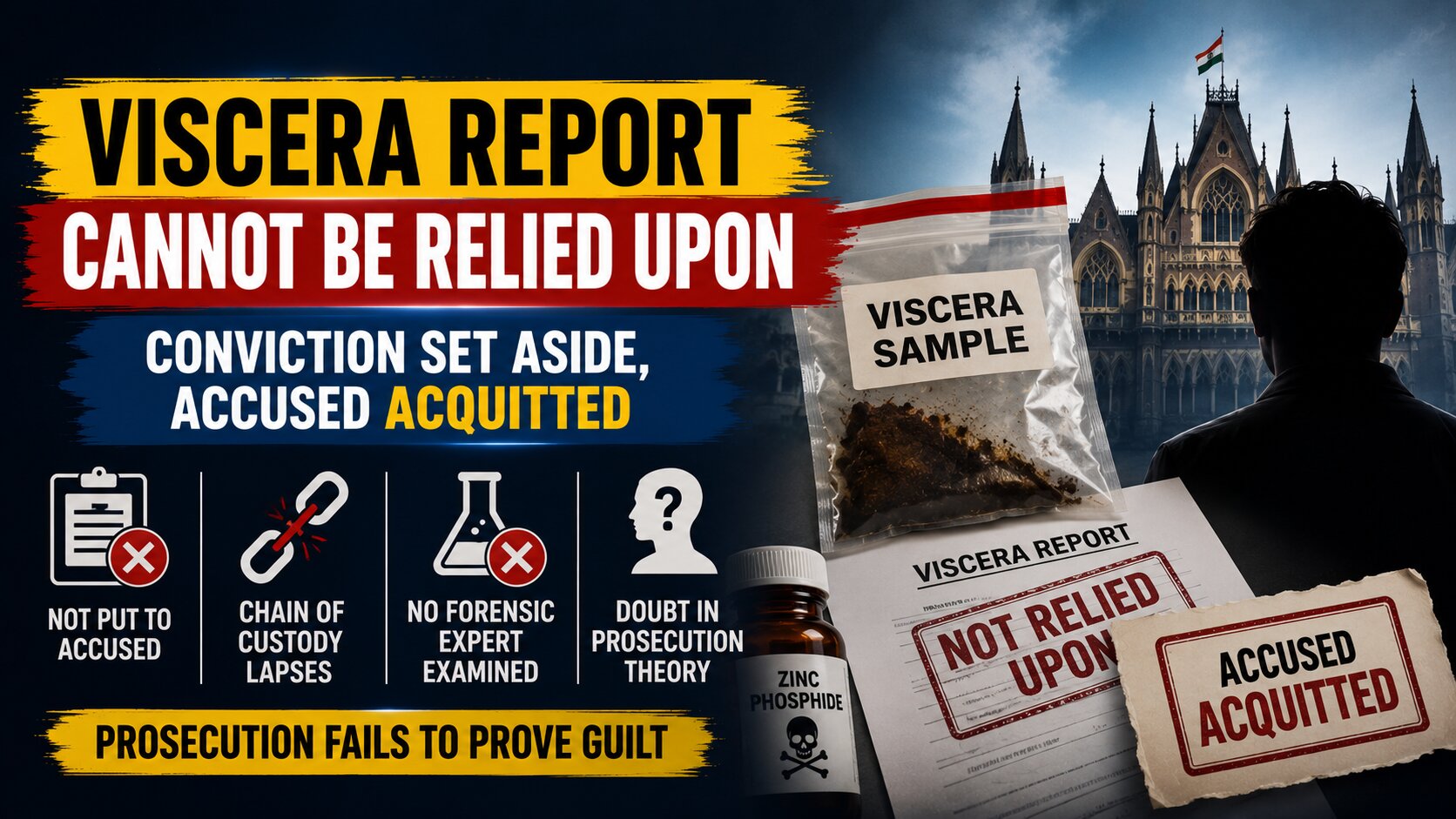
During the trial, while recording statements under Section 313 CrPC, the accused were questioned generally about the administration of poison but were not specifically confronted with the viscera report.
-
The prosecution failed to establish a proper chain of custody for the viscera, including lack of documentation regarding preservation and transfer.
-
No forensic expert was examined to confirm that the viscera sample was received in a sealed and untampered condition.
-
The prosecution alleged forcible administration of poison, but no physical injuries were found on the deceased or the accused to indicate any struggle.
-
The accused challenged their conviction before the Allahabad High Court, arguing procedural lapses and evidentiary deficiencies.
Issues
-
Whether the viscera report can be relied upon for conviction when it was not specifically put to the accused during their examination under Section 313 CrPC?
-
Whether failure to confront the accused with a crucial piece of scientific evidence violates the principles of a fair trial?
-
Whether deficiencies in the chain of custody of the viscera render the evidence unreliable?
-
Whether the prosecution successfully proved the forcible administration of poison beyond reasonable doubt?
Judgement
-
The High Court held that the viscera report could not be relied upon as it was never specifically put to the accused during their examination under Section 313 CrPC.
-
The Court emphasized that merely asking general questions about poisoning is insufficient when a specific scientific report forms the basis of conviction.
-
It relied on Supreme Court precedents which mandate that any incriminating evidence must be put to the accused to allow them an opportunity to explain.
-
The Court found serious lapses in the chain of custody of the viscera, including absence of documentation and lack of testimony regarding its handling and preservation.
-
It noted that no forensic expert was examined to confirm the integrity of the viscera sample.
-
The Court expressed doubt regarding the prosecution’s theory of forcible administration of zinc phosphide, given its bitter taste and strong odor.
-
It observed that a healthy individual would resist such administration, yet no injuries were found to support any struggle.
-
Since the viscera report was the sole conclusive evidence and could not be considered, the prosecution failed to establish guilt beyond reasonable doubt.
-
Accordingly, the High Court allowed the appeal and set aside the conviction of the accused.
Held
-
The viscera report cannot be considered as evidence since it was not put to the accused under Section 313 CrPC.
-
The conviction based on such evidence is unsustainable in law.
-
The prosecution failed to prove the case beyond reasonable doubt.
-
The accused were acquitted of all charges.
Analysis
-
The judgment reinforces the fundamental principle of a fair trial, emphasizing that the accused must be given an opportunity to respond to all incriminating evidence.
-
The Court correctly applied precedents such as Asraf Ali v. State of Assam (2008), Sujit Biswas v. State of Assam (2013), and Chandan Pasi v. State of Bihar (2025), which mandate exclusion of evidence not put to the accused.
-
The ruling highlights the critical importance of Section 313 CrPC as a safeguard against procedural unfairness.
-
The Court’s scrutiny of the chain of custody underscores the necessity of maintaining evidentiary integrity in criminal trials.
-
The reasoning regarding the physical properties of zinc phosphide demonstrates a practical and scientific approach to evaluating prosecution claims.
-
The judgment strengthens the standard of burden of proof required in criminal cases, particularly where conviction is based on scientific evidence.
-
A notable strength of the judgment is its insistence on procedural compliance as a prerequisite for substantive justice.
-
The decision may have a significant impact on future cases by ensuring stricter adherence to procedural safeguards and evidentiary standards.
-
However, the absence of a detailed discussion on alternative evidence (if any) may be seen as a limitation in assessing the overall prosecution case.