
X v. Union of India & Ors., 2026
Adult Sex Workers Can't Be Forcibly Rehabilitated: SC
Judgement Details
Court
Supreme Court of India
Date of Decision
1 June 2026
Judges
Justice J.B. Pardiwala & Justice R. Mahadevan
Citation
Acts / Provisions
Facts of the Case
-
The Supreme Court was considering a miscellaneous application seeking guidelines and directions for the protection of the fundamental rights of victims of trafficking for Commercial Sexual Exploitation (CSE).
-
During the proceedings, Senior Advocate Aparna Bhat proposed the preparation of a comprehensive Victim Protection Plan.
-
The Court examined the functioning of Section 17 of the Immoral Traffic (Prevention) Act, 1956, which deals with the rehabilitation and custody of persons rescued from prostitution-related situations.
-
The Bench found that the existing framework frequently adopts a uniform approach towards all persons rescued during anti-trafficking operations.
-
The Court observed that the law often fails to distinguish between:
-
Persons trafficked against their will.
-
Persons initially trafficked but later continuing voluntarily.
-
Persons who entered sex work voluntarily.
-
-
The Court noted that many adult sex workers are subjected to rescue, detention, and rehabilitation processes even when they do not seek such intervention.
-
It was argued that compulsory rehabilitation without regard to the wishes of adult individuals undermines their autonomy, dignity, and personal liberty.
-
The Court therefore examined whether the victim's consent should be the determining factor in decisions relating to rehabilitation and protective custody.
-
The Bench also considered its earlier judgment in Budhadev Karmaskar v. State of West Bengal, which recognized the rights of voluntary adult sex workers.
Issues
-
Whether the consent of an adult sex worker should be the primary consideration in decisions relating to rehabilitation, reintegration, and placement in protective homes?
-
Whether the existing framework under Section 17 of the Immoral Traffic (Prevention) Act, 1956 adopts an impermissible one-size-fits-all approach towards trafficking victims and voluntary adult sex workers?
-
Whether voluntary adult sex workers can be subjected to compulsory rescue, detention, and rehabilitation measures without their consent?
-
Whether a Magistrate is required to conduct a threshold inquiry to determine whether an adult individual is voluntarily engaged in sex work before directing protective custody?
-
Whether the State's obligation to provide rehabilitation authorizes it to impose rehabilitation against the wishes of an adult victim?
-
Whether the wishes of a victim may be overridden in circumstances involving coercion, threats, undue influence, or safety risks?
-
Whether anti-trafficking mechanisms should distinguish between trafficked persons and voluntary adult sex workers?
Judgement
-
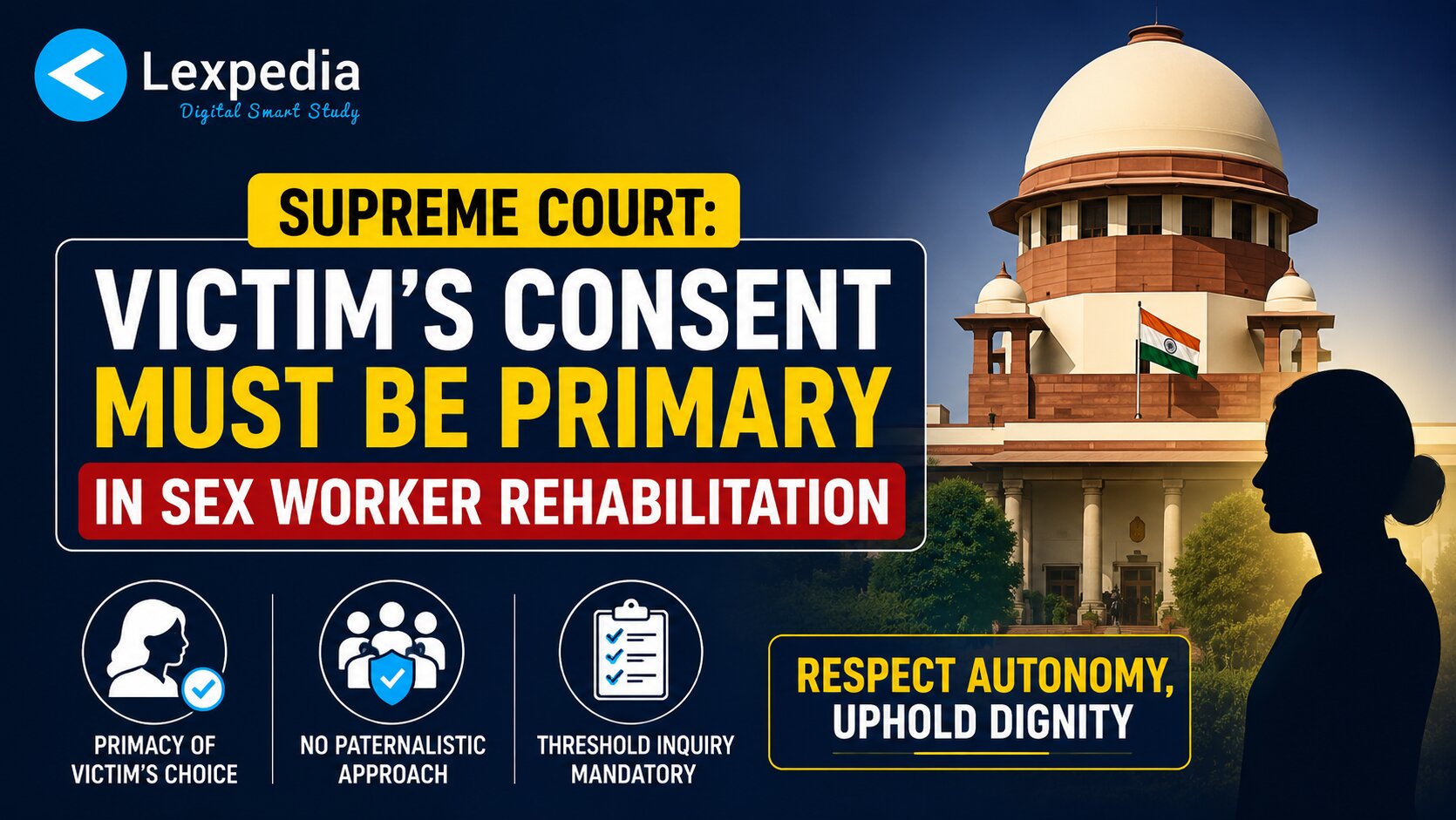
The Supreme Court held that the consent of adult sex workers must be the primary consideration in decisions concerning rehabilitation, reintegration, and placement in protective homes.
-
The Court rejected the paternalistic assumptions underlying the current operation of Section 17 ITPA.
-
The Bench observed that victims cannot be treated as passive objects of rescue and rehabilitation.
-
It held that the choices, autonomy, and dignity of adult individuals must be respected.
-
The Court directed that a threshold inquiry must be conducted whenever an adult individual is produced before a Magistrate under Section 17 ITPA.
-
The inquiry must determine:
-
Whether the person is voluntarily engaged in Commercial Sex Work.
-
Whether the person desires long-term protective custody.
-
Whether the expressed preference is genuinely voluntary.
-
-
The Court emphasized that social workers may assist in conducting a preliminary assessment, but the victim's own statement must receive primacy.
-
It was held that voluntary adult sex workers should ordinarily not be subjected to rescue and detention mechanisms designed for trafficking victims.
-
The Court clarified that rehabilitation cannot be imposed upon an unwilling adult.
-
The Bench held that a Magistrate may depart from the victim's wishes only in exceptional circumstances involving:
-
Serious safety concerns.
-
Coercion.
-
Threats.
-
Tutoring.
-
Undue influence.
-
-
Any departure from the victim's wishes must be supported by written reasons.
-
The Court approved the incorporation of these principles into the proposed Victim Protection Plan.
-
The Bench also called attention to the need for legislative reforms in the anti-trafficking framework.
Held
-
Consent of adult sex workers is the primary consideration in rehabilitation decisions.
-
Voluntary adult sex workers should not ordinarily be subjected to compulsory rescue, detention, or rehabilitation.
-
A threshold inquiry is mandatory before placing an adult individual in protective custody under Section 17 ITPA.
-
Victims cannot be treated as passive objects of rehabilitation.
-
The State cannot impose rehabilitation against the wishes of an adult victim.
-
Departure from the victim's wishes is permissible only in exceptional situations involving coercion, threats, undue influence, or serious safety concerns.
-
Any such departure must be supported by written reasons.
-
The Victim Protection Plan must incorporate these safeguards.
Analysis
-
The judgment represents a significant shift from a paternalistic welfare model to a rights-based approach in dealing with victims of trafficking and adult sex workers.
-
The Court recognized that autonomy, agency, and self-determination are fundamental constitutional values that cannot be ignored in rehabilitation decisions.
-
By emphasizing victim consent, the Court reaffirmed the centrality of Article 21 of the Constitution, which protects dignity and personal liberty.
-
The ruling acknowledges that individuals involved in sex work are not a homogeneous group and that treating all such persons identically can produce unjust outcomes.
-
The introduction of a threshold inquiry mechanism is a major procedural safeguard that prevents automatic detention of voluntary adult sex workers.
-
The Court drew a crucial distinction between human trafficking and voluntary adult sex work, thereby reducing the risk of misuse of anti-trafficking laws.
-
The judgment strengthens the principle that rehabilitation must be voluntary and participatory, rather than coercive.
-
By requiring written reasons whenever a victim's wishes are overridden, the Court enhances transparency and accountability in judicial decision-making.
-
The ruling expands upon the principles laid down in Budhadev Karmaskar, further protecting the rights of adult sex workers.
-
The judgment is likely to influence future legislative reforms concerning ITPA, anti-trafficking laws, and victim protection mechanisms.
-
It advances the constitutional ideals of dignity, equality, freedom of choice, and individual autonomy.
-
The decision establishes a victim-centric framework where the affected individual's voice becomes the most important factor in determining their future.