
Parveen Kumar @ Parveen Chauhan v. State of Haryana & Ors.
Supreme Court Clarifies the Doctrine of Per Incuriam and the Binding Nature of Precedents.
Judgement Details
Court
Justice Sanjay Karol & Justice Nongmeikapam Kotiswar Singh
Date of Decision
1 July 2026
Judges
Supreme Court of India
Citation
Acts / Provisions
Facts of the Case
-
The dispute concerned the applicability of Haryana's Remission Policies governing premature release of convicts.
-
The petitioner claimed the benefit of the 2002 Remission Policy.
-
The controversy arose because a two-Judge Bench in State of Haryana v. Raj Kumar (2021) held that the 2002 Policy was statutory in nature and stood superseded by the 2008 Policy framed under the Code of Criminal Procedure.
-
However, an earlier three-Judge Bench in State of Haryana v. Jagdish had held that the 1993 Remission Policy was issued in exercise of the Governor's constitutional power under Article 161 and could not be overridden by a subsequent statutory remission policy.
-
The Supreme Court found that the 1993 and 2002 Remission Policies were materially identical in their source of power under Article 161.
-
The principal issue before the Court was whether the decision in Raj Kumar (2021) could continue to bind courts despite being inconsistent with the earlier larger Bench decision.
Issues
-
Whether a judgment can be declared Per Incuriam when it is inconsistent with an earlier decision rendered by a Bench of equal or larger strength?
-
Whether a judgment delivered without considering a relevant statutory provision can be treated as Per Incuriam?
-
Whether a Bench of co-equal strength can take a view contrary to an earlier decision without referring the matter to a Larger Bench?
-
Whether the decision in State of Haryana v. Raj Kumar (2021) was Per Incuriam in view of the earlier three-Judge Bench decision in State of Haryana v. Jagdish?
-
Whether Haryana's 2002 Remission Policy derived its authority from Article 161 of the Constitution and therefore could not be overridden by a statutory remission policy?
Judgement
-
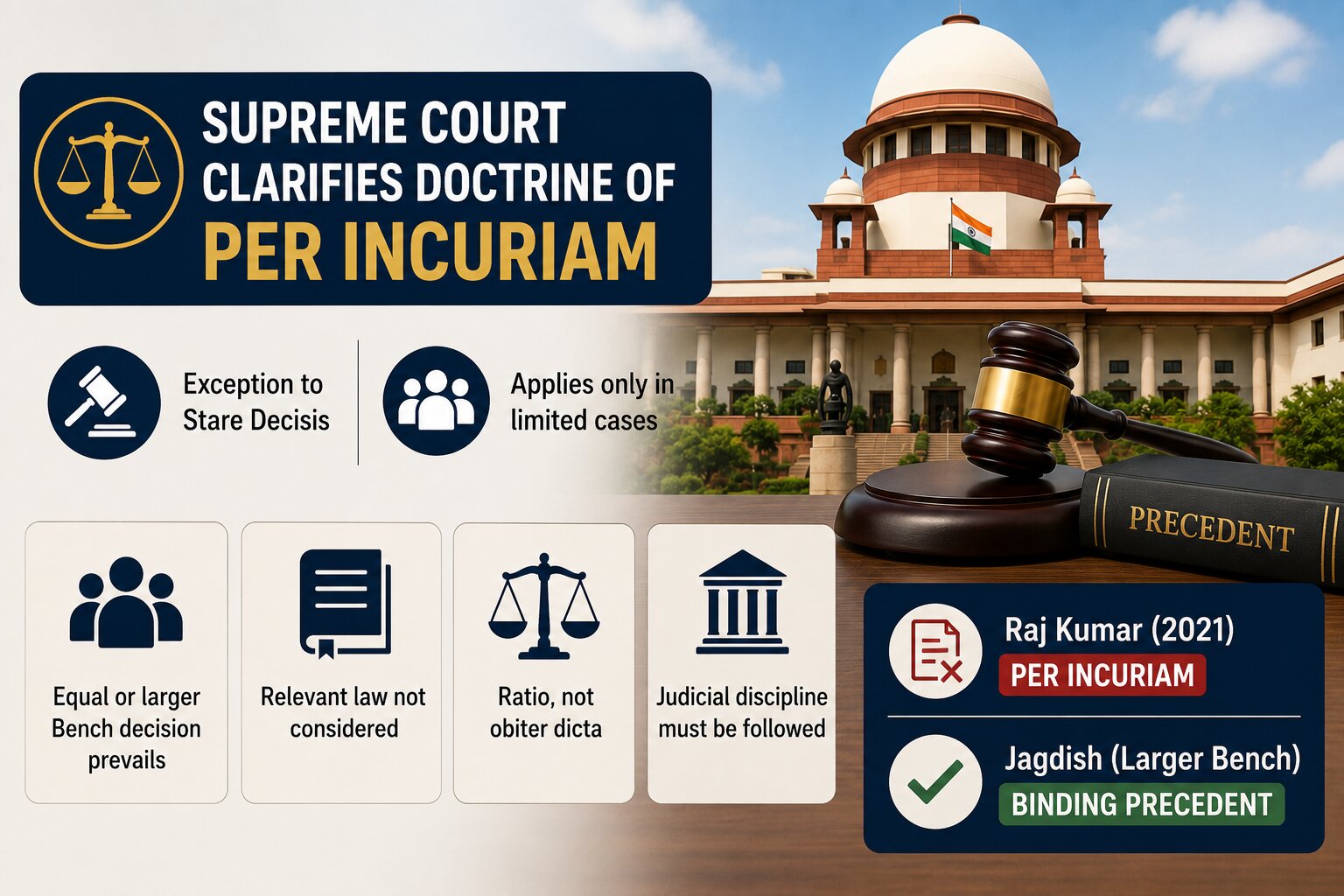
The Supreme Court held that the doctrine of Per Incuriam is an exception to the principle of Stare Decisis and must be applied sparingly.
-
The Court held that a judgment is Per Incuriam when its Ratio Decidendi is irreconcilable with an earlier decision of a Bench of equal or larger strength.
-
It further held that a judgment may also be Per Incuriam where a relevant statutory provision, rule, or regulation was not brought to the notice of the Court.
-
The Court clarified that the doctrine applies only to the Ratio Decidendi and not to Obiter Dicta.
-
It reiterated that Judicial Discipline requires a co-equal Bench disagreeing with an earlier decision to refer the matter to a Larger Bench instead of taking a contrary view.
-
The Court observed that the binding nature of a precedent depends upon the strength of the Bench, not the number of judges expressing a particular opinion.
-
It held that a Bench of lesser strength cannot overrule or disregard the decision of a Larger Bench.
-
Applying these principles, the Court declared State of Haryana v. Raj Kumar (2021) to be Per Incuriam because it directly conflicted with the binding ratio laid down by the three-Judge Bench in State of Haryana v. Jagdish.
-
The Court held that the 2002 Remission Policy, like the 1993 Policy, was issued under Article 161 and therefore retained its constitutional character.
-
The appeal was accordingly decided by following the law laid down in Jagdish.
Held
-
The doctrine of Per Incuriam is a limited exception to Stare Decisis.
-
A judgment is Per Incuriam if it conflicts with an earlier decision of a Bench of equal or larger strength or ignores a relevant statutory provision.
-
The doctrine applies only to the Ratio Decidendi and not to Obiter Dicta.
-
A co-equal Bench cannot take a contrary view without referring the matter to a Larger Bench.
-
State of Haryana v. Raj Kumar (2021) was declared Per Incuriam.
-
The law laid down in State of Haryana v. Jagdish continues to govern the issue.
Analysis
-
The judgment comprehensively explains the scope and limitations of the Doctrine of Per Incuriam, making it an important precedent on Judicial Precedent.
-
It reinforces the constitutional principle of Judicial Discipline, ensuring consistency and certainty in the administration of justice.
-
The Court clarified that Per Incuriam cannot be invoked merely because a judgment is considered erroneous; it applies only in narrowly defined situations.
-
The decision strengthens the principle that Bench Strength, and not judicial preference, determines the binding force of precedents.
-
The judgment protects the doctrine of Stare Decisis, while recognizing Per Incuriam as a narrow exception necessary to maintain coherence in judicial decisions.
-
By declaring Raj Kumar (2021) as Per Incuriam, the Court reaffirmed the supremacy of decisions rendered by Larger Benches.
-
The ruling is likely to become a leading authority on Judicial Precedent, Per Incuriam, Ratio Decidendi, and Reference to Larger Benches.