
Modon Urang v. State of Assam & Anr., 2026
Conviction under Section 302 IPC - Reliability of Police Eye-Witness Evidence
Judgement Details
Court
Gauhati High Court
Date of Decision
18 May 2026
Judges
Justice Michael Zothankhuma and Justice Rajesh Mazumdar
Citation
Acts / Provisions
Facts of the Case
-
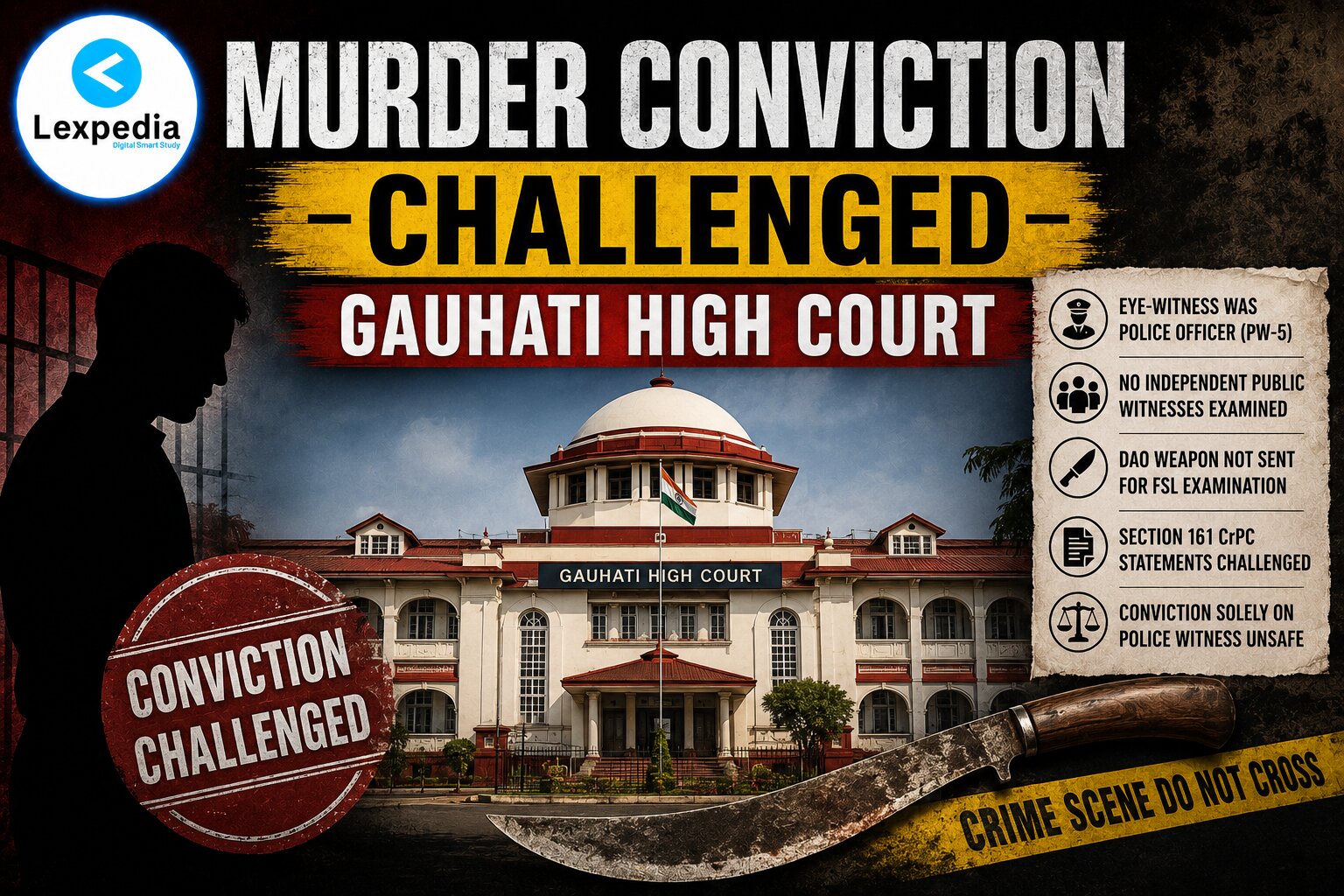
The appellant was accused of murdering his wife by hacking her with a dao (sharp cutting weapon).
-
The FIR was lodged by the brother of the deceased.
-
The incident allegedly occurred in a tea garden area during bonus distribution where a market was present.
-
The prosecution relied heavily on PW-5, an Assistant Sub-Inspector of Police, who was an eye-witness to the incident.
-
The appellant argued that conviction based solely on a police witness/“chance witness” was unsafe.
-
It was further argued that no independent public witnesses were examined despite the crowded location.
-
The seized dao weapon was not sent for FSL examination, which was argued to weaken the prosecution case.
-
The defence also challenged procedural aspects regarding Section 161 CrPC statements.
Issues
-
Whether conviction can be sustained solely on the testimony of a police eyewitness (PW-5)?
-
Whether the absence of independent public witnesses in a crowded place affects prosecution reliability?
-
Whether non-sending of the weapon (dao) for FSL examination is fatal to the prosecution case?
-
Whether non-recording of statements under Section 161 CrPC in writing vitiates the trial?
Judgement
-
The Court held that there was no reason to doubt the credibility of PW-5 (police eyewitness).
-
It observed that merely being a police officer or chance witness does not discredit testimony.
-
The Court noted that no evidence of enmity, bias, or ulterior motive was shown against PW-5.
-
It held that absence of independent witnesses does not automatically weaken prosecution if direct eyewitness evidence is trustworthy.
-
The Court rejected the argument regarding non-FSL examination of the seized weapon.
-
It held that provisions under Sections 161 and 162 CrPC do not mandate written recording of every statement in a manner that affects admissibility.
-
The Court concluded that the prosecution proved the guilt of the accused beyond reasonable doubt.
-
The conviction and sentence under Section 302 IPC (life imprisonment + fine) were affirmed.
-
The Court also recommended consideration of Section 357A CrPC victim compensation benefits for dependents.
Held
-
Police eyewitness testimony is reliable if credible and untainted by bias.
-
Conviction can stand even in absence of independent witnesses, if direct evidence is trustworthy.
-
Non-FSL testing of weapon is not automatically fatal to prosecution.
-
Procedural irregularities under Sections 161–162 CrPC do not vitiate trial if evidence is otherwise reliable.
-
Conviction under Section 302 IPC upheld.
Analysis
-
The Court reinforced the principle that credibility of testimony, not the status of witness, is decisive in criminal trials.
-
It clarified that a police officer can be a competent eyewitness if their testimony inspires confidence.
-
The judgment rejects the assumption that independent witnesses are mandatory in every criminal case, especially where direct evidence exists.
-
It strengthens the doctrine that procedural lapses (like non-FSL testing) do not override substantive proof.
-
The Court emphasized absence of motive for false implication as a key factor in assessing witness reliability.
-
The ruling aligns with settled principles of evidence appreciation under criminal jurisprudence.
-
It also reflects a victim-oriented approach by suggesting Section 357A CrPC compensation for dependents.