
Mitesh @ T.V. Vaghela v. State of Gujarat, 2026
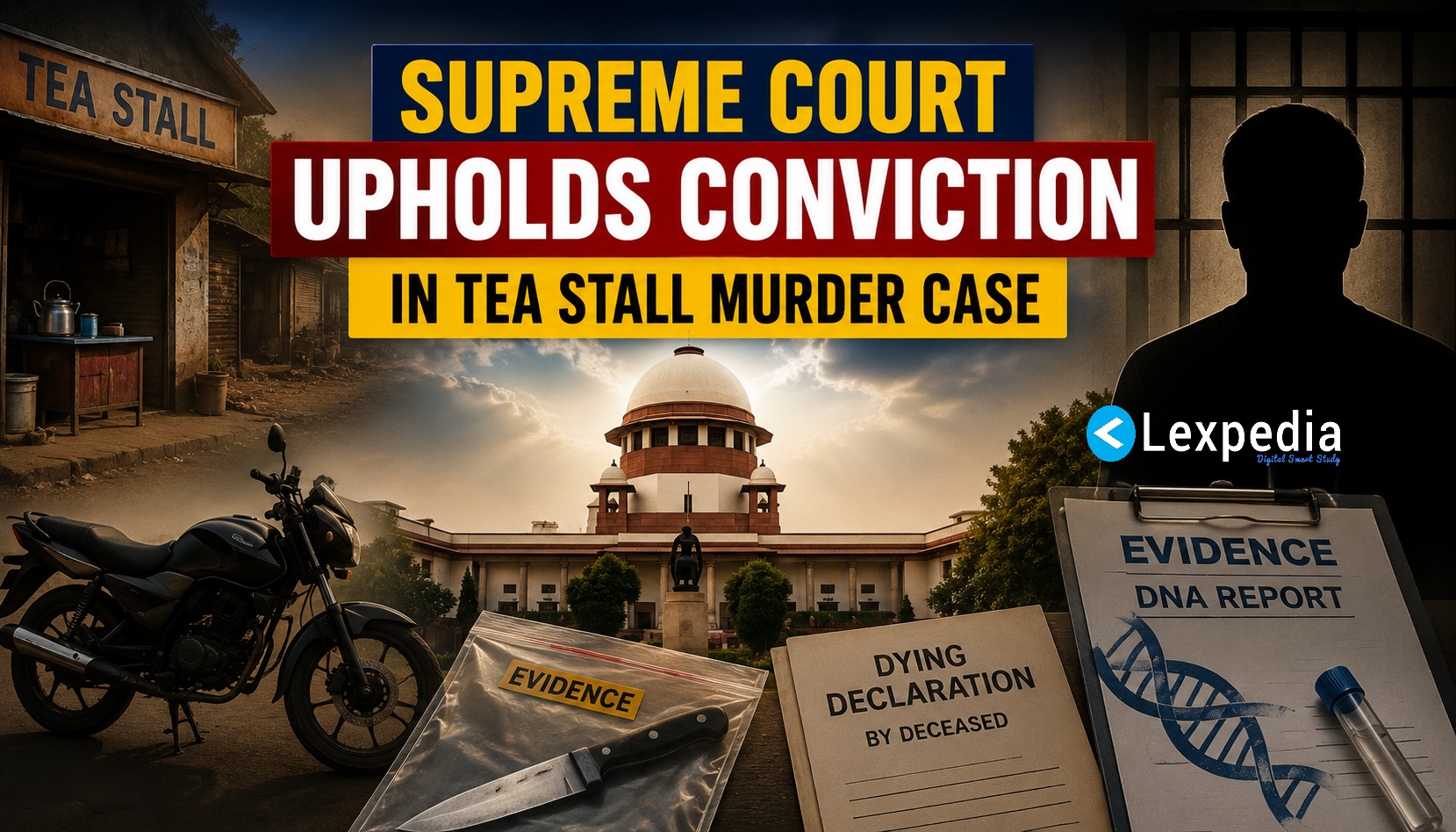
The Court reinforced the principle that absence of an eyewitness does not weaken the prosecution case if strong circumstantial evidence exists.
Judgement Details
Court
Supreme Court of India
Date of Decision
11 May 2026
Judges
Justice Aravind Kumar & Justice Prasanna B. Varale
Citation
Acts / Provisions
Facts of the Case
-
The case relates to the murder of Somabhai Sankabhai Rabari, who ran a tea stall in Ahmedabad.
-
On 11 December 1998, a quarrel occurred between the accused and the deceased after the accused allegedly threw a half-burnt cigarette into a bucket used at the tea stall.
-
The accused allegedly threatened the deceased during the altercation.
-
The next morning, the deceased was found injured near his tea stall.
-
The deceased informed his brother (PW-1) that the accused had stabbed him with a knife.
-
The deceased also repeated the same statement while being taken to the hospital in an auto-rickshaw.
-
He later died upon arrival at the hospital.
-
A knife (alleged weapon of offence) was recovered at the instance of the accused during investigation.
-
Trial Court and High Court convicted the accused for murder.
-
The accused appealed to the Supreme Court, arguing absence of eyewitness and unreliability of PW-1’s testimony.
Issues
-
Whether the conviction can be sustained in the absence of an eyewitness to the actual occurrence?
-
Whether the testimony of PW-1, who is not an eyewitness to the incident, is sufficient to support conviction?
-
Whether reliance on dying declaration and circumstantial evidence is legally valid to establish guilt?
-
Whether a solitary witness’s testimony can form the basis of conviction in a murder case?
Judgement
-
The Supreme Court upheld the conviction of the accused.
-
The Court held that the absence of an eyewitness is not fatal when other reliable circumstances establish guilt.
-
The Court accepted the reliability of the dying declaration made by the deceased to PW-1 and others.
-
It held that PW-1’s testimony, though not an eyewitness account, was material and credible.
-
The Court found the evidence of PW-12 (auto-rickshaw driver) corroborative and consistent.
-
The Court reaffirmed that quality of evidence is more important than quantity.
Held
-
The Supreme Court dismissed the appeal.
-
The conviction for murder was affirmed.
-
It was held that circumstantial evidence and dying declarations, when reliable, are sufficient to sustain conviction even without an eyewitness.
Analysis
-
The Court reinforced the principle that absence of an eyewitness does not weaken the prosecution case if strong circumstantial evidence exists.
-
It emphasized the evidentiary value of a dying declaration, especially when consistent and corroborated.
-
The Court highlighted that witness credibility depends on quality, consistency, and reliability, not number of witnesses.
-
It accepted the corroboration between PW-1 and PW-12, strengthening the prosecution case.
-
The judgment strengthens jurisprudence on circumstantial evidence and corroborative testimony in murder cases.
-
It reflects judicial caution against rejecting credible testimony merely due to lack of direct eyewitnesses.