
Md. Idrish & Ors. v. Union of India & Ors., 2026
Public Premises Act Protections Apply Only After Occupation Is Established; Demolition Challenge Dismissed.
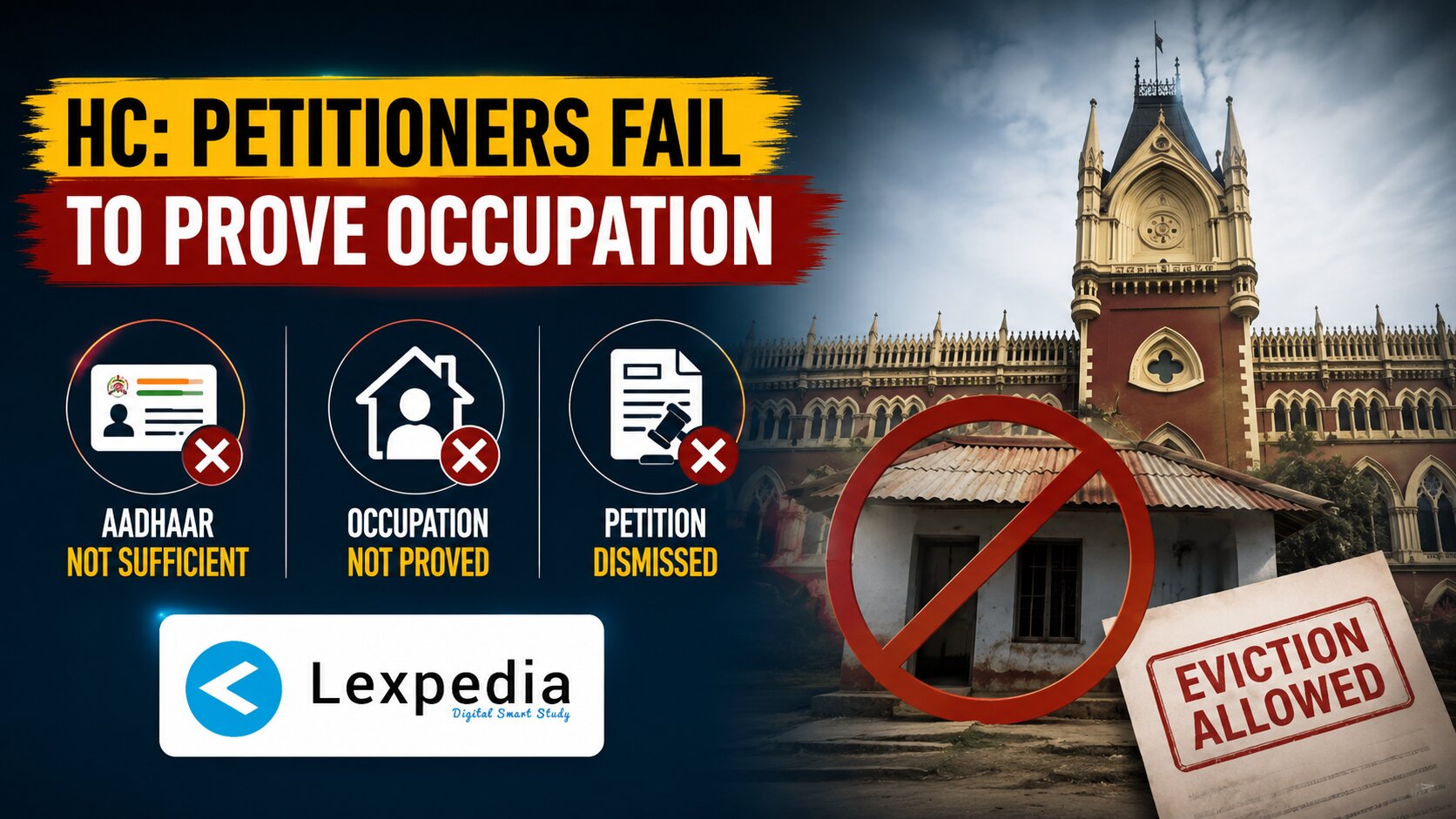
Judgement Details
Court
Calcutta High Court
Date of Decision
6 July 2026
Judges
Justice Partha Sarathi Sen
Citation
Acts / Provisions
Facts of the Case
-
The petitioners filed a writ petition seeking to restrain the authorities from demolishing residential quarters belonging to the Calcutta Dock Labour Board (CDLB) and Kolkata Port Trust situated at Brook Lane, Garden Reach, Kolkata.
-
They alleged that the Port authorities initiated demolition and eviction without complying with the mandatory procedure prescribed under the Public Premises (Eviction of Unauthorised Occupants) Act, 1971.
-
According to the petitioners, no notice had been issued by the Estate Officer before commencing demolition proceedings.
-
To establish their occupation of the premises, the petitioners relied mainly on photocopies of their Aadhaar Cards, which reflected the addresses of the disputed quarters.
-
They also filed a supplementary affidavit identifying the specific portions allegedly occupied by each petitioner.
-
The Kolkata Port Trust opposed the petition, contending that the petitioners failed to produce any document establishing either lawful occupation or even settled possession of the premises.
-
The Port authorities further relied upon a communication from the Deputy Commissioner of Police, Port Division, stating that the buildings were in imminent danger of collapse and posed a serious threat to life and property.
-
The authorities argued that immediate demolition was necessary in public interest due to the unsafe condition of the buildings.
Issues
-
Whether the petitioners established that they were occupying the disputed public premises?
-
Whether the petitioners proved that they were in "unauthorised occupation" within the meaning of Section 2(g) of the Public Premises (Eviction of Unauthorised Occupants) Act, 1971?
-
Whether the procedural safeguards under Sections 4 and 5 of the Public Premises Act were applicable in the absence of proof of occupation?
-
Whether the demolition proceedings initiated by the authorities were liable to be restrained by the High Court?
Judgement
-
The High Court held that the petitioners failed to establish that they were actually occupying the disputed residential quarters.
-
The Court observed that mere production of Aadhaar Cards showing the addresses of the premises was insufficient to prove possession or occupation.
-
It noted that the petitioners failed to explain how they came into possession of the public premises despite being specifically directed by an earlier Bench to disclose the source of their occupation.
-
The Court held that the petitioners failed to establish even "unauthorised occupation" as defined under Section 2(g) of the Public Premises Act.
-
It emphasized that the procedural safeguards under Sections 4 and 5 of the Act become applicable only after a person establishes that he is an unauthorised occupant of the public premises.
-
Since the petitioners failed to discharge this initial burden, they could not claim protection under the statutory eviction procedure.
-
The Court distinguished the earlier Division Bench decision in Board of Trustees for the Port of Kolkata v. Vijay Kumar Arya, observing that the earlier case involved an admitted lessee with a recognised legal right to occupy the premises.
-
The Court found that the present petitioners had failed to produce any material demonstrating lawful, settled, or even unauthorised occupation.
-
Finding no merit in the writ petition, the Court dismissed the petition, vacated the interim order, and declined to interfere with the proposed demolition.
Held
-
The petitioners failed to establish occupation or possession of the disputed public premises.
-
Mere Aadhaar Cards containing the address of the premises do not constitute proof of occupation.
-
The protections under Sections 4 and 5 of the Public Premises Act are unavailable unless the person first establishes unauthorised occupation.
-
The demolition proceedings were not liable to be interfered with.
-
The writ petition was dismissed and the interim protection was vacated.
Analysis
-
The judgment clarifies that procedural safeguards under the Public Premises (Eviction of Unauthorised Occupants) Act, 1971 are available only to persons who first establish their occupation of the public premises.
-
The Court correctly interpreted Section 2(g) by holding that the burden initially lies upon the claimant to prove occupation before invoking statutory protections.
-
The decision reinforces the evidentiary principle that documentary proof of address alone cannot establish possession or occupation of immovable property.
-
The Court appropriately distinguished between documentary identity proof and legally admissible evidence demonstrating actual possession.
-
The judgment prevents misuse of writ jurisdiction by persons who fail to establish the factual foundation necessary for seeking equitable relief.
-
The Court also balanced public safety concerns by considering the official communication warning that the buildings were structurally unsafe and posed a threat to life.
-
The distinction drawn from Board of Trustees for the Port of Kolkata v. Vijay Kumar Arya demonstrates that procedural protections depend upon the factual circumstances of each case and cannot be mechanically applied.
-
The ruling strengthens the principle that extraordinary constitutional remedies under Article 226 cannot be granted in the absence of credible evidence supporting the petitioner's claim.
-
The judgment is likely to guide future disputes involving public premises by emphasizing proof of occupation as a threshold requirement before statutory eviction procedures become applicable.
-
A notable strength of the decision is its strict adherence to statutory interpretation while simultaneously recognizing the need to protect public safety.