
Laxmilal v. Parwati, 2026
Customary Nata Marriage Cannot Defeat Statutory Bar on Bigamy Under Hindu Marriage Act, 1955: Rajasthan High Court
Judgement Details
Court
Rajasthan High Court
Date of Decision
18 May 2026
Judges
Justice Arun Monga & Justice Sandeep Shah
Citation
Acts / Provisions
Facts of the Case
-
The petitioner-husband and respondent-wife were legally married under Hindu law, and had been living separately for around 27 years.
-
The separation occurred due to the wife’s job posting in another location, leading to long-term distance between the spouses.
-
During the subsistence of the first marriage (without divorce), the husband entered into a second relationship termed a “Nata Marriage”, allegedly with the wife’s consent.
-
The husband later sought divorce, arguing:
-
The marriage had become a “dead matrimonial relationship”.
-
Continued existence of marriage caused him mental cruelty.
-
-
The Family Court rejected the divorce petition, leading to the present appeal before the High Court.
Issues
-
Whether a customary “Nata Marriage” can be treated as a valid legal defense to bigamy under the Hindu Marriage Act, 1955?
-
Whether consent of an existing spouse can validate a second marriage under Section 5(i) read with Section 11 of the Hindu Marriage Act, 1955?
-
Whether Section 29(2) of the Hindu Marriage Act allows recognition of customs like Nata Marriage that permit remarriage without dissolution of the first marriage?
-
Whether long separation and continued subsistence of marriage constitute mental cruelty sufficient to grant divorce?
Judgement
-
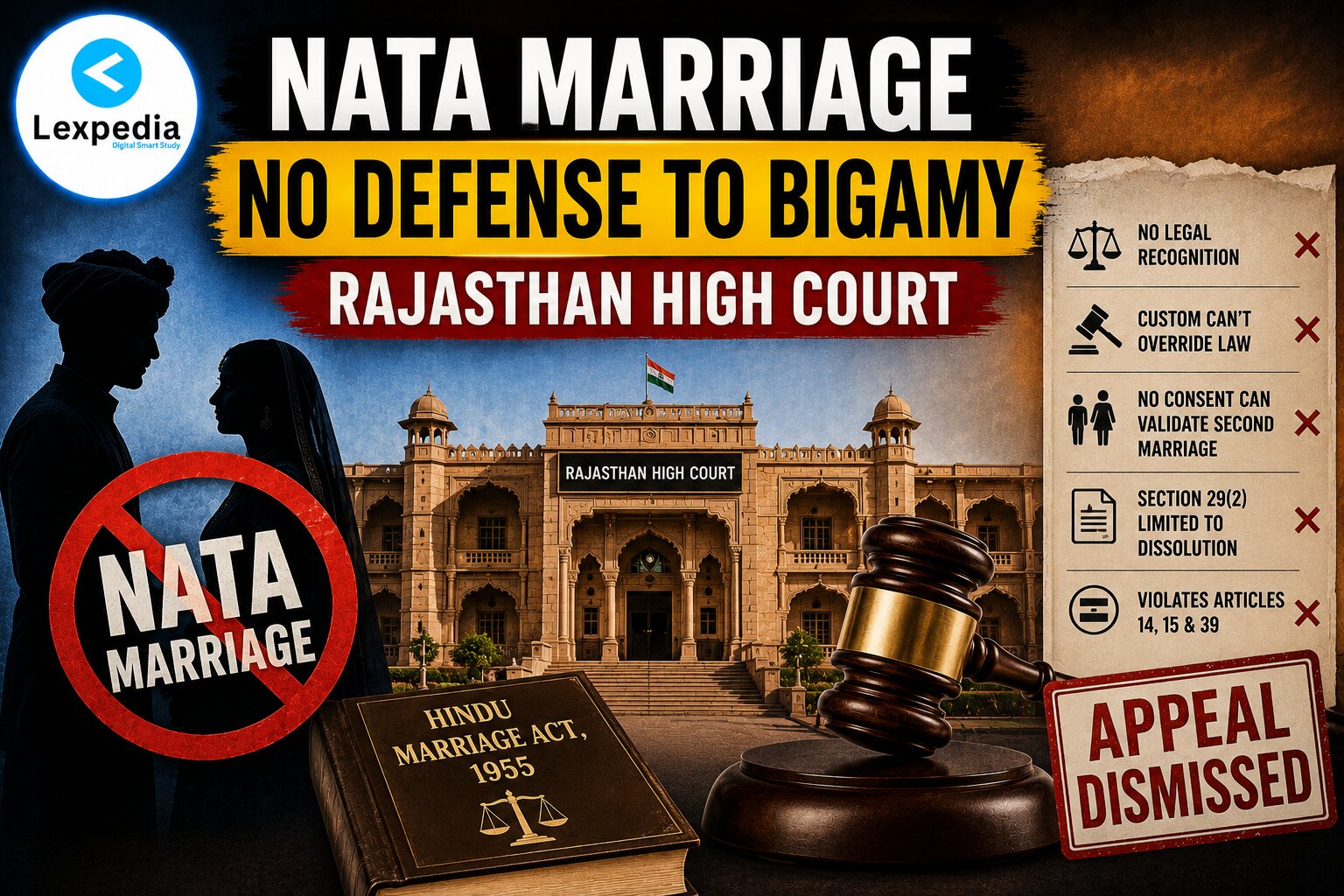
The Court held that Nata Marriage has no legal recognition as a defense to bigamy.
-
It ruled that custom cannot override statutory law, especially the Hindu Marriage Act, 1955.
-
Accepting such a custom would make Section 5(i) meaningless and defeat the principle of monogamy.
-
The Court observed that no consent of a spouse can validate a second marriage during the subsistence of a first valid marriage.
-
It held that Section 29(2) is limited only to customs relating to dissolution of marriage, not to those permitting remarriage during subsistence of marriage.
-
The Court emphasized that recognizing Nata Marriage would violate Articles 14, 15, and 39, undermining gender justice and equality.
-
The appeal was accordingly dismissed, and the Family Court’s order was upheld.
Held
-
The appeal was dismissed.
-
The rejection of the divorce application was upheld.
Analysis
-
The Court strongly reaffirmed the principle that statutory law prevails over customary practices in matrimonial disputes.
-
It emphasized that monogamy under Section 5(i) is a matter of public policy, not subject to private consent or waiver.
-
The judgment highlights the gender inequality created by informal practices like Nata Marriage, where:
-
The first wife remains legally married but socially abandoned.
-
The second woman lacks legal recognition and matrimonial rights.
-
-
The Court adopted a constitutional approach, linking family law with Articles 14, 15, and 39 to ensure gender justice.
-
It narrowly interpreted Section 29(2) to prevent misuse of customs that contradict statutory prohibitions.
-
The decision reinforces that courts cannot be used to legitimize illegal or statutorily prohibited relationships under the guise of custom.