
Lawrence and Ors. v. State of Kerala, 2026
The evidentiary use of police statements recorded during investigation.
Judgement Details
Court
Kerala High Court
Date of Decision
23 May 2026
Judges
Justice A. Badharudeen
Citation
Acts / Provisions
Facts of the Case
-
The accused persons were facing trial before the Additional Sessions Court in Kerala.
-
During the course of trial, three prosecution witnesses were examined.
-
While conducting cross-examination, the defence counsel attempted to confront the witnesses with their earlier statements recorded by the Investigating Officer under Section 161 Cr.P.C.
-
The defence intended to use these previous statements to contradict the witnesses and challenge the credibility of their testimony before the court.
-
The Sessions Court disallowed the defence from using the statements on the ground that Section 162 Cr.P.C. prohibited such use.
-
Aggrieved by this restriction, the accused approached the Kerala High Court through a Criminal Miscellaneous Case.
-
The petitioners argued that Section 162 Cr.P.C. does not prohibit the use of Section 161 statements for contradiction during cross-examination.
-
The matter thus raised an important issue concerning the evidentiary use of police statements recorded during investigation.
Issues
-
Whether statements recorded under Section 161 Cr.P.C. can be used during cross-examination to contradict prosecution witnesses?
-
Whether Section 162 Cr.P.C. completely prohibits the use of statements recorded by the Investigating Officer during trial?
-
Whether the accused has a right to use previous statements of witnesses for shaking the credibility and veracity of their testimony?
-
Whether the Sessions Court erred in disallowing the defence from confronting witnesses with their previous statements?
Judgement
-
The Kerala High Court disagreed with the interpretation adopted by the Sessions Judge regarding Section 162 Cr.P.C.
-
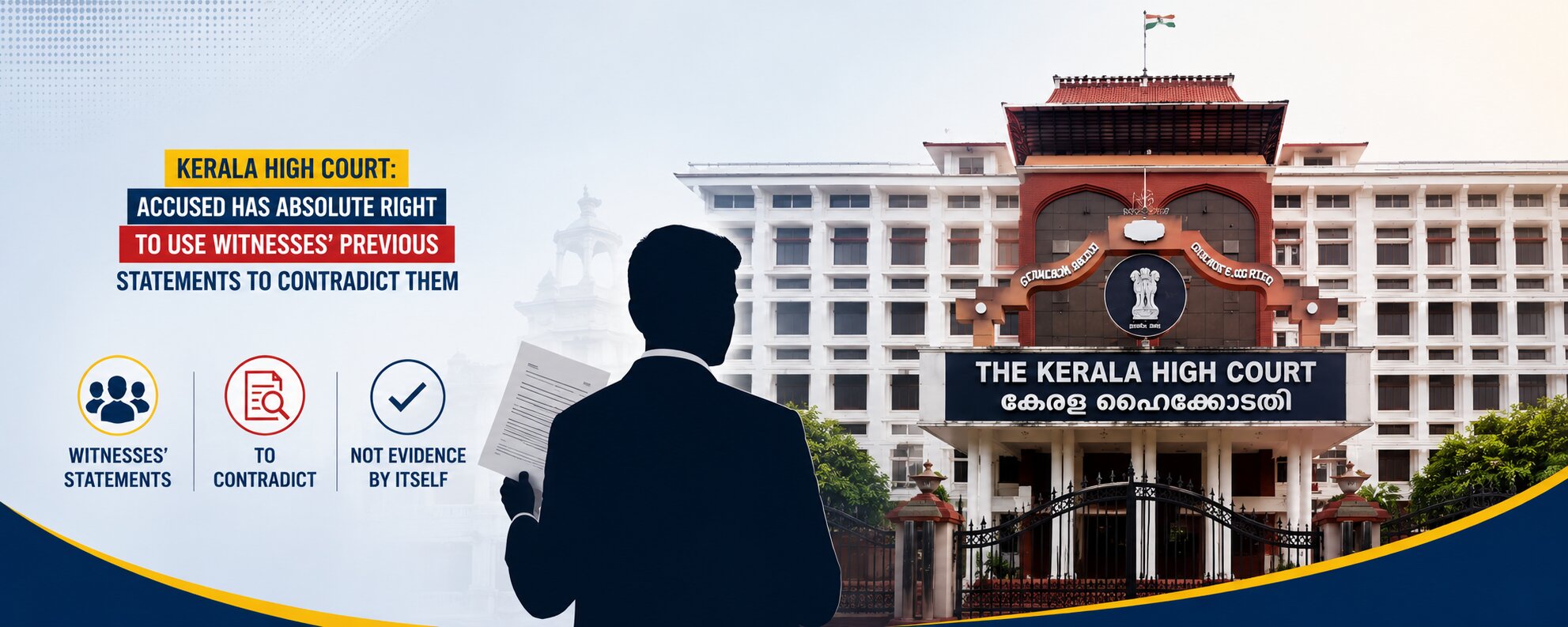
The Court clarified that statements recorded under Section 161 Cr.P.C. are not substantive evidence by themselves.
-
However, the Court emphasized that Section 162 Cr.P.C. specifically permits the use of such statements for the limited purpose of contradiction.
-
The Court held that such contradiction must be carried out in the manner prescribed under Section 145 of the Indian Evidence Act.
-
Justice A. Badharudeen observed that cross-examination is primarily intended to test the truthfulness and reliability of witnesses.
-
The Court recognized that the accused possesses an absolute right to confront witnesses with their earlier statements in order to challenge their credibility.
-
The High Court further clarified that the prohibition under Section 162 Cr.P.C. applies only to the use of such statements as substantive evidence for proving facts in issue.
-
The Court held that the Sessions Court had committed an error in preventing the defence from using the statements for contradiction.
-
Consequently, the High Court allowed the Criminal Miscellaneous Case.
-
The Sessions Judge was directed to recall the three prosecution witnesses.
-
The defence counsel was permitted to cross-examine the witnesses using their previous Section 161 statements.
-
The trial court was also directed to expedite the proceedings and complete the cross-examination within three weeks.
Held
-
Statements under Section 161 Cr.P.C. cannot be treated as substantive evidence.
-
Such statements can legally be used to contradict witnesses during cross-examination.
-
Section 162 Cr.P.C. does not prohibit contradiction of witnesses through prior police statements.
-
The accused has an absolute right to use previous statements for testing the credibility of prosecution witnesses.
-
The Sessions Court’s refusal to permit such cross-examination was legally unsustainable.
Analysis
-
The judgment reinforces the importance of fair trial principles and the right of the accused to effectively defend themselves.
-
The Court adopted a balanced interpretation of Sections 161 and 162 Cr.P.C. by distinguishing between “use as evidence” and “use for contradiction.”
-
The ruling strengthens the role of cross-examination as a fundamental safeguard in criminal trials.
-
By emphasizing Section 145 of the Evidence Act, the Court reaffirmed established evidentiary principles governing contradictions.
-
The judgment prevents an overly restrictive interpretation of Section 162 Cr.P.C. that could weaken the defence’s ability to challenge unreliable testimony.
-
The Court recognized that witness credibility is central to criminal adjudication and that prior inconsistent statements are important tools for testing truthfulness.
-
The decision upholds procedural fairness and protects the accused against possible prejudice arising from inconsistent witness testimonies.
-
The ruling is significant because it clarifies that investigative statements, though not substantive evidence, still possess procedural relevance during trial.
-
The judgment may guide subordinate courts in ensuring that defence rights during cross-examination are not unnecessarily curtailed.
-
The decision contributes to the jurisprudence on evidentiary fairness and reinforces adversarial criminal procedure principles.