
Lakhi Devi v. State of Jharkhand, 2026
Mere Abuse Over a Trivial Domestic Dispute Does Not Constitute Cruelty Under Section 498A IPC.
Judgement Details
Court
Jharkhand High Court
Date of Decision
6 July 2026
Judges
Justice Pradeep Kumar Srivastava
Citation
Acts / Provisions
Facts of the Case
-
The appellant, who was the mother-in-law of the deceased, was convicted by the Trial Court under Section 498A IPC and sentenced to three years' rigorous imprisonment along with a fine.
-
The Trial Court acquitted the appellant of the charge under Section 306 IPC relating to abetment of suicide.
-
According to the prosecution, on 20 January 2001, the deceased removed a pot containing treacle (gur ka sheera) from a raised place on the wall and placed it on the ground.
-
The appellant allegedly became annoyed by this act and abused the deceased over the trivial domestic incident.
-
It was alleged that, feeling humiliated, the deceased took burning fire from a mud stove in the courtyard and set herself ablaze, sustaining severe burn injuries.
-
The deceased later succumbed to her injuries during treatment, following which the offence under Section 306 IPC was added during investigation.
-
The prosecution also alleged that the deceased had been subjected to cruelty by the appellant since the beginning of her marriage, which had taken place about seven years earlier.
-
During the trial, the prosecution examined eleven witnesses and produced documentary evidence, including the deceased's fardbeyan, which the Trial Court treated as a dying declaration.
-
The appellant challenged her conviction before the High Court, contending that the allegations disclosed only a minor domestic quarrel and did not satisfy the statutory ingredients of cruelty under Section 498A IPC.
Issues
-
Whether merely abusing or scolding a daughter-in-law over a trivial domestic incident constitutes "cruelty" under Section 498A IPC?
-
Whether the prosecution proved the essential ingredients of cruelty contemplated under Explanation (a) or Explanation (b) to Section 498A IPC?
-
Whether the Trial Court correctly appreciated the evidence while convicting the appellant under Section 498A IPC after acquitting her of the offence under Section 306 IPC?
-
Whether the absence of specific allegations during the appellant's examination under Section 313 CrPC affected the sustainability of the conviction?
Judgement
-
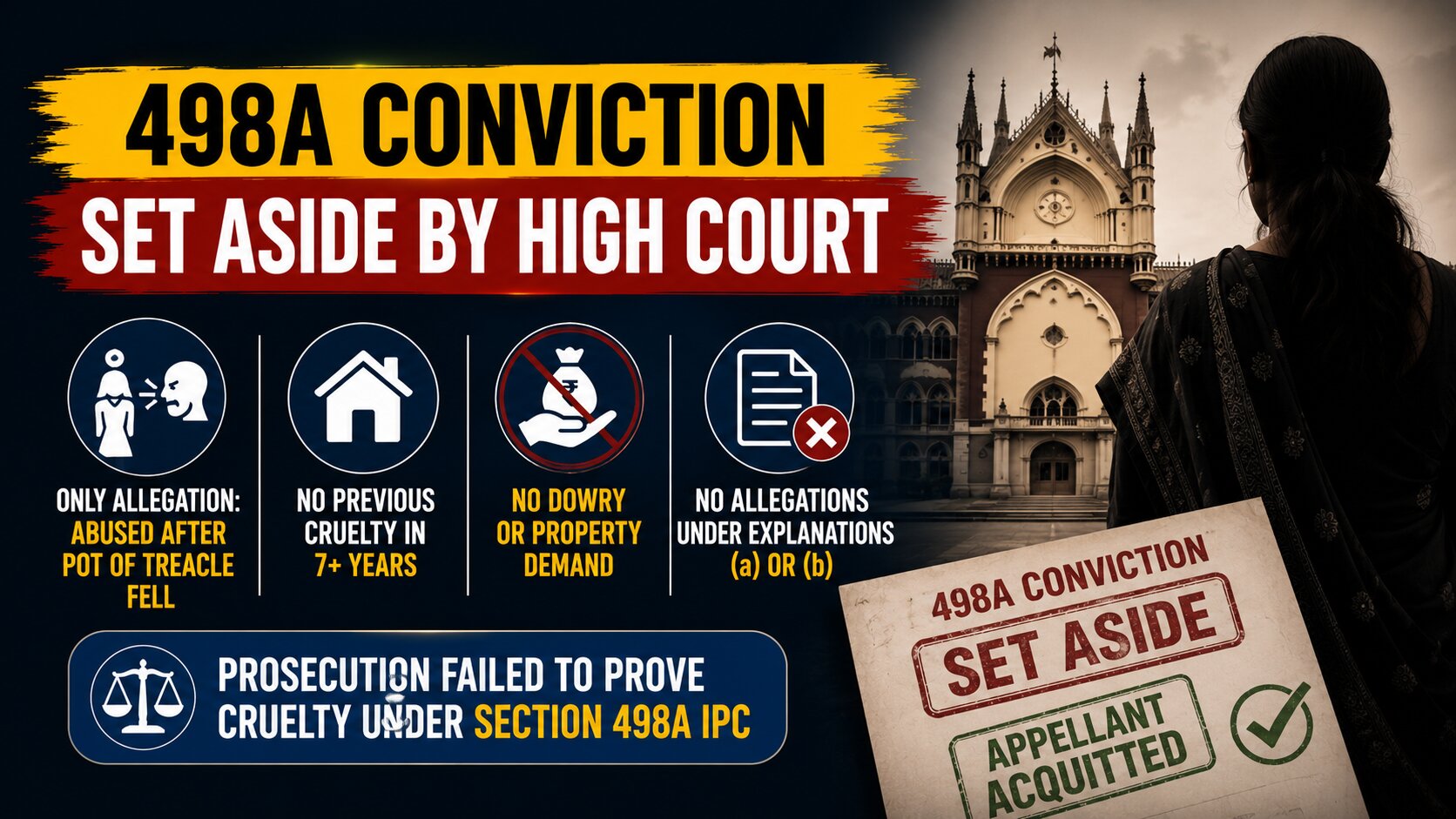
The High Court held that the prosecution failed to establish the statutory ingredients required for conviction under Section 498A IPC.
-
The Court observed that the only specific allegation against the appellant was that she abused the deceased after the latter placed a pot of treacle on the ground.
-
It found that no other overt act of cruelty or harassment had been attributed to the appellant.
-
The Court noted that there was no evidence of any previous instances of cruelty or harassment during the more than seven years the deceased had resided in her matrimonial home.
-
It held that the second limb of Section 498A IPC, relating to harassment for unlawful demand of property or dowry, was admittedly absent.
-
The Court further observed that the charge framed against the appellant did not contain allegations attracting either Explanation (a) or Explanation (b) to Section 498A IPC.
-
It also noted that during the appellant's examination under Section 313 CrPC, no specific allegation explaining how she had subjected the deceased to cruelty or harassment was put to her.
-
The Court held that the Trial Court had committed a serious error in appreciating the evidence while recording the conviction under Section 498A IPC.
-
Accordingly, the High Court set aside the conviction and sentence imposed upon the appellant.
-
Since the appellant was already on bail, she was discharged from the liabilities of her bail bonds.
Held
-
Mere abuse or scolding over a trivial domestic issue does not, by itself, amount to "cruelty" under Section 498A IPC.
-
The prosecution failed to establish the essential ingredients of the offence under Section 498A IPC.
-
The conviction recorded by the Trial Court was legally unsustainable.
-
The appeal was allowed, and the conviction and sentence were set aside.
-
The appellant stood discharged from her bail bond obligations.
Analysis
-
The judgment reiterates that conviction under Section 498A IPC requires proof of statutory cruelty as specifically defined in the provision and cannot be founded upon ordinary domestic disagreements.
-
The Court correctly emphasized that every matrimonial dispute or verbal altercation does not constitute criminal cruelty attracting penal liability.
-
The decision reinforces the distinction between routine household discord and conduct likely to drive a woman to commit suicide or cause grave physical or mental injury.
-
By examining the ingredients of Explanation (a) and Explanation (b) to Section 498A IPC, the Court reaffirmed that both limbs of the provision require strict proof before criminal liability can arise.
-
The judgment highlights the importance of proper framing of charges and ensuring that the accused is specifically confronted with the allegations during examination under Section 313 CrPC.
-
The Court appropriately scrutinized the evidentiary record and found the prosecution's allegations to be vague and unsupported by any previous incidents of cruelty.
-
The ruling strengthens the principle that criminal convictions cannot rest on assumptions or generalized allegations unsupported by reliable evidence.
-
The decision also serves as a safeguard against misuse of Section 498A IPC by ensuring that convictions are based only upon conduct satisfying the statutory definition of cruelty.
-
The judgment reinforces the fundamental criminal law principle that the prosecution bears the burden of proving every essential ingredient of the offence beyond reasonable doubt.
-
A notable strength of the judgment is its insistence on strict statutory interpretation while preventing criminalization of isolated, trivial domestic quarrels.