
Hirani Developers v. Nehru Nagar Samruddhi CHS Ltd. and Another, 2026
Supreme Court Holds Incorporation of Earlier Agreement Includes Arbitration Clause Even Without Specific Reference
Judgement Details
Court
Supreme Court of India
Date of Decision
15 May 2026
Judges
Justice Sanjay Kumar & Justice K. Vinod Chandran
Citation
Acts / Provisions
Facts of the Case
- The dispute arose out of a redevelopment project undertaken by Hirani Developers involving members of a housing society.
-
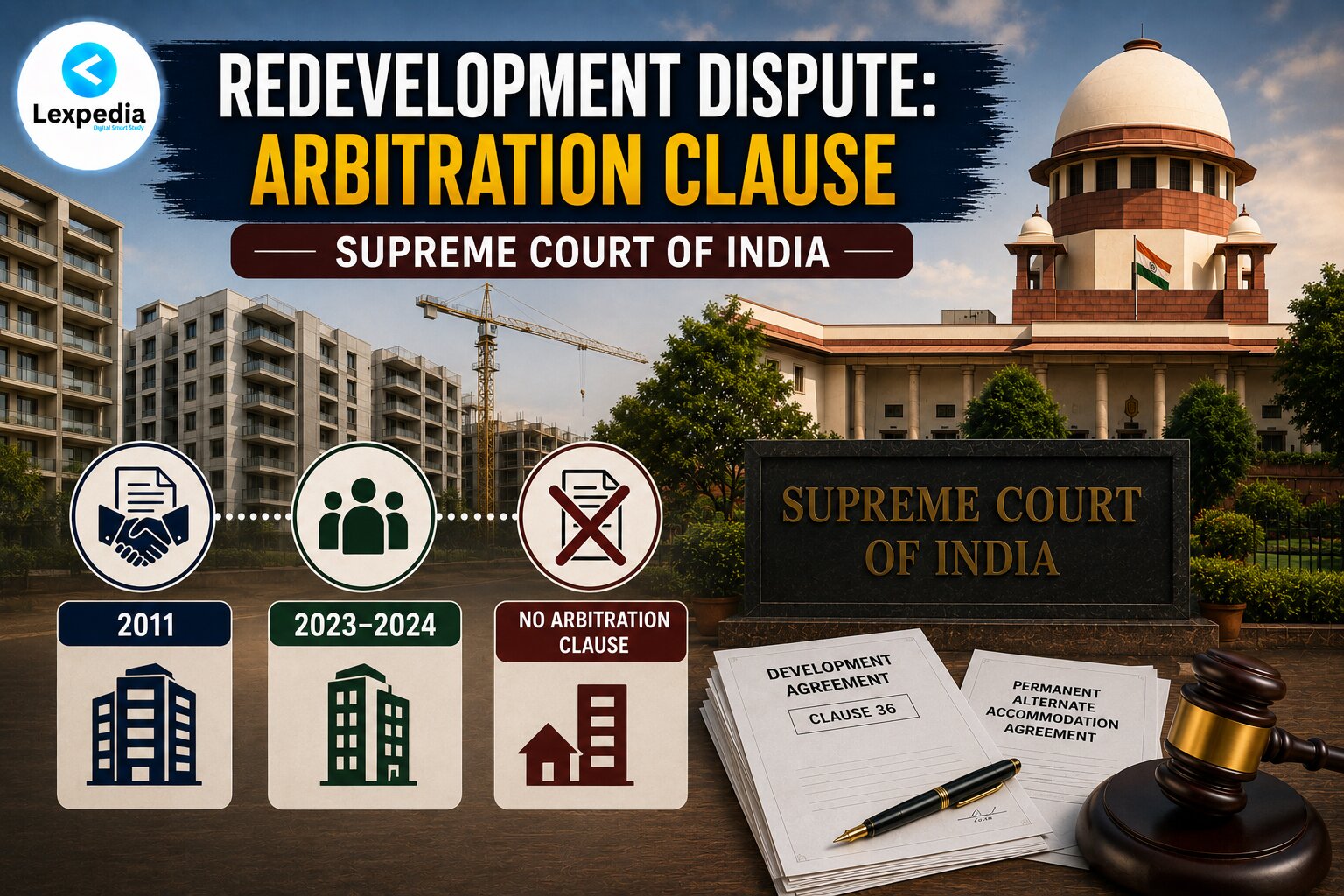
A Development Agreement executed in 2011 between the developer and Nehru Nagar Samruddhi CHS Ltd. contained an arbitration clause under Clause 36.
-
Subsequently, individual society members entered into Permanent Alternate Accommodation Agreements with the developer during the redevelopment process in 2023 and 2024.
-
These later agreements did not contain an independent arbitration clause.
-
However, Clause 14 of the later agreements expressly stated that all terms and conditions of the earlier Development Agreement would form part of the later agreements and all clauses would bind the parties.
-
Disputes later arose between the parties concerning redevelopment and accommodation arrangements.
-
Some society members approached the Consumer Disputes Redressal Commission under the Consumer Protection Act, 2019.
-
The developer invoked arbitration by issuing notices under Section 21 of the Arbitration and Conciliation Act, 1996.
-
The respondents refused to participate in arbitration, contending that no arbitration agreement existed between the developer and individual members.
-
The developer then filed applications under Section 11 before the Bombay High Court seeking appointment of an arbitrator.
-
The Bombay High Court dismissed the applications on the ground that the later agreements neither specifically referred to the arbitration clause nor clearly expressed an intention to arbitrate disputes.
-
Aggrieved by this decision, the developer approached the Supreme Court.
Issues
-
Whether incorporation of all terms and conditions of an earlier agreement into a subsequent agreement includes incorporation of the arbitration clause?
-
Whether a subsequent agreement must specifically mention the arbitration clause of an earlier agreement to invoke arbitration?
-
Whether incorporation by reference under Section 7(5) of the Arbitration and Conciliation Act, 1996 is sufficient to establish a valid arbitration agreement?
-
Whether the Bombay High Court erred in refusing appointment of an arbitrator under Section 11 of the Arbitration and Conciliation Act, 1996?
-
Whether the Permanent Alternate Accommodation Agreements demonstrated a clear intention of the parties to adopt the arbitration clause contained in the Development Agreement?
Judgement
-
The Supreme Court set aside the decision of the Bombay High Court.
-
The Court held that where a later agreement expressly incorporates all terms and conditions of an earlier agreement, the arbitration clause contained in the earlier agreement also becomes part of the later agreement.
-
The Court observed that the present case was not a mere reference to an earlier agreement but a complete incorporation of the Development Agreement into the later agreements.
-
The Court noted that Clause 14 of the later agreements clearly demonstrated the parties’ intention to incorporate the earlier Development Agreement “body and soul.”
-
The Court relied upon the decision in M.R. Engineers and Contractors Private Limited v. Som Datt Builders Limited, (2009) 7 SCC 696.
-
The Court held that specific mention of the arbitration clause was unnecessary once the parties had unequivocally incorporated all clauses of the earlier agreement.
-
The Court observed that the High Court had incorrectly interpreted Section 7(5) of the Arbitration and Conciliation Act, 1996.
-
The Supreme Court concluded that a valid arbitration agreement existed between the parties by incorporation.
-
Accordingly, the appeal was allowed.
Held
-
Incorporation of all terms and conditions of an earlier agreement includes incorporation of the arbitration clause contained therein.
-
A later agreement need not separately mention or specifically refer to the arbitration clause if the earlier agreement is incorporated in entirety.
-
The Bombay High Court erred in refusing appointment of an arbitrator.
-
A valid arbitration agreement existed between the parties by incorporation under Section 7(5) of the Arbitration and Conciliation Act, 1996.
Analysis
-
The judgment reinforces the principle of incorporation by reference in arbitration law.
-
The Supreme Court adopted a pro-arbitration approach consistent with the legislative objective of promoting alternative dispute resolution.
-
The ruling clarifies that an arbitration clause need not be separately reproduced in every subsequent agreement if the earlier agreement is incorporated comprehensively.
-
The Court distinguished between a mere reference to another contract and incorporation of the contract in entirety.
-
Reliance on M.R. Engineers and Contractors Pvt. Ltd. v. Som Datt Builders Ltd. strengthens the precedential consistency in arbitration jurisprudence.
-
The judgment reduces technical barriers often used to resist arbitration proceedings.
-
The decision promotes contractual certainty and commercial efficiency in redevelopment and infrastructure transactions.
-
The ruling also limits unnecessary judicial interference at the referral stage under Section 11 of the Arbitration and Conciliation Act, 1996.
-
The judgment reflects the judiciary’s continued support for arbitration-friendly interpretation of commercial agreements.